
नासा का वॉयेजर 1 किस वर्ष प्रक्षेपित किया गया था?
In which year was NASA's Voyager 1 launched?
वॉयेजर 1 को 5 सितंबर 1977 को टाइटन IIIE-सेंटॉर रॉकेट से प्रक्षेपित किया गया था। इसका जुड़वाँ यान वॉयेजर 2 है।
Voyager 1 was launched on 5 September 1977 on a Titan IIIE-Centaur rocket. Its twin is Voyager 2. (Source: Indian Express)
वॉयेजर 1 पृथ्वी से लगभग एक प्रकाश-दिवस (light-day) की दूरी पर पहुँच गया है। यह दूरी लगभग कितनी है?
Voyager 1 has reached about one light-day from Earth. Roughly how far is that?
एक प्रकाश-दिवस वह दूरी है जो प्रकाश एक दिन में तय करता है, लगभग 25.9 अरब किमी। वॉयेजर 1 लगभग 61,000 किमी/घंटा की गति से चल रहा है।
A light-day is the distance light travels in one day, about 25.9 billion km. Voyager 1 is moving at about 61,000 km/hr. (Source: Indian Express)
वॉयेजर 1 किस वर्ष से पृथ्वी से सबसे दूर स्थित अंतरिक्ष यान बना हुआ है?
Since which year has Voyager 1 been the farthest spacecraft from Earth?
वॉयेजर 1, 17 फ़रवरी 1998 से सबसे दूर का अंतरिक्ष यान है। इसके कैमरे 1990 में बंद कर दिए गए थे, और 2026 तक इसके 10 मूल वैज्ञानिक उपकरणों में से केवल 2 काम कर रहे थे।
Voyager 1 has been the farthest spacecraft since 17 February 1998. Its cameras were switched off in 1990, and by 2026 only 2 of its 10 original instruments were working. (Source: Indian Express)
'हीलियोपॉज़' (heliopause) क्या है?
What is the 'heliopause'?
हीलियोपॉज़ वह सीमा है जहाँ सौर पवन का प्रभाव अंतरतारकीय माध्यम से कमज़ोर हो जाता है। वॉयेजर 1 अब अंतरतारकीय अंतरिक्ष में है।
The heliopause is where the solar wind's influence becomes weaker than the interstellar medium's. Voyager 1 is now in interstellar space. (Source: Indian Express)
राष्ट्रीय प्राकृतिक चिकित्सा दिवस (National Naturopathy Day) कब मनाया जाता है?
When is National Naturopathy Day observed?
राष्ट्रीय प्राकृतिक चिकित्सा दिवस हर साल 18 नवंबर को मनाया जाता है। 2026 का 9वाँ संस्करण नागमंगला, कर्नाटक में 'प्राकृतिक चिकित्सा, स्वस्थ भारत' थीम के साथ है।
National Naturopathy Day is observed on 18 November. The 9th edition in 2026 is at Nagamangala, Karnataka, with the theme 'Prakrutik Chikitsa, Swasth Bharat'. (Source: Indian Express)
राष्ट्रीय प्राकृतिक चिकित्सा संस्थान (NIN) कहाँ स्थित है?
Where is the National Institute of Naturopathy (NIN) located?
NIN पुणे में है। इसका नया 25 एकड़ का परिसर 'निसर्ग ग्राम' 25 फ़रवरी 2024 को उद्घाटित हुआ, जिसमें 250 बिस्तरों का अस्पताल और केंद्र सरकार के तहत पहला BNYS कॉलेज है।
NIN is in Pune. Its new 25-acre Nisarg Gram campus, inaugurated on 25 February 2024, has a 250-bed hospital and the first BNYS college under the Central Government. (Source: Indian Express)
बैचलर ऑफ नेचुरोपैथी एंड योगिक साइंसेज़ (BNYS) डिग्री कार्यक्रम की अवधि कितनी है?
What is the duration of the Bachelor of Naturopathy and Yogic Sciences (BNYS) degree programme?
BNYS 5.5 वर्ष का डिग्री कार्यक्रम है। NIN 2026–27 सत्र से निसर्ग ग्राम में 100 सीटें दे रहा है।
BNYS is a 5.5-year degree programme. NIN offers 100 seats at Nisarg Gram from the 2026–27 session. (Source: Indian Express)
These notes are not in the language you chose, so they are shown as written.
Source: IE
Why in News?
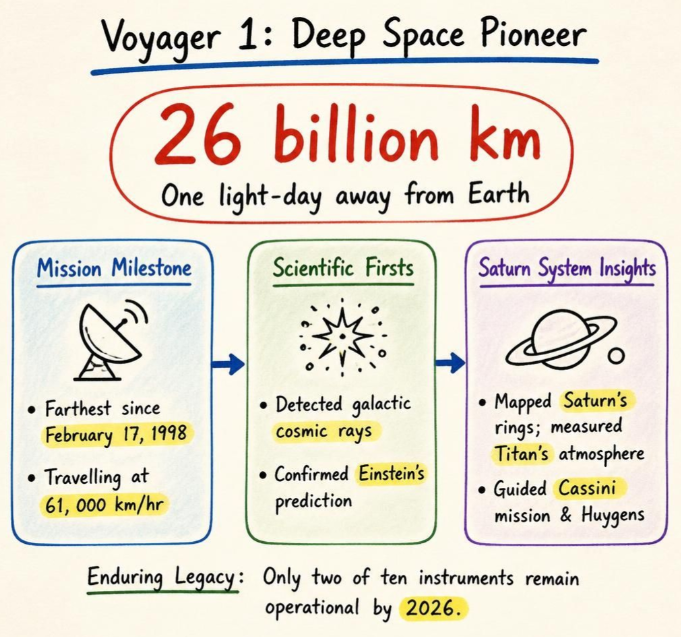
NASA's Voyager 1 has reached a distance of approximately one light-day (26 billion km) from Earth, making it one of the most distant human-made objects in space.
Key Highlights
- Voyager 1 is travelling at approximately 61,000 km/hr.
- It has remained the farthest spacecraft from Earth since 17 February 1998.
- Its observations continue to provide valuable information about interstellar space, cosmic rays and planetary systems.
- Its cameras were switched off in 1990.
- By 2026, only 2 of its original 10 scientific instruments remained operational.
Major Scientific Contributions
1. Galactic Cosmic Rays
- Its ultraviolet spectrometer unexpectedly detected galactic cosmic rays between 1992 and 2013.
- Provided insights into the space environment beyond the Solar System.
- Raised questions about solar wind interactions with interstellar atoms near the heliopause.
2. Einstein's Theory of General Relativity
- Voyager 1's observations independently confirmed Einstein's prediction regarding the frequency shift of electromagnetic radiation in a gravitational field.
3. Study of Saturn and Titan
- Used radio signals to study the distribution of materials and fine structures within Saturn's rings.
- Radio occultation helped measure the temperature and pressure of Titan's atmosphere.
- Its findings contributed to planning NASA's Cassini mission and the Huygens probe.
Quick Learning: Voyager 1
| Particulars | Details |
| Agency | NASA (USA) |
| Launch date | 5 September 1977 |
| Launch vehicle | Titan IIIE-Centaur |
| Mission | Exploration of outer planets and interstellar space |
| Primary targets | Jupiter and Saturn |
| Current status | Interstellar space |
| Twin spacecraft | Voyager 2 |
Important Scientific Terms
- Light-day: Distance travelled by light in one day (approximately 25.9 billion km).
- Heliopause: Boundary where the influence of the solar wind becomes weaker than that of the interstellar medium.
- Galactic Cosmic Rays: High-energy particles originating outside the Solar System.
- Radio Occultation: Technique used to study planetary atmospheres and structures by analysing changes in radio signals passing through them.
Source: IE
Context
National Naturopathy Day is observed on 18 November every year. The 9th edition in 2026 is being celebrated at Nagamangala, Karnataka, under the theme ‘Prakrutik Chikitsa, Swasth Bharat’.
About Naturopathy
- Naturopathy is a drug-free system of healing that promotes the body's natural self-healing capacity through diet, fasting, water, mud, massage and natural living.
- It is based on the principle of “Return to Nature” and the use of natural elements.
- Major therapies include hydrotherapy, mud therapy, magnetotherapy, chromotherapy, physiotherapy, yoga and a Saatvik diet.
- It focuses on health promotion, disease prevention and lifestyle modification.
Government Initiatives and Institutional Development
1. National Institute of Naturopathy (NIN), Pune
- Its new 25-acre campus, Nisarg Gram, was inaugurated on 25 February 2024.
- Built at a cost of ₹213.55 crore, it includes a 250-bedded hospital.
- It houses the first BNYS college under the Central Government.
- It promotes research, standardisation, training and quality naturopathy services.
2. Education and Professional Regulation
- Bachelor of Naturopathy and Yogic Sciences (BNYS) is a 5.5-year degree programme.
- NIN offers 100 seats at Nisarg Gram from the 2026–27 academic session.
- The Naturopathy Registration Board (NRB) provides central registration of practitioners and accreditation of institutions.
3. Research and Development
- The Central Council for Research in Yoga and Naturopathy (CCRYN), established in 1978 and funded by the Ministry of Ayush, undertakes research and development.
4. Expansion of Healthcare Infrastructure
- New 200-bed Yoga and Naturopathy hospitals have been established at Jhajjar (Haryana) and Nagamangala (Karnataka).
- NIN also runs specialised OPDs for maternal care, diabetes and mind-body medicine.
5. Tribal Healthcare
- Nisarg Arogya Sadhana Kendra provides yoga and naturopathy services to tribal communities.
- It also trains tribal youth and supports capacity-building among traditional healers.
- The government aims to recognise one lakh tribal healers.
Quick Learning
| Institution / Initiative | Key information |
|---|---|
| National Naturopathy Day | 18 November |
| NIN | Pune, Maharashtra |
| Nisarg Gram | New NIN campus |
| CCRYN | Research in Yoga and Naturopathy; established in 1978 |
| BNYS | 5.5-year degree programme |
| Ayush Visa | Introduced in 2023 |