
तीसरे अग्रिम अनुमानों के अनुसार 2025–26 में भारत का बागवानी उत्पादन कितना अनुमानित है?
According to the Third Advance Estimates, what is India's projected horticultural production for 2025–26?
2025–26 का अनुमान 3,869.15 लाख टन है, जो 2024–25 के 3,707.38 लाख टन से 161.77 लाख टन (4.36%) अधिक है।
The 2025–26 estimate is 3,869.15 lakh tonnes, up 161.77 lakh tonnes (4.36%) from 3,707.38 lakh tonnes in 2024–25.
भारत के बागवानी क्षेत्र के संबंध में निम्नलिखित कथनों पर विचार कीजिए:
1. 2025–26 में उत्पादन में 4.36% वृद्धि का अनुमान है।
2. बागवानी के अंतर्गत खेती का क्षेत्रफल भी बढ़ा है।
3. एकीकृत बागवानी विकास मिशन (MIDH) एक केंद्र प्रायोजित योजना है।
उपर्युक्त में से कौन-से कथन सही हैं?
Consider the following statements about India's horticulture sector:
1. Production is projected to grow by 4.36% in 2025–26.
2. The area under horticultural cultivation has also increased.
3. The Mission for Integrated Development of Horticulture (MIDH) is a centrally sponsored scheme.
Which of the statements given above are correct?
कथन 2 गलत है: खेती का क्षेत्र 301.36 लाख हेक्टेयर से घटकर 297.21 लाख हेक्टेयर रह गया है, फिर भी उत्पादन रिकॉर्ड स्तर पर अनुमानित है।
Statement 2 is wrong: the area fell from 301.36 lakh hectares to 297.21 lakh hectares, yet production is projected at a record level.
स्रोत में बताई गई बागान फसलों (plantation crops) में निम्नलिखित में से कौन शामिल नहीं है?
Which of the following is NOT among the plantation crops mentioned in the source?
स्रोत में बागान फसलों के रूप में काजू, नारियल और कोको का उल्लेख है। गेहूँ एक खाद्यान्न फसल है, बागवानी फसल नहीं।
The source lists cashew, coconut and cocoa as plantation crops. Wheat is a foodgrain, not a horticultural crop.
नासा का वॉयेजर 1 किस वर्ष प्रक्षेपित किया गया था?
In which year was NASA's Voyager 1 launched?
वॉयेजर 1 को 5 सितंबर 1977 को टाइटन IIIE-सेंटॉर रॉकेट से प्रक्षेपित किया गया था। इसका जुड़वाँ यान वॉयेजर 2 है।
Voyager 1 was launched on 5 September 1977 on a Titan IIIE-Centaur rocket. Its twin is Voyager 2. (Source: Indian Express)
वॉयेजर 1 पृथ्वी से लगभग एक प्रकाश-दिवस (light-day) की दूरी पर पहुँच गया है। यह दूरी लगभग कितनी है?
Voyager 1 has reached about one light-day from Earth. Roughly how far is that?
एक प्रकाश-दिवस वह दूरी है जो प्रकाश एक दिन में तय करता है, लगभग 25.9 अरब किमी। वॉयेजर 1 लगभग 61,000 किमी/घंटा की गति से चल रहा है।
A light-day is the distance light travels in one day, about 25.9 billion km. Voyager 1 is moving at about 61,000 km/hr. (Source: Indian Express)
वॉयेजर 1 किस वर्ष से पृथ्वी से सबसे दूर स्थित अंतरिक्ष यान बना हुआ है?
Since which year has Voyager 1 been the farthest spacecraft from Earth?
वॉयेजर 1, 17 फ़रवरी 1998 से सबसे दूर का अंतरिक्ष यान है। इसके कैमरे 1990 में बंद कर दिए गए थे, और 2026 तक इसके 10 मूल वैज्ञानिक उपकरणों में से केवल 2 काम कर रहे थे।
Voyager 1 has been the farthest spacecraft since 17 February 1998. Its cameras were switched off in 1990, and by 2026 only 2 of its 10 original instruments were working. (Source: Indian Express)
'हीलियोपॉज़' (heliopause) क्या है?
What is the 'heliopause'?
हीलियोपॉज़ वह सीमा है जहाँ सौर पवन का प्रभाव अंतरतारकीय माध्यम से कमज़ोर हो जाता है। वॉयेजर 1 अब अंतरतारकीय अंतरिक्ष में है।
The heliopause is where the solar wind's influence becomes weaker than the interstellar medium's. Voyager 1 is now in interstellar space. (Source: Indian Express)
जलवायु परिवर्तन प्रदर्शन सूचकांक (CCPI) 2027 में भारत की रैंक क्या है?
What is India's rank in the Climate Change Performance Index (CCPI) 2027?
भारत CCPI 2027 में 28वें स्थान पर है, जबकि CCPI 2026 में 23वें और CCPI 2025 में 10वें स्थान पर था।
India is 28th in CCPI 2027, down from 23rd in CCPI 2026 and 10th in CCPI 2025. (Source: Indian Express)
जलवायु परिवर्तन प्रदर्शन सूचकांक (CCPI) कौन प्रकाशित करता है?
Who publishes the Climate Change Performance Index (CCPI)?
CCPI को जर्मनवॉच, न्यूक्लाइमेट इंस्टीट्यूट और CAN इंटरनेशनल हर साल प्रकाशित करते हैं। यह पहली बार 2005 में प्रकाशित हुआ और 14 संकेतकों को चार श्रेणियों में आँकता है।
CCPI is published annually by Germanwatch, NewClimate Institute and CAN International. First published in 2005, it uses 14 indicators in four categories. (Source: Indian Express)
CCPI 2027 में शीर्ष तीन स्थान खाली क्यों रखे गए?
Why were the top three positions in CCPI 2027 kept vacant?
किसी भी देश के 'बहुत उच्च' श्रेणी में न आने के कारण शीर्ष तीन स्थान खाली रखे गए। डेनमार्क लगातार छठे वर्ष चौथे स्थान पर रहा।
The top three places were left vacant because no country reached the 'Very High' category. Denmark stayed 4th for the sixth year running. (Source: Indian Express)
These notes are not in the language you chose, so they are shown as written.
SOURCE
Why in News?
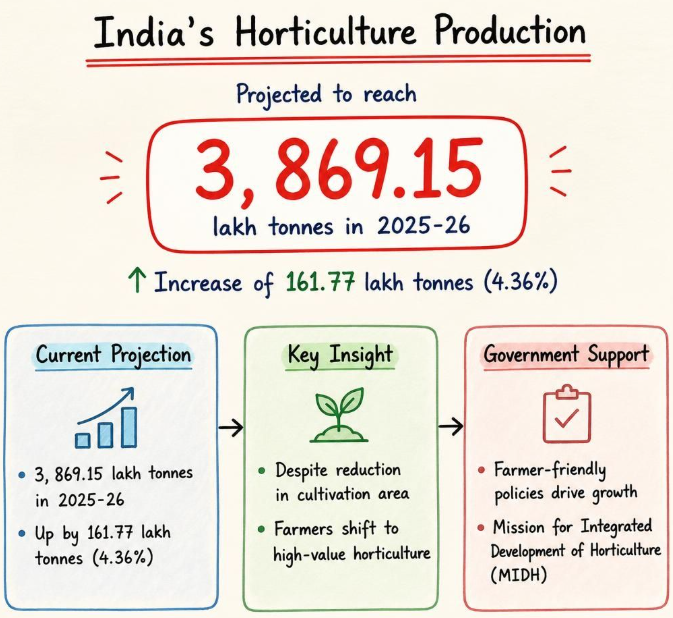
India's horticultural production is projected to reach a record 3,869.15 lakh tonnes in 2025–26, registering a growth of 4.36% over the previous year.
Key Highlights
- The Third Advance Estimates were released by Union Agriculture Minister Shivraj Singh Chouhan in New Delhi.
- Production is expected to increase by 161.77 lakh tonnes (4.36%) compared to 2024–25.
- Horticultural production in 2024–25 stood at 3,707.38 lakh tonnes.
- Record production is projected despite a decline in the area under horticultural cultivation.
- Growth is expected to improve farmers' incomes, strengthen nutritional security and promote agricultural diversification.
Area and Production
| Particulars | 2024–25 | 2025–26 (Projected) |
| Production | 3,707.38 lakh tonnes | 3,869.15 lakh tonnes |
| Cultivated area | 301.36 lakh hectares | 297.21 lakh hectares |
Major Developments
- Farmers are diversifying from traditional crops towards high-value horticultural crops.
- Horticulture includes:
- Fruits and vegetables
- Flowers and spices
- Plantation crops (cashew, coconut and cocoa)
- Aromatic and medicinal plants.
- Improved technology, research and post-harvest management are supporting productivity and farmers' income.
Government Initiative: Mission for Integrated Development of Horticulture (MIDH)
- A centrally sponsored scheme aimed at promoting the holistic development of the horticulture sector.
- Focuses on research, modern technology, quality planting material and post-harvest management.
- Supports improved production, productivity and market access.
Significance
- Enhances nutritional and food security.
- Promotes crop diversification and agricultural self-reliance.
- Improves farmers' income through high-value crops.
- Increases productivity despite declining cultivated area.
Source: IE
Why in News?
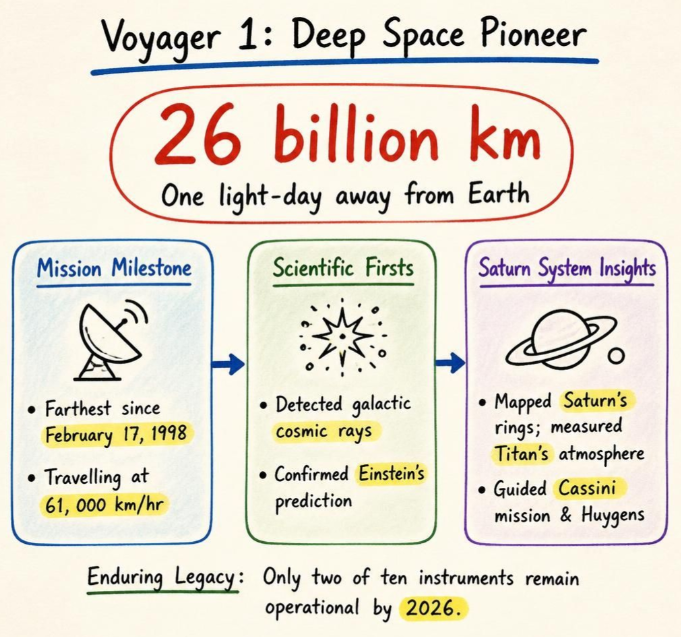
NASA's Voyager 1 has reached a distance of approximately one light-day (26 billion km) from Earth, making it one of the most distant human-made objects in space.
Key Highlights
- Voyager 1 is travelling at approximately 61,000 km/hr.
- It has remained the farthest spacecraft from Earth since 17 February 1998.
- Its observations continue to provide valuable information about interstellar space, cosmic rays and planetary systems.
- Its cameras were switched off in 1990.
- By 2026, only 2 of its original 10 scientific instruments remained operational.
Major Scientific Contributions
1. Galactic Cosmic Rays
- Its ultraviolet spectrometer unexpectedly detected galactic cosmic rays between 1992 and 2013.
- Provided insights into the space environment beyond the Solar System.
- Raised questions about solar wind interactions with interstellar atoms near the heliopause.
2. Einstein's Theory of General Relativity
- Voyager 1's observations independently confirmed Einstein's prediction regarding the frequency shift of electromagnetic radiation in a gravitational field.
3. Study of Saturn and Titan
- Used radio signals to study the distribution of materials and fine structures within Saturn's rings.
- Radio occultation helped measure the temperature and pressure of Titan's atmosphere.
- Its findings contributed to planning NASA's Cassini mission and the Huygens probe.
Quick Learning: Voyager 1
| Particulars | Details |
| Agency | NASA (USA) |
| Launch date | 5 September 1977 |
| Launch vehicle | Titan IIIE-Centaur |
| Mission | Exploration of outer planets and interstellar space |
| Primary targets | Jupiter and Saturn |
| Current status | Interstellar space |
| Twin spacecraft | Voyager 2 |
Important Scientific Terms
- Light-day: Distance travelled by light in one day (approximately 25.9 billion km).
- Heliopause: Boundary where the influence of the solar wind becomes weaker than that of the interstellar medium.
- Galactic Cosmic Rays: High-energy particles originating outside the Solar System.
- Radio Occultation: Technique used to study planetary atmospheres and structures by analysing changes in radio signals passing through them.
Source: IE
Why in News?
India has been ranked 28th in the Climate Change Performance Index (CCPI) 2027, declining five positions from its 23rd rank in CCPI 2026.
About Climate Change Performance Index (CCPI)
- It is an international assessment tool that tracks the climate performance of the world's largest greenhouse gas emitters.
- First published in 2005.
- Covers 64 countries and the European Union, accounting for over 90% of global greenhouse gas emissions.
- Published annually by:
- Germanwatch
- NewClimate Institute
- Climate Action Network International (CAN International).
- Objective: To assess countries' progress towards climate action and alignment with the Paris Agreement goal of limiting global warming to 1.5°C.
Assessment Framework
CCPI uses 14 indicators under four categories:
| Category | Assessment |
| GHG Emissions | Emission levels and trends |
| Renewable Energy | Renewable energy development |
| Energy Use | Energy consumption and efficiency |
| Climate Policy | National and international climate policies |
- Around 500 climate and energy experts contribute to the policy assessment.
Key Highlights: CCPI 2027
| Country/Region | Rank | Performance |
| Denmark | 4th | 84.05 points |
| European Union | 19th | Medium |
| France | 20th | Medium |
| Germany | 25th | Medium |
| India | 28th | Medium |
| UAE | 64th | Very Low |
| Saudi Arabia | 65th | Very Low |
| Russia | 66th | Very Low |
| USA | 67th | Very Low |
| Iran | 68th | Very Low |
- Top three positions: Kept vacant because no country achieved the Very High performance rating.
- Denmark: Retained 4th position for the sixth consecutive year.
- G20: UK is the only G20 country in the High performance category, while 10 G20 countries fall under the Very Low category.
- India's performance: 28th in 2027, compared to 23rd in 2026 and 10th in 2025.
|
The Paris Agreement, adopted in 2015 at COP21, remains the cornerstone of global climate governance, though it faces a critical crossroads in 2026. While it successfully shifted climate action from top-down mandates to a "bottom-up" voluntary framework, recent UN reports indicate that the 1.5°C goal is now considered unachievable without a temporary "overshoot." 🌍 Core Architecture & Objectives The agreement is a legally binding international treaty aimed at limiting global warming to well below 2°C, preferably 1.5°C, compared to pre-industrial levels. • Nationally Determined Contributions (NDCs): The heart of the agreement where each country sets its own voluntary targets. These are updated every 5 years to reflect "highest possible ambition." • Global Stocktake (GST): A periodic review (every 5 years) to assess collective progress. The first GST concluded at COP28 (2023), calling for a "transition away from fossil fuels." • Transparency Framework: A binding obligation to report regularly on emissions and progress in implementation, ensuring international accountability. |
Source: IE
Context
The 12th Session of the India–Belarus Inter-Governmental Commission on Trade, Economic, Scientific, Technological and Cultural Cooperation was held in New Delhi to strengthen bilateral cooperation.
About Belarus
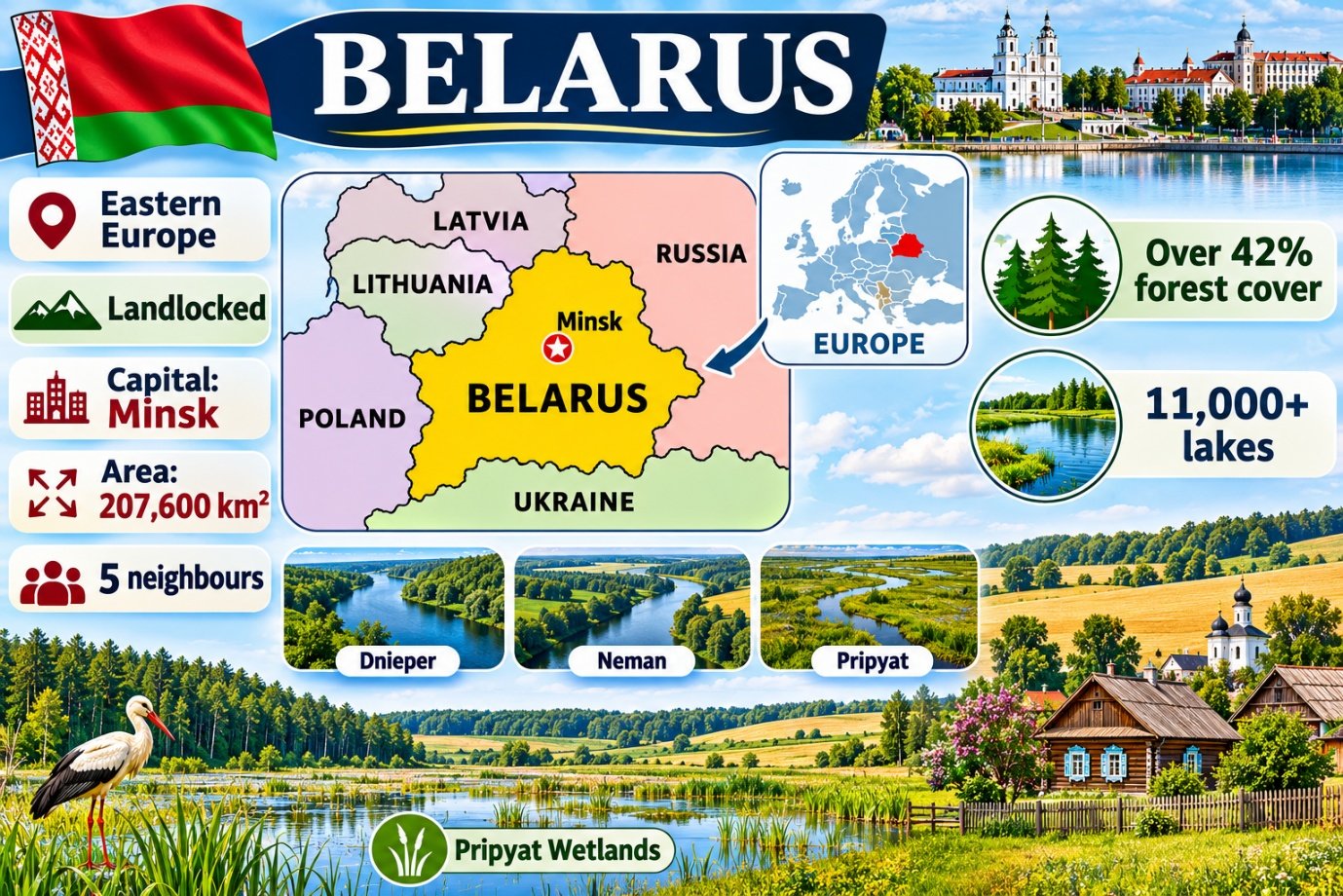
- Location: Landlocked country in Eastern Europe.
- Capital: Minsk.
- Neighbouring Countries:
- North and East: Russia
- South: Ukraine
- West: Poland
- Northwest: Lithuania and Latvia
Geographical Features
| Feature | Description |
| Terrain | Mainly flat lowlands, with low hills and uplands |
| Forests | Around 40% of the country is forested |
| Climate | Cool continental climate, moderated by Atlantic maritime influences |
| Rivers | Dnieper and Mukhavyets; the latter is a tributary of the Bug (Buh) River |
| Natural Resources | Peat, forests, oil, natural gas, brown coal, fertile land, limestone and iron |
Source: IE
Context
Quad leaders met in Manila on the sidelines of the East Asia Summit and announced new initiatives to strengthen cooperation in artificial intelligence, cybersecurity, maritime security and economic engagement. India will host the first Quad Business Leaders’ Forum in Mumbai in early 2027.
Key Developments
1. Quad Business Leaders’ Forum
- The inaugural forum will be held in Mumbai in early 2027.
- It aims to strengthen private-sector partnerships, trade and commercial cooperation among Quad countries.
2. Quad AI Accelerator
- Promotes collaborative research and development in Artificial Intelligence (AI) among India, the US, Japan and Australia.
- Aims to strengthen technological innovation and cooperation.
3. Quad Cybersecurity Cooperation
- Seeks to enhance collective resilience against cyber threats.
- Promotes a secure and trusted digital environment across the Indo-Pacific.
4. Indo-Pacific Maritime Surveillance Collaboration
- Planned for 2027 to strengthen maritime domain awareness.
- For the first time, patrol aircraft will participate in a Quad maritime exercise.
- Aims to improve maritime monitoring and interoperability.

About the Quad
The Quadrilateral Security Dialogue (Quad) is an informal strategic grouping comprising four countries:
- India
- United States
- Japan
- Australia
Evolution
- 2004: Originated as the Tsunami Core Group for humanitarian assistance and disaster relief.
- 2007: Japanese PM Shinzo Abe proposed the idea of a quadrilateral dialogue.
- 2017: Revived as Quad 2.0.
- 2021: Elevated to the Leaders’ level.
Significance for India
- Maritime Security: Strengthens India's role in maintaining stability and freedom of navigation in the Indo-Pacific.
- Technology Cooperation: Provides opportunities for collaboration in AI, cybersecurity and emerging technologies.
- Economic Resilience: Supports diversified supply chains and greater private-sector investment.
- Strategic Partnerships: Deepens cooperation with major Indo-Pacific democracies without requiring a formal military alliance.
Conclusion
The Quad is evolving from a primarily strategic dialogue into a broader platform for economic, technological and maritime cooperation, supporting a stable and rules-based Indo-Pacific.
Source: IE
Context
National Naturopathy Day is observed on 18 November every year. The 9th edition in 2026 is being celebrated at Nagamangala, Karnataka, under the theme ‘Prakrutik Chikitsa, Swasth Bharat’.
About Naturopathy
- Naturopathy is a drug-free system of healing that promotes the body's natural self-healing capacity through diet, fasting, water, mud, massage and natural living.
- It is based on the principle of “Return to Nature” and the use of natural elements.
- Major therapies include hydrotherapy, mud therapy, magnetotherapy, chromotherapy, physiotherapy, yoga and a Saatvik diet.
- It focuses on health promotion, disease prevention and lifestyle modification.
Government Initiatives and Institutional Development
1. National Institute of Naturopathy (NIN), Pune
- Its new 25-acre campus, Nisarg Gram, was inaugurated on 25 February 2024.
- Built at a cost of ₹213.55 crore, it includes a 250-bedded hospital.
- It houses the first BNYS college under the Central Government.
- It promotes research, standardisation, training and quality naturopathy services.
2. Education and Professional Regulation
- Bachelor of Naturopathy and Yogic Sciences (BNYS) is a 5.5-year degree programme.
- NIN offers 100 seats at Nisarg Gram from the 2026–27 academic session.
- The Naturopathy Registration Board (NRB) provides central registration of practitioners and accreditation of institutions.
3. Research and Development
- The Central Council for Research in Yoga and Naturopathy (CCRYN), established in 1978 and funded by the Ministry of Ayush, undertakes research and development.
4. Expansion of Healthcare Infrastructure
- New 200-bed Yoga and Naturopathy hospitals have been established at Jhajjar (Haryana) and Nagamangala (Karnataka).
- NIN also runs specialised OPDs for maternal care, diabetes and mind-body medicine.
5. Tribal Healthcare
- Nisarg Arogya Sadhana Kendra provides yoga and naturopathy services to tribal communities.
- It also trains tribal youth and supports capacity-building among traditional healers.
- The government aims to recognise one lakh tribal healers.
Quick Learning
| Institution / Initiative | Key information |
|---|---|
| National Naturopathy Day | 18 November |
| NIN | Pune, Maharashtra |
| Nisarg Gram | New NIN campus |
| CCRYN | Research in Yoga and Naturopathy; established in 1978 |
| BNYS | 5.5-year degree programme |
| Ayush Visa | Introduced in 2023 |