
State PCS Exam 2026
Updates, Tips & Strategies
Your complete guide to cracking Provincial Civil Services
What Is the PCS Exam?
Provincial Civil Services (PCS) is a prestigious state-level competitive examination conducted by State Public Service Commissions to recruit officers for Group A & B posts in the state administration.
Successful candidates are appointed as Deputy Collectors, Deputy Superintendents of Police, Block Development Officers, and other gazetted officers. The exam follows a three-stage structure similar to the UPSC Civil Services Examination, making it one of the most respected career paths for aspirants across India.
Prelims
Objective · Qualifying
Mains
Descriptive · Merit
Interview
Personality Test
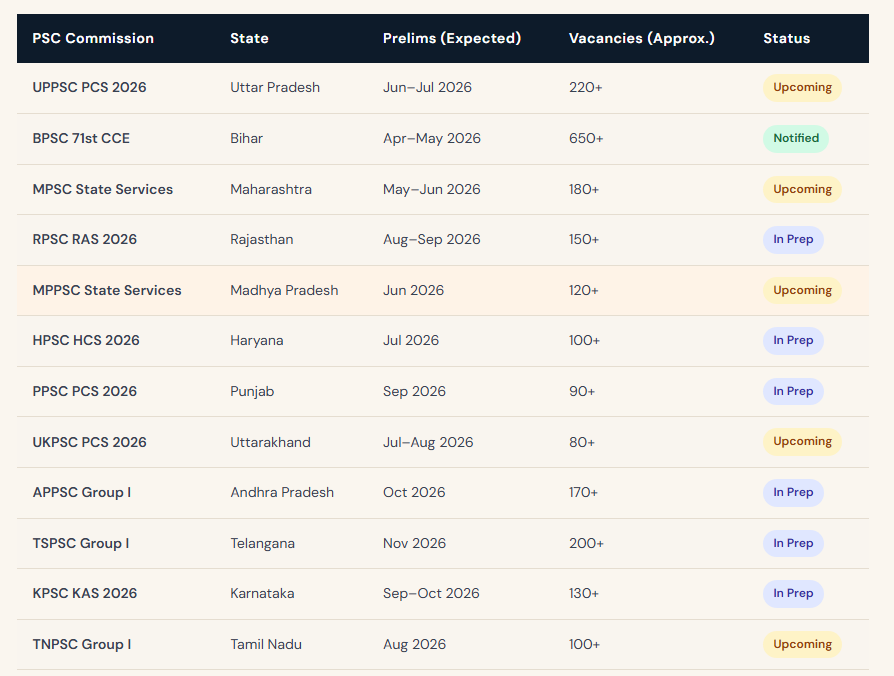
State-Wise PSC Exam Calendar 2026
Below is a consolidated overview of major State PSC exams and their expected timelines for 2026. Always verify dates on the official commission website as schedules are subject to revision.
Syllabus Overview
General Studies Paper I — History, Culture & Geography Indian History with special emphasis on the Modern Period, Indian National Movement, World History, Indian and World Geography, Physical and Human Geography, and State-specific history and culture.
General Studies Paper II — Polity, Governance & International Relations Indian Constitution, Political System, Panchayati Raj, Public Policy, Rights Issues, Governance, Social Justice, and International Relations including India’s foreign policy and bilateral relations.
General Studies Paper III — Economy, Science & Environment Indian Economy, Economic Development, Planning, Agriculture, Rural Development, Science and Technology, Biodiversity, Environment, and Disaster Management.
General Studies Paper IV — Ethics, Integrity & Aptitude Ethics and human interface, Attitude, Aptitude, Foundational Values for Civil Services, Emotional Intelligence, Contributions of moral thinkers, Public Administration ethics, and Case Studies.
Essay Paper Two essays of approximately 1,000 words each, usually one on a social/philosophical theme and one on a contemporary national issue.
Optional Subject Chosen from a list of subjects such as Public Administration, Geography, History, Sociology, Political Science, Agriculture, Hindi Literature, and others depending on the state commission.
Preparation Tips & Strategies
1. Start With the Syllabus, Not the Books Before opening any book, read the official syllabus of your target PSC carefully. Download previous years’ question papers and map them to the syllabus. This gives you a clear picture of which topics carry more weight and which can be covered lightly. Never prepare blindly.
2. Build Your Foundation With NCERTs NCERT textbooks from Classes 6 to 12 are the starting point for every serious aspirant. Cover History, Geography, Polity, Economy, and Science NCERTs thoroughly before moving to any reference book. They build conceptual clarity that no coaching material can replace.
3. Master State-Specific Content This is the single biggest differentiator in state PSC preparation. National-level content is important, but state-specific topics — the history, geography, economy, government schemes, folk culture, important personalities, rivers, and current affairs of your state — can make or break your Prelims. Set aside 25 to 30 percent of your GK preparation for your target state.
4. Solve Previous Year Papers Religiously Previous year question papers are your best guide to the exam. Solve at least the last 10 years’ papers — both Prelims and Mains. Identify recurring topics, frequently tested concepts, and the style of questions. This exercise alone can sharpen your preparation more than months of random reading.
5. Prelims: Accuracy Over Attempts In Prelims, most state PSCs have negative marking. It is more important to attempt questions with confidence than to attempt everything. Aim for 70 to 75 percent accuracy. Practice elimination of options — even when you are not fully sure of the right answer, eliminating two wrong options significantly improves your odds.
6. Mains: Make Answer Writing a Daily Habit The biggest mistake aspirants make is waiting until after Prelims to start answer writing. Begin early. Write at least one answer every day. Follow a structure — a crisp introduction, a well-organised body with multiple dimensions (social, economic, political, constitutional, ethical), and a forward-looking conclusion. Review your answers critically or get them evaluated by a mentor.
7. Current Affairs: Be Selective and Consistent Read one quality newspaper daily. The Hindu or Dainik Jagran (for Hindi medium) are recommended. Focus on editorials, government schemes, Supreme Court judgments, economic policies, and state government decisions. Maintain a current affairs notebook divided by subject and revise it weekly. Quality and consistency matter more than reading multiple sources.
8. Choose Your Optional Subject Carefully Your optional subject is a significant scorer in Mains. Choose it based on genuine interest, available study material, and overlap with General Studies topics — not based on what others are choosing. Public Administration, Geography, History, and Sociology are popular and well-resourced. Once chosen, commit fully. Changing optional mid-preparation wastes 3 to 4 months.
9. Revision Is Non-Negotiable Reading something once is never enough. Plan your preparation so that you complete at least three revision cycles before the exam. Use short notes, mind maps, and bullet summaries to make revision faster. If you cannot revise it, you have not actually studied it.
10. Mock Tests Are Your Reality Check Enrol in a good test series for both Prelims and Mains. Treat every mock test as a real exam — sit in a quiet place, maintain strict time limits, and analyse your performance honestly after every test. Mock tests reveal your weak areas and train your mind for examination conditions.
12-Month Preparation Roadmap
| Timeline | Focus Area | Key Tasks |
|---|---|---|
| Months 1 & 2 | Foundation | Complete all relevant NCERTs. Understand the exam pattern and syllabus in detail. Select your optional subject and begin introductory study. Start reading a newspaper daily from Day 1. |
| Months 3 to 5 | Standard References | Study standard reference books — Laxmikanth for Polity, Bipin Chandra for Modern History, Spectrum for Freedom Struggle, and standard sources for Economy & Environment. Continue optional subject preparation simultaneously. |
| Months 6 & 7 | First Revision & Mock Tests | Revise all static subjects thoroughly. Start solving Prelims mock tests (at least 2 per week). Begin writing one Mains answer daily. Identify weak areas and improve them. |
| Months 8 & 9 | State-Specific Preparation | Cover target state’s history, geography, economy, culture, folk art, rivers, important personalities, and government schemes comprehensively. Attempt full-length Prelims mock tests regularly. |
| Months 10 & 11 | Mains Intensive | Focus completely on Mains preparation. Write full-length answers daily. Practice previous year Mains papers under timed conditions. Write one essay every week and practice Ethics case studies daily. |
| Month 12 | Final Consolidation | Rapid revision of all subjects. Consolidate current affairs from the last 6 months. Practice mock interviews if needed. Maintain good health, proper sleep, and a calm, focused mindset. |
Cracking the Interview
The Personality Test is not a knowledge quiz. The board is assessing whether you have the temperament, values, and judgement to serve as a public official. They want to see intellectual honesty, balanced thinking, awareness of ground realities, and the ability to remain composed under pressure.
Prepare your Detailed Application Form thoroughly — know your hobbies, hometown, graduation subject, and optional subject well enough to hold a detailed conversation on each. Stay updated on important national and state events from the past six months. Practice speaking your thoughts clearly and confidently.
Above all, be yourself. The board can immediately identify rehearsed, mechanical answers. Authentic, thoughtful responses — even if imperfect — always create a better impression than polished but hollow ones.
Common Mistakes to Avoid
Neglecting state-specific topics and over-focusing on national-level content is the most common error among state PSC aspirants. Studying from too many sources without mastering any one properly is equally damaging. Skipping regular revision, ignoring answer writing practice until the last moment, underestimating the Ethics paper, and going into the interview without specific preparation — these are the mistakes that separate candidates who clear the exam from those who do not.
Be strategic, be consistent, and be honest with yourself about where your preparation stands.
The Shri Raj IAS Advantage
At Shri Raj IAS Academy, we specialise in state-level civil services preparation. Our faculty brings deep expertise in state PSC patterns and regional administrative contexts. We offer structured classroom programmes, personalised mentorship, a rigorous mock test series, and regular answer-writing workshops — all designed around the specific demands of UPPSC, UKPSC, BPSC, MPPSC, RPSC, and other state examinations.
Whether you are just beginning your preparation or looking to sharpen your final stage strategy, Shri Raj IAS is your trusted partner on the journey to becoming a civil servant.