
जनगणना 2027 का स्व-गणना (self-enumeration) पोर्टल 16 नवंबर 2026 को पहले चार राज्यों में शुरू हुआ। निम्नलिखित में से कौन-सा राज्य उनमें शामिल नहीं था?
The Census 2027 self-enumeration portal went live on 16 November 2026 in four states first. Which of the following was NOT one of them?
पोर्टल पहले उत्तर प्रदेश, उत्तराखंड, गोवा और पंजाब के लिए शुरू हुआ; देशभर में पहुँच जनवरी 2027 से प्रस्तावित है।
The portal first opened for Uttar Pradesh, Uttarakhand, Goa and Punjab; nationwide access is planned from January 2027. (Source: The Hindu)
जनगणना में अलग से दर्ज किए जाने वाले छह प्रमुख धार्मिक समुदायों में निम्नलिखित में से कौन शामिल नहीं है?
Which of the following is NOT among the six major religious communities recorded separately in the Census?
जनगणना हिंदू, मुस्लिम, ईसाई, सिख, बौद्ध और जैन को अलग दर्ज करती है। सरना जैसे आदिवासी धर्म 'अन्य धर्म और मत' श्रेणी में आते हैं; इसलिए अलग सरना कोड की माँग है।
The Census records Hindu, Muslim, Christian, Sikh, Buddhist and Jain separately. Tribal faiths such as Sarna fall under 'Other Religions and Persuasions', hence the demand for a separate Sarna code. (Source: The Hindu)
झारखंड विधानसभा ने अलग सरना धर्म कोड की माँग वाला प्रस्ताव किस वर्ष पारित किया?
In which year did the Jharkhand Assembly pass a resolution seeking a separate Sarna religion code?
झारखंड विधानसभा ने 2020 में प्रस्ताव पारित किया। स्रोत के अनुसार 2011 की जनगणना में लगभग 50 लाख लोगों ने 'अन्य' श्रेणी में स्वयं को सरना बताया था।
The Jharkhand Assembly passed the resolution in 2020. According to the source, about 5 million people identified as Sarna under 'Other' in the 2011 Census. (Source: The Hindu)
भारत में जनगणना कराने के लिए कौन-सा प्राधिकरण ज़िम्मेदार है?
Which authority is responsible for conducting the Census in India?
जनगणना महापंजीयक और जनगणना आयुक्त कराते हैं। उन्होंने स्पष्ट किया कि पोर्टल पर दिखी 287 प्रविष्टियाँ केवल सुझाव (predictive text) थीं, नए धर्मों का आधिकारिक वर्गीकरण नहीं।
The Census is run by the Registrar General and Census Commissioner. They clarified that the 287 entries shown on the portal were predictive-text suggestions, not official classifications of new religions. (Source: The Hindu)
स्रोत के अनुसार, कौन-से दो देश अब भी पोलियो-स्थानिक (endemic) हैं?
According to the source, which two countries remain polio-endemic?
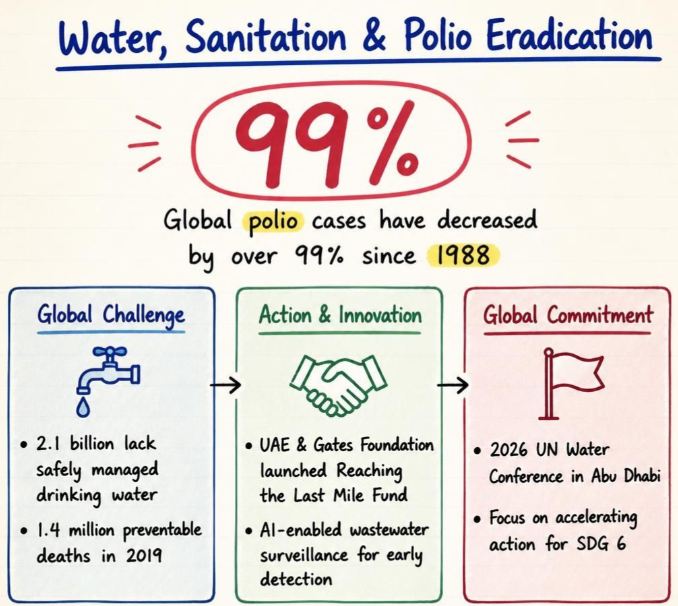
अफ़ग़ानिस्तान और पाकिस्तान पोलियो-स्थानिक हैं, जहाँ 2024 में मामलों का पुनरुत्थान देखा गया। 1988 से वैश्विक पोलियो मामलों में 99% से अधिक कमी आई है।
Afghanistan and Pakistan remain polio-endemic, with resurgences reported in 2024. Global polio cases have fallen by over 99% since 1988. (Source: The Hindu)
स्रोत के अनुसार, 2024 में विश्व में कितने लोगों के पास सुरक्षित रूप से प्रबंधित स्वच्छता (sanitation) नहीं थी?
According to the source, how many people worldwide lacked safely managed sanitation in 2024?
2024 में 3.4 अरब लोगों के पास सुरक्षित स्वच्छता और 2.1 अरब के पास सुरक्षित पेयजल नहीं था। 2019 में असुरक्षित जल और स्वच्छता से 14 लाख रोकी जा सकने वाली मौतें हुईं।
In 2024, 3.4 billion people lacked safely managed sanitation and 2.1 billion lacked safe drinking water. Unsafe water and sanitation caused 1.4 million preventable deaths in 2019. (Source: The Hindu)
संयुक्त राष्ट्र जल सम्मेलन 2026 की सह-मेज़बानी कौन-से दो देश करेंगे?
Which two countries will co-host the UN Water Conference 2026?
UAE और सेनेगल अबू धाबी में इसकी सह-मेज़बानी करेंगे। सम्मेलन का फोकस SDG 6 (सबके लिए जल और स्वच्छता) की दिशा में तेज़ कार्रवाई पर है।
The UAE and Senegal will co-host it in Abu Dhabi. It focuses on accelerating action on SDG 6 (water and sanitation for all). (Source: The Hindu)
अपशिष्ट जल निगरानी (wastewater surveillance) का मुख्य लाभ क्या है?
What is the main advantage of wastewater surveillance?
सीवेज की जाँच से समुदाय में फैल रहे रोगाणु पहले ही पकड़े जा सकते हैं। AI इन आँकड़ों का विश्लेषण कर पूर्व-चेतावनी प्रणाली को मज़बूत करता है।
Testing sewage can detect pathogens circulating in a community early. AI can analyse this data and strengthen early-warning systems. (Source: The Hindu)
भारत-इज़राइल जल प्रौद्योगिकी केंद्र (CoWT) अगस्त 2024 में कहाँ स्थापित किया गया?
Where was the India-Israel Centre of Water Technology (CoWT) set up in August 2024?
CoWT IIT मद्रास में इज़राइली दूतावास और AMRUT मिशन के साथ बना है। इसका लक्ष्य भारतीय शहरों में 24×7 जलापूर्ति, लीकेज पहचान और नॉन-रेवेन्यू वॉटर घटाना है।
CoWT is at IIT Madras with the Israeli Embassy and the AMRUT Mission. It aims at 24×7 urban water supply, leak detection and lower Non-Revenue Water. (Source: Indian Express)
इज़राइल का 'सोरेक-2' (Sorek-2) क्या है?
What is Israel's 'Sorek-2'?
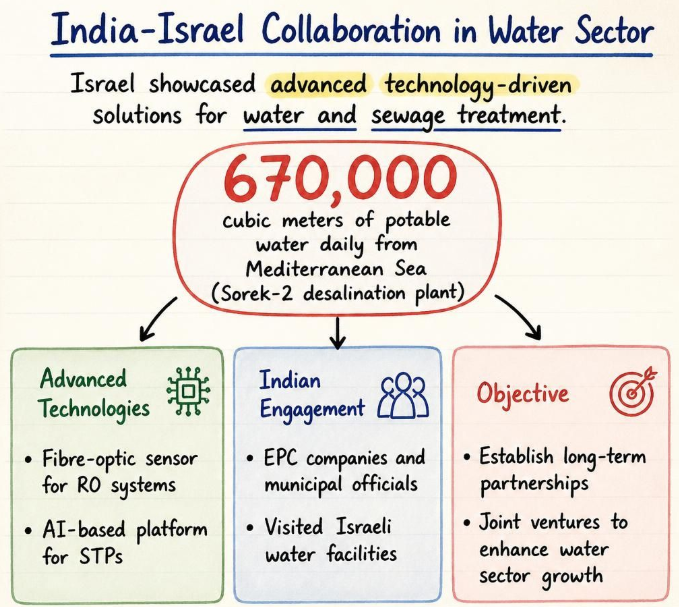
सोरेक-2 रिवर्स ऑस्मोसिस से भूमध्य सागर के पानी से प्रतिदिन लगभग 6,70,000 घन मीटर पेयजल बनाता है।
Sorek-2 uses reverse osmosis to produce about 670,000 cubic metres of drinking water a day from Mediterranean seawater. (Source: Indian Express)
These notes are not in the language you chose, so they are shown as written.
Source: The Hindu
Why in News?
- The self-enumeration portal for Census 2027 briefly displayed 287 entries under the ‘Other’ religions category, including ISKCON, Sarna, Shia and Pentecostal.
- The drop-down menu was subsequently removed following queries raised with the Union Home Ministry.
- The government clarified that these were predictive-text entries intended to assist enumerators and were not official classifications of new religions.
Key Developments
- The self-enumeration portal went live on 16 November 2026 for Uttar Pradesh, Uttarakhand, Goa and Punjab, with nationwide access planned for January 2027.
- The expanded list was a new development, as previous censuses generally tabulated such responses after enumeration.
- The Registrar General and Census Commissioner of India clarified that respondents can write any religion under the ‘Others’ category, consistent with previous practices.
Religious categories in the Census
The Census traditionally records six major religious communities separately:
| Major religious categories | Other category |
|---|---|
| Hindu, Muslim, Christian, Sikh, Buddhist and Jain | Other Religions and Persuasions |
- The ‘Other’ category allows individuals belonging to smaller religious communities and indigenous faiths to identify their beliefs.
- It helps document India's religious and cultural diversity and provides data for policy formulation and cultural preservation.
Demand for a Separate Sarna Religion Code
- Several tribal communities have demanded a separate Census code for Adivasi faiths, particularly the Sarna religion.
- They argue that Sarna represents a distinct indigenous belief system and should not be subsumed under existing religious categories.
- The Jharkhand Assembly passed a resolution in 2020 seeking a separate Sarna code.
- The Chief Minister of Jharkhand has also urged the Union Government to recognise it.
About Sarna Religion
- Followed by several tribal communities, particularly in Jharkhand, Odisha and West Bengal.
- Centres on nature worship, sacred groves and reverence for natural elements.
- According to the supplied article, approximately 5 million people identified as Sarna under the ‘Other’ category in the 2011 Census.
Self-Enumeration in Census 2027
- Census 2027 introduces an online self-enumeration mechanism through which households can submit demographic information digitally before a mandatory visit by a census enumerator.
- It aims to improve convenience and facilitate data collection.
| Feature | Details |
|---|---|
| Census authority | Registrar General and Census Commissioner of India |
| Mechanism | Online self-enumeration |
| Respondents | Households |
| Subsequent process | Mandatory enumerator visit |
| Purpose | Facilitate demographic data collection |
Issues and Challenges
- Recognition of indigenous faiths: Lack of separate codes may affect the visibility of tribal religious identities.
- Classification difficulties: Distinguishing between religions, denominations, sects and religious persuasions can be complex.
- Data comparability: Changes in classification can affect comparisons between Census years.
- Community representation: Census categories should allow individuals to accurately record their self-identified beliefs.
- Administrative clarity: Clear guidelines are needed to distinguish predictive-text suggestions from official Census classifications.
Source: The Hindu
Why in News?
Global health leaders have emphasised integrating water infrastructure with public health strategies. Wastewater surveillance and AI are emerging as tools for early detection of infectious diseases.
Key Facts
- Global polio cases have declined by over 99% since 1988, mainly due to vaccination and surveillance.
- In 2024, 2.1 billion people lacked safely managed drinking water and 3.4 billion lacked safely managed sanitation.
- Unsafe water and sanitation contributed to 1.4 million preventable deaths in 2019.
- Afghanistan and Pakistan remain polio-endemic countries, with resurgences reported in 2024.
Water as Preventive Health Infrastructure
- Contaminated water facilitates the transmission of polio and other infectious diseases.
- Safe drinking water prevents exposure to pathogens, while proper sanitation breaks disease transmission chains.
- Integrating water, sanitation and healthcare policies can strengthen disease prevention, particularly in underserved communities.
Wastewater Surveillance and AI
- Wastewater surveillance involves testing sewage to detect pathogens circulating within communities.
- It can identify disease transmission before large numbers of clinical cases emerge.
- AI can analyse surveillance data, identify patterns and support early-warning systems.
| Initiative | Significance |
| Abu Dhabi wastewater surveillance | Demonstrates wastewater-based pathogen monitoring |
| European Wastewater Surveillance Dashboard (2025) | Supports tracking of pathogens through wastewater data |
| AI-based surveillance | Enables faster analysis and outbreak prediction |
Global Initiatives
- Reaching the Last Mile Fund: Established by the UAE and the Gates Foundation to combat polio and neglected tropical diseases, particularly among underserved communities.
- UN Water Conference 2026: To be co-hosted by the UAE and Senegal in Abu Dhabi, focusing on accelerating action towards SDG 6.
- SDG 6: Ensure availability and sustainable management of water and sanitation for all.
Challenges and Way Forward
- Inadequate drinking water and sanitation infrastructure, particularly in remote areas.
- Persistent polio transmission in Afghanistan and Pakistan.
- Fragmented coordination between water, sanitation and public health programmes.
- Limited funding for infrastructure and disease surveillance.
Way Forward:
- Integrate water infrastructure investment with public health programmes.
- Expand wastewater surveillance and AI-based early-warning systems.
- Strengthen vaccination and sanitation in polio-endemic regions.
- Improve access to safe water, especially for underserved communities.
- Promote international cooperation and sustainable financing.
Source: IE
Why in News?
Israel showcased advanced water and sewage treatment technologies to an Indian delegation, aiming to establish long-term partnerships and joint ventures in water management.
Technologies Showcased
An Indian delegation of EPC companies and municipal officials visited Israeli water facilities and the 12th Kinneret Water Conference.
| Technology | Application |
| Fibre-optic sensors (Perciv) | Work like an MRI for Reverse Osmosis (RO) membranes, diagnosing faults and monitoring system efficiency to prevent breakdowns. |
| AI-based STP platform (Majji) | Uses AI, data and microscopic videos to optimise secondary wastewater treatment and detect issues such as foaming. |
| Trenchless Automated Leakage Repair (TALR) – Curapipe | Detects and automatically seals leaks in water infrastructure. |
| Sorek-2 desalination plant | Uses RO technology to produce 670,000 cubic metres of potable water daily from Mediterranean seawater. |
Major Pillars of India-Israel Cooperation
Rural Water Management – Bundelkhand Project
- Uttar Pradesh and Israel are implementing a water-management project in drought-prone Bundelkhand, particularly around Jhansi.
- The Gangawali village pilot (2024–2026) demonstrates SCADA-based automated water delivery, solar-powered pumping and geomembrane-lined reservoirs.
- The project is being expanded to 24 neighbouring villages downstream of the Pahuj Canal.
- Farmers are trained in water budgeting and crop planning according to water availability, following the principle of "More Crop per Drop".
Urban Water Management – Centre of Water Technology
- The India-Israel Centre of Water Technology (CoWT) was established at IIT Madras in August 2024.
- It involves the Embassy of Israel, IIT Madras and the AMRUT Mission under the Ministry of Housing and Urban Affairs.
- It focuses on adapting Israeli technologies for Indian cities, including 24×7 water supply and smart leak detection.
- An important objective is reducing Non-Revenue Water (NRW), i.e. water lost through leakage, theft and distribution inefficiencies.
Agricultural Cooperation – Centres of Excellence
- Under the Indo-Israel Agriculture Project (IIAP), more than 30 operational Centres of Excellence (CoEs) have been established across 12+ states.
- They promote high-quality seedlings, drip irrigation and fertigation (application of fertilisers through irrigation water).
- These technologies improve water-use efficiency and are demonstrated to local farmers.
Other Areas of Cooperation
| Area | Significance |
| Desalination | Potential application in coastal regions and islands; a major G2G project has been identified for Lakshadweep. |
| Wastewater reuse | Israel recycles around 90% of its wastewater; India is promoting treated wastewater for industrial use and irrigation. |
| Digital water management | AI and IoT enable real-time monitoring of water flow, leakage and pipe bursts. |
Significance for India
- Strengthens water security through desalination and advanced treatment technologies.
- Improves agricultural water efficiency and supports drought-prone regions.
- Reduces urban water losses through smart monitoring and leakage detection.
- Promotes wastewater recycling and reduces pressure on freshwater resources.
- Encourages technology transfer, joint ventures and institutional cooperation.
Key Fact: According to the supplied article, India is the only country where Israel has appointed a dedicated Water Attaché for bilateral water-sector cooperation.
UPSC Prelims MCQ
Q.Consider the following statements:
- Reverse Osmosis is used for desalination.
- Fertigation involves supplying fertilisers through irrigation water.
- Non-Revenue Water includes losses due to leakage in distribution systems.
Which of the statements are correct?
(a) 1 and 2 only
(b) 2 and 3 only
(c) 1 and 3 only
(d) 1, 2 and 3
Answer: (d)
UPSC Mains Question:
Q.Discuss the significance of India-Israel cooperation in water management. How can technology transfer improve India's rural and urban water security?
Source: IE
Why in News?
Prime Minister Narendra Modi is attending the ASEAN-India Summit and East Asia Summit in Manila amid changing geopolitical dynamics in Asia, including China's growing assertiveness, uncertainty over US security commitments and closer China-Russia relations.
Changing Geopolitical Landscape in Asia
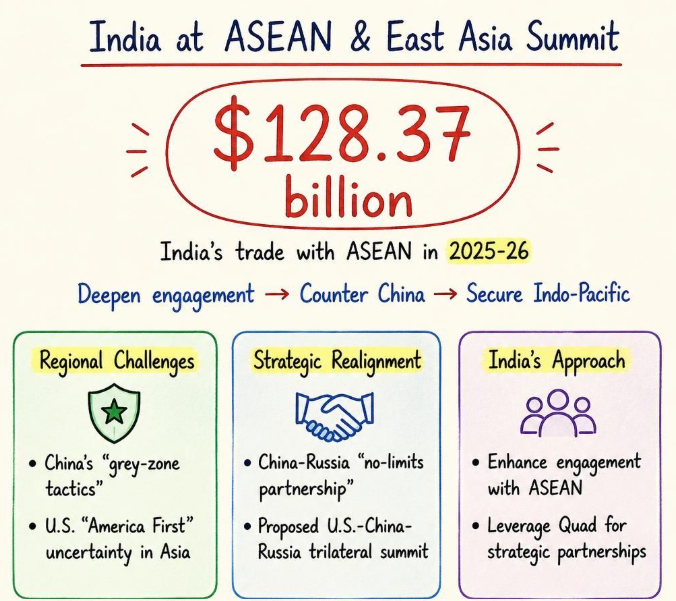
- China's assertiveness: China's military and economic coercion, along with grey-zone tactics, pose challenges to regional stability and maritime security.
- US policy uncertainty: The America First doctrine and the US military focus on Eastern Europe and West Asia have created uncertainty about its traditional security commitments in Asia.
- China-Russia partnership: Their growing "no-limits partnership" is changing global power dynamics.
- Proposed trilateral engagement: A potential US-China-Russia trilateral summit adds another dimension to the changing geopolitical environment.
|
The ASEAN-India Summit serves as the highest-level institutional mechanism for dialogue between India and the Association of Southeast Asian Nations (ASEAN), anchoring India's Act East Policy. As of November 2026, Prime Minister Narendra Modi is participating in the 23rd ASEAN-India Summit and the 21st East Asia Summit in Manila, Philippines. This engagement is pivotal as both sides are currently observing 2026 as the ASEAN-India Year of Maritime Cooperation. 🚀 Recent Developments & Outcomes (2025-2026) • Year of Maritime Cooperation (2026): Designated to enhance the "Blue Economy" and security, featuring the second ASEAN-India Maritime Exercise (AIME) off the Philippine coast. • Plan of Action (2026-2030): A new strategic roadmap adopted in July 2025 that aligns the Comprehensive Strategic Partnership (CSP) with the ASEAN 2045: Our Shared Future framework. • Digital Public Infrastructure (DPI): Significant focus on exporting India's "Digital Stack," fintech collaboration, and payment system linkages (like UPI-based cross-border payments). • Year of Tourism (2025): A $5 million fund was operationalized to boost people-to-people connectivity and sustainable tourism. |
Importance of ASEAN for India
- ASEAN-India and East Asia Summits provide platforms for India to engage with countries across the rapidly changing Asian landscape.
- India's trade with ASEAN reached US$128.37 billion in 2025–26, considerably lower than ASEAN-China trade, which exceeds US$1 trillion.
- Deeper engagement with ASEAN is important for:
- Expanding trade and economic cooperation.
- Countering China's growing regional influence.
- Strengthening maritime security.
- Diversifying global supply chains.
Role of the Quad
- The Quad comprises India, the United States, Japan and Australia.
- It provides a platform for strategic cooperation among countries sharing concerns about China's expansionism.
|
The Evolution of the Quad The grouping's history is often divided into two distinct phases, reflecting the changing threat perceptions in the region. 1. Quad 1.0 (2004–2008): Emerged from the Tsunami Core Group (2004). It was formally proposed by Japanese PM Shinzo Abe in 2007 but collapsed in 2008 after Australia withdrew to avoid antagonizing China. 2. Quad 2.0 (2017–Present): Revived on the sidelines of the ASEAN summit in Manila. It was elevated to the Leaders' Summit level in 2021, signaling a major upgrade in institutional commitment. |
- Cooperation includes:
- Maritime security.
- Critical and emerging technologies.
- Climate change.
- Cybersecurity.
- Continued ministerial consultations help strengthen India's strategic partnerships in the Indo-Pacific.
India's Strategic Priorities
- Promote a peaceful, prosperous and resilient Indo-Pacific.
- Strengthen ASEAN engagement to improve economic and security cooperation.
- Use the Quad to deepen partnerships with the US, Japan and Australia.
- Enhance maritime capabilities and regional connectivity.
- Maintain strategic flexibility amid great-power rivalries.
- Support a stable regional order while strengthening India's national capabilities.
Key Organisations and Groupings
| Grouping | Members / Significance |
| ASEAN | Association of Southeast Asian Nations; promotes regional cooperation. |
| East Asia Summit (EAS) | Forum for dialogue on regional political, security and economic issues. |
| ASEAN-India Summit | Platform for strengthening India's engagement with ASEAN. |
| Quad | India, US, Japan and Australia; cooperation on strategic and regional issues. |
UPSC Prelims MCQ
Q.Consider the following statements:
- The Quad comprises India, the United States, Japan and Australia.
- ASEAN-China trade exceeds US$1 trillion, according to the supplied article.
- The Quad's cooperation is limited exclusively to military security.
Which of the statements given above are correct?
(a) 1 and 2 only
(b) 2 and 3 only
(c) 1 and 3 only
(d) 1, 2 and 3
Answer: (a)
Explanation: Quad cooperation also covers technology, climate, maritime issues and cybersecurity.
UPSC Mains Question
Q.Examine the significance of ASEAN and the Quad in advancing India's strategic interests in the Indo-Pacific amid growing geopolitical competition.
Source: IE
Why in News?
The Forum for People's Collective Efforts (FPCE), a homebuyers' organisation, has urged the government to introduce significant reforms in the Real Estate (Regulation and Development) Act, 2016 (RERA), citing gaps in protecting homebuyers' interests. Following its representation to the Prime Minister, officials from the Cabinet Secretariat held discussions with FPCE representatives on the proposed reforms.
Background: About RERA Act, 2016
- Objective: To regulate the real estate sector, protect homebuyers and promote transparency, accountability and timely completion of projects.
- Implementation: Provides for the establishment of Real Estate Regulatory Authorities (RERAs) and Real Estate Appellate Tribunals in States and Union Territories.
- Key Provision: Section 18 provides for refund and compensation when a promoter fails to complete or deliver a project as agreed or is unable to give possession.
Major Reforms Proposed by FPCE
- Transfer of Consumer Protection: Shift homebuyer protection responsibilities from the Ministry of Housing and Urban Affairs (MoHUA) to the Department of Consumer Affairs to strengthen the consumer-centric approach.
- National Appellate Tribunal: Establish a National Appellate Tribunal for Real Estate, replacing existing State Appellate Tribunals, to ensure uniform interpretation of RERA provisions across States. It may be modelled on the National Company Law Appellate Tribunal (NCLAT).
- Statutory Status to Agreement for Sale (AFS): Include the Agreement for Sale in a Schedule to the RERA Act, giving it statutory recognition and making its provisions legally binding.
- Statutory Exit Option: Introduce an exit mechanism allowing homebuyers to withdraw from projects due to personal hardships, such as job loss or the death of an earning family member, with a defined refund mechanism.
- Automatic Compensation: Empower RERA to proactively calculate and disburse compensation for delayed or deficient projects instead of requiring individual homebuyers to file complaints. Promoters would submit allottee lists to facilitate direct disbursement.
Significance of Proposed Reforms
- Strengthens institutional accountability and consumer protection in the real estate sector.
- Reduces litigation and procedural delays for homebuyers.
- Promotes uniformity in the interpretation and implementation of RERA across States.
- Addresses situations where genuine personal hardships prevent buyers from continuing with property purchases.
- Improves transparency and builds confidence among homebuyers and investors.
Conclusion
The proposed RERA reforms seek to shift the regulatory framework towards stronger, proactive homebuyer protection. Their implementation could improve accountability, reduce disputes and strengthen confidence in India's real estate sector.