
स्रोत के अनुसार, कौन-से दो देश अब भी पोलियो-स्थानिक (endemic) हैं?
According to the source, which two countries remain polio-endemic?
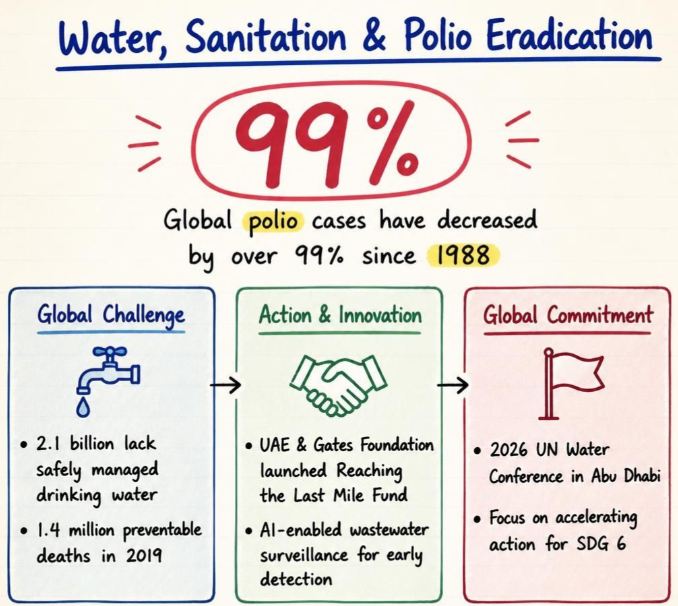
अफ़ग़ानिस्तान और पाकिस्तान पोलियो-स्थानिक हैं, जहाँ 2024 में मामलों का पुनरुत्थान देखा गया। 1988 से वैश्विक पोलियो मामलों में 99% से अधिक कमी आई है।
Afghanistan and Pakistan remain polio-endemic, with resurgences reported in 2024. Global polio cases have fallen by over 99% since 1988. (Source: The Hindu)
स्रोत के अनुसार, 2024 में विश्व में कितने लोगों के पास सुरक्षित रूप से प्रबंधित स्वच्छता (sanitation) नहीं थी?
According to the source, how many people worldwide lacked safely managed sanitation in 2024?
2024 में 3.4 अरब लोगों के पास सुरक्षित स्वच्छता और 2.1 अरब के पास सुरक्षित पेयजल नहीं था। 2019 में असुरक्षित जल और स्वच्छता से 14 लाख रोकी जा सकने वाली मौतें हुईं।
In 2024, 3.4 billion people lacked safely managed sanitation and 2.1 billion lacked safe drinking water. Unsafe water and sanitation caused 1.4 million preventable deaths in 2019. (Source: The Hindu)
संयुक्त राष्ट्र जल सम्मेलन 2026 की सह-मेज़बानी कौन-से दो देश करेंगे?
Which two countries will co-host the UN Water Conference 2026?
UAE और सेनेगल अबू धाबी में इसकी सह-मेज़बानी करेंगे। सम्मेलन का फोकस SDG 6 (सबके लिए जल और स्वच्छता) की दिशा में तेज़ कार्रवाई पर है।
The UAE and Senegal will co-host it in Abu Dhabi. It focuses on accelerating action on SDG 6 (water and sanitation for all). (Source: The Hindu)
अपशिष्ट जल निगरानी (wastewater surveillance) का मुख्य लाभ क्या है?
What is the main advantage of wastewater surveillance?
सीवेज की जाँच से समुदाय में फैल रहे रोगाणु पहले ही पकड़े जा सकते हैं। AI इन आँकड़ों का विश्लेषण कर पूर्व-चेतावनी प्रणाली को मज़बूत करता है।
Testing sewage can detect pathogens circulating in a community early. AI can analyse this data and strengthen early-warning systems. (Source: The Hindu)
These notes are not in the language you chose, so they are shown as written.
Source: The Hindu
Why in News?
Global health leaders have emphasised integrating water infrastructure with public health strategies. Wastewater surveillance and AI are emerging as tools for early detection of infectious diseases.
Key Facts
- Global polio cases have declined by over 99% since 1988, mainly due to vaccination and surveillance.
- In 2024, 2.1 billion people lacked safely managed drinking water and 3.4 billion lacked safely managed sanitation.
- Unsafe water and sanitation contributed to 1.4 million preventable deaths in 2019.
- Afghanistan and Pakistan remain polio-endemic countries, with resurgences reported in 2024.
Water as Preventive Health Infrastructure
- Contaminated water facilitates the transmission of polio and other infectious diseases.
- Safe drinking water prevents exposure to pathogens, while proper sanitation breaks disease transmission chains.
- Integrating water, sanitation and healthcare policies can strengthen disease prevention, particularly in underserved communities.
Wastewater Surveillance and AI
- Wastewater surveillance involves testing sewage to detect pathogens circulating within communities.
- It can identify disease transmission before large numbers of clinical cases emerge.
- AI can analyse surveillance data, identify patterns and support early-warning systems.
| Initiative | Significance |
| Abu Dhabi wastewater surveillance | Demonstrates wastewater-based pathogen monitoring |
| European Wastewater Surveillance Dashboard (2025) | Supports tracking of pathogens through wastewater data |
| AI-based surveillance | Enables faster analysis and outbreak prediction |
Global Initiatives
- Reaching the Last Mile Fund: Established by the UAE and the Gates Foundation to combat polio and neglected tropical diseases, particularly among underserved communities.
- UN Water Conference 2026: To be co-hosted by the UAE and Senegal in Abu Dhabi, focusing on accelerating action towards SDG 6.
- SDG 6: Ensure availability and sustainable management of water and sanitation for all.
Challenges and Way Forward
- Inadequate drinking water and sanitation infrastructure, particularly in remote areas.
- Persistent polio transmission in Afghanistan and Pakistan.
- Fragmented coordination between water, sanitation and public health programmes.
- Limited funding for infrastructure and disease surveillance.
Way Forward:
- Integrate water infrastructure investment with public health programmes.
- Expand wastewater surveillance and AI-based early-warning systems.
- Strengthen vaccination and sanitation in polio-endemic regions.
- Improve access to safe water, especially for underserved communities.
- Promote international cooperation and sustainable financing.