
10 नवंबर को लिथियम-आयन बैटरी 'ब्लैक मास' के निर्यात पर प्रतिबंध किस संस्था ने लगाया?
Which body prohibited the export of lithium-ion battery 'black mass' on November 10?
DGFT ने ब्लैक मास को 'Free' श्रेणी से हटाकर 'Prohibited' श्रेणी में डाल दिया, ताकि बैटरी-रीसाइक्लिंग की कीमती सामग्री देश में ही रहे।
The DGFT shifted black mass from the 'Free' to the 'Prohibited' category so that valuable battery-recycling material stays within India. (Source: Indian Express)
'ब्लैक मास' मुख्य रूप से किससे प्राप्त होता है?
'Black mass' is mainly obtained from which of the following?
ब्लैक मास एक मध्यवर्ती पदार्थ है जो पुरानी लिथियम-आयन बैटरियों और बैटरी निर्माण के स्क्रैप को तोड़कर और संसाधित करके मिलता है।
Black mass is an intermediate material obtained by shredding and processing spent lithium-ion batteries and battery-manufacturing scrap. (Source: Indian Express)
बैटरी ब्लैक मास के संबंध में निम्नलिखित कथनों पर विचार कीजिए:
1. इसमें लिथियम, निकल, कोबाल्ट, मैंगनीज और ग्रेफाइट जैसी सामग्री होती है।
2. नए आदेश में इसे 'Free' से 'Restricted' श्रेणी में डाला गया है।
3. बैटरी अपशिष्ट प्रबंधन नियम वर्ष 2022 के हैं।
उपर्युक्त में से कौन-से कथन सही हैं?
Consider the following statements about battery black mass:
1. It contains materials such as lithium, nickel, cobalt, manganese and graphite.
2. The new order moved it from the 'Free' to the 'Restricted' category.
3. The Battery Waste Management Rules date from 2022.
Which of the statements given above are correct?
कथन 2 गलत है: ब्लैक मास को 'Prohibited' (प्रतिबंधित) श्रेणी में डाला गया है, 'Restricted' में नहीं। कथन 1 और 3 सही हैं।
Statement 2 is wrong: black mass was moved to the 'Prohibited' category, not 'Restricted'. Statements 1 and 3 are correct. (Source: Indian Express)
बैटरी रीसाइक्लिंग को बढ़ावा देने के लिए किसके लिए 'न्यूनतम मूल्य' (floor price) तय करने का सुझाव दिया गया है?
To promote battery recycling, a floor price has been suggested for which of the following?
EPR प्रमाणपत्रों का कम मूल्यांकन बैटरी अपशिष्ट प्रबंधन नियम, 2022 को लागू करने में बड़ी चुनौती है। न्यूनतम मूल्य से खनिज-पुनर्प्राप्ति की वास्तविक लागत झलकेगी।
Undervalued EPR certificates are a major hurdle for the Battery Waste Management Rules, 2022. A floor price would reflect the real cost of mineral recovery. (Source: Indian Express)
गहरे समुद्र की पनडुब्बी 'मत्स्य-6000' किस संस्थान ने ISRO के सहयोग से विकसित की है?
Which institute developed the deep-ocean submersible Matsya-6000 in collaboration with ISRO?
मत्स्य-6000 को NIOT, चेन्नई ने ISRO के साथ मिलकर बनाया है। ISRO के VSSC और LPSC ने टाइटेनियम पर्सनल स्फीयर के डिज़ाइन और निर्माण में योगदान दिया।
Matsya-6000 was developed by NIOT, Chennai, with ISRO. ISRO's VSSC and LPSC helped design and fabricate its titanium personnel sphere. (Source: Indian Express)
भारत की समुद्रयान परियोजना के संबंध में निम्नलिखित कथनों पर विचार कीजिए:
1. मत्स्य-6000 को तीन एक्वानॉट ले जाने के लिए बनाया गया है।
2. इसे पृथ्वी विज्ञान मंत्रालय के अंतर्गत NIOT विकसित कर रहा है।
3. इसका लक्ष्य 6,000 मीटर तक की गहराई का अन्वेषण है।
4. इसका पर्सनल स्फीयर एल्युमिनियम मिश्रधातु से बना है।
उपर्युक्त में से कौन-से कथन सही हैं?
With reference to India's Samudrayaan Project, consider the following statements:
1. Matsya-6000 is designed to carry three aquanauts.
2. It is being developed by NIOT under the Ministry of Earth Sciences.
3. It aims to explore ocean depths of up to 6,000 metres.
4. Its personnel sphere is made of aluminium alloy.
Which of the statements given above are correct?
कथन 4 गलत है: 2.1 मीटर व्यास का पर्सनल स्फीयर उच्च-शक्ति टाइटेनियम मिश्रधातु से बना है, जो लगभग 600 bar दबाव सह सकता है।
Statement 4 is wrong: the 2.1-metre personnel sphere is made of high-strength titanium alloy and withstands about 600 bar of pressure. (Source: Indian Express)
आपात स्थिति में मत्स्य-6000 की जीवन-रक्षक प्रणाली अधिकतम कितने समय तक चल सकती है?
For how long can Matsya-6000's emergency life-support system last at most?
सामान्य संचालन 12 घंटे का है, जबकि आपातकालीन जीवन-रक्षा 96 घंटे तक उपलब्ध है। 500 मीटर का परीक्षण गोता 2027 की शुरुआत में बंगाल की खाड़ी में प्रस्तावित है।
Normal endurance is 12 hours, while emergency life support lasts up to 96 hours. A 500-metre trial dive is planned in the Bay of Bengal in early 2027. (Source: Indian Express)
मध्य हिंद महासागर बेसिन (CIOB) में पॉलीमेटैलिक नोड्यूल्स के अन्वेषण का भारत का विशेष अनुबंध किस संस्था से मिला है?
From which body does India hold an exclusive contract to explore polymetallic nodules in the Central Indian Ocean Basin (CIOB)?
ISA से मिला यह अनुबंध लगभग 75,000 वर्ग किमी क्षेत्र का है। इन नोड्यूल्स में कोबाल्ट, निकल, तांबा और मैंगनीज होते हैं। डीप ओशन मिशन 2021 में ₹4,077 करोड़ के बजट के साथ शुरू हुआ था।
The ISA contract covers about 75,000 sq km. These nodules contain cobalt, nickel, copper and manganese. The Deep Ocean Mission began in 2021 with a budget of ₹4,077 crore. (Source: Indian Express)
लोक प्रशासन में उत्कृष्टता के लिए प्रधानमंत्री पुरस्कार 2026 का वेब पोर्टल किस विभाग ने शुरू किया?
Which department launched the web portal for the Prime Minister's Awards for Excellence in Public Administration 2026?
DARPG ने 13 नवंबर 2026 को पोर्टल शुरू किया। यह विभाग कार्मिक, लोक शिकायत और पेंशन मंत्रालय के अंतर्गत आता है।
DARPG launched the portal on November 13, 2026. It works under the Ministry of Personnel, Public Grievances and Pensions. (Source: Indian Express)
लोक प्रशासन में उत्कृष्टता के लिए प्रधानमंत्री पुरस्कार किस वर्ष शुरू किए गए थे?
In which year were the Prime Minister's Awards for Excellence in Public Administration introduced?
ये पुरस्कार 2006 में शुरू हुए। 2026 के पुरस्कारों की मूल्यांकन अवधि 1 अप्रैल 2024 से 30 नवंबर 2026 तक है।
The awards were introduced in 2006. The assessment period for the 2026 awards runs from April 1, 2024 to November 30, 2026. (Source: Indian Express)
These notes are not in the language you chose, so they are shown as written.
Source: IE
GS3: Economy | Environment | Science & Technology
Why in News?
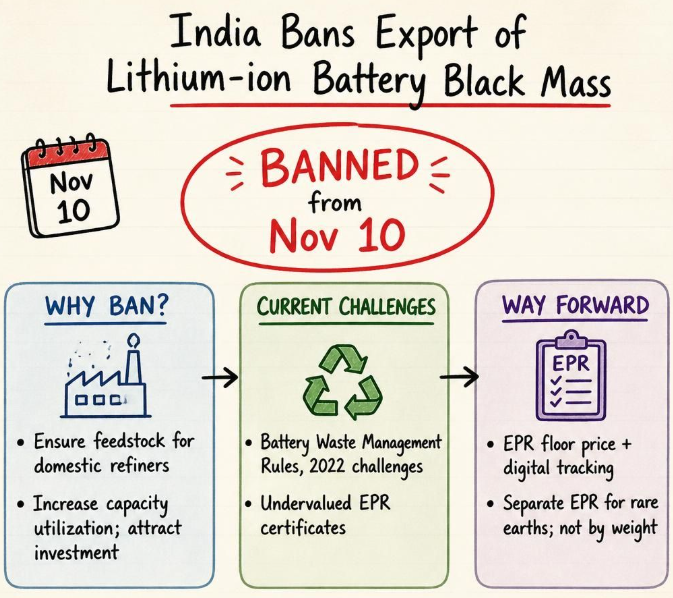
- On November 10, the Directorate General of Foreign Trade (DGFT) prohibited the export of lithium-ion battery black mass by shifting it from the 'Free' to the 'Prohibited' category.
- The move aims to retain valuable battery-recycling materials within India and strengthen domestic recovery of critical minerals.
What is Battery Black Mass?
- Black mass is an intermediate material obtained by shredding and processing spent lithium-ion batteries and battery-manufacturing scrap.
- It contains valuable materials such as lithium, nickel, cobalt, manganese and graphite.
- These materials can be recovered through specialised chemical processing and reused in battery manufacturing.
Objectives of the Export Ban
- Domestic Feedstock: Ensure a steady supply of black mass for Indian recyclers and refiners.
- Capacity Utilisation: Improve the utilisation of domestic recycling facilities.
- Investment: Attract investment in battery recycling and critical-mineral recovery.
- Import Dependence: Reduce India's dependence on imported critical minerals used in battery manufacturing.
Challenges in India's Battery Recycling Ecosystem
- Limited Processing Capacity: Lithium-ion battery recycling is still emerging, with only a few dozen licensed operators, unlike the established lead-acid battery recycling sector.
- Risk of Dumping: Export restrictions alone cannot create a recycling ecosystem. Without adequate downstream processing capacity, accumulated black mass could lead to dumping.
- Undervalued EPR Certificates: Battery Waste Management Rules, 2022, face implementation challenges due to undervaluation of Extended Producer Responsibility (EPR) certificates.
- Insufficient Downstream Investment: Specialised chemical-processing units are needed to recover minerals and supply inputs directly to domestic battery manufacturers.
Way Forward
- Develop specialised chemical-processing facilities to convert black mass into battery-grade materials.
- Introduce a floor price for EPR certificates to reflect the actual cost of mineral recovery and incentivise high-yield recycling.
- Establish digital tracking systems to prevent fake or merely paper-based compliance.
- Strengthen policy support and investment across the battery-recycling value chain.
Source: IE
Why in News?
- India's indigenously developed deep-ocean submersible Matsya-6000 is scheduled to undergo a 500-metre trial dive in the Bay of Bengal in early 2027.
- The trial is an important step towards the Samudrayaan Project, which aims to send three aquanauts (human explorers) to a depth of 6,000 metres.
- The project is part of India's Deep Ocean Mission (DOM), under the Ministry of Earth Sciences (MoES).
Samudrayaan Project and Matsya-6000
Samudrayaan is India's first manned deep-ocean exploration mission.
- Developed by: National Institute of Ocean Technology (NIOT), Chennai, in collaboration with ISRO.
- Objective: Develop indigenous human-submersible technology for deep-sea exploration and resource assessment.
- Capacity: Three aquanauts.
- Target depth: 6,000 metres.
Technical Features of Matsya-6000
| Feature | Details |
|---|---|
| Personnel sphere | 2.1-metre diameter |
| Material | High-strength titanium alloy |
| Maximum depth | 6,000 metres |
| Pressure resistance | Approximately 600 bar |
| Normal endurance | 12 hours |
| Emergency life support | Up to 96 hours |
| Operating temperature | As low as -3°C |
- Titanium alloy: Provides high strength-to-weight ratio, corrosion resistance and durability under extreme underwater pressure.
- ISRO contribution: Vikram Sarabhai Space Centre (VSSC) and Liquid Propulsion Systems Centre (LPSC) contributed to the design and fabrication of the titanium personnel sphere, including advanced electron beam welding techniques.
- Two aquanauts from NIOT are undergoing training for the mission.
Deep Ocean Mission (DOM)
- Launched in 2021 by the Ministry of Earth Sciences.
- Budget: ₹4,077 crore for five years.
- It aims to strengthen India's deep-sea exploration and technological capabilities.
Major focus areas:
- Development of manned submersible technology.
- Deep-sea mining technology.
- Ocean climate change advisory services.
- Deep-sea biodiversity exploration.
- Development of technologies for sustainable ocean-resource utilisation.
Strategic and Economic Significance
- Blue Economy: Supports the sustainable use of ocean resources for economic development.
- Critical minerals: Enables exploration of polymetallic nodules containing cobalt, nickel, copper and manganese, which are important for batteries and renewable-energy technologies.
- Central Indian Ocean Basin (CIOB): India holds an exclusive exploration contract from the International Seabed Authority (ISA) covering approximately 75,000 sq. km. for polymetallic nodules.
Trial and Future Roadmap
- Early 2027: Planned 500-metre trial dive to test buoyancy, stability and life-support systems.
- 2028: Target for the full-depth manned dive to 6,000 metres, according to the supplied material.
Conclusion
Samudrayaan represents an important step in India's deep-ocean exploration capabilities. Matsya-6000 can strengthen scientific research, access to critical seabed resources and technological self-reliance while supporting India's Blue Economy objectives.
UPSC Prelims Practice
Q.With reference to India's Samudrayaan Project, consider the following statements:
- Matsya-6000 is designed to carry three aquanauts.
- The project is being developed by NIOT under the Ministry of Earth Sciences.
- It aims to explore ocean depths of up to 6,000 metres.
- Its personnel sphere is made of aluminium alloy.
Which of the statements given above are correct?
(a) 1 and 2 only
(b) 1, 2 and 3 only
(c) 2, 3 and 4 only
(d) 1, 2, 3 and 4
Answer: (b) 1, 2 and 3 only.
UPSC Mains Practice
Q.Discuss the significance of India's Deep Ocean Mission in strengthening the Blue Economy, exploring critical mineral resources and achieving technological self-reliance. (15 Marks)
Source: IE
Why in News?
- The Department of Administrative Reforms and Public Grievances (DARPG) launched the web portal for the Prime Minister’s Awards for Excellence in Public Administration 2026 on November 13, 2026, initiating the registration process.
About the Awards
- Introduced in 2006, the awards recognise excellence, innovation and effective implementation of government programmes in public administration.
- They aim to promote good governance, improve public service delivery and encourage replication of successful administrative practices.
- The assessment period for the 2026 awards is April 1, 2024, to November 30, 2026.
Key Features and Categories
| Feature | Details |
| Total awards | 16 |
| Assessment period | April 1, 2024 – November 30, 2026 |
| Holistic Development of Districts | Revamped category with 9 new schemes and 3 schemes continued from 2025 |
| Aspirational Blocks | Dedicated category covering 513 blocks across 331 districts |
| Award components | Trophy, Scroll and ₹20 lakh incentive |
| Incentive utilisation | Public welfare projects or bridging resource gaps |
Schemes under Holistic Development of Districts
| Newly Added Schemes (2026) | Continued Schemes (2025) |
| Swachh Bharat Mission (Urban) | Har Ghar Jal Yojana |
| AMRUT | PM Surya Ghar Muft Bijli Yojana |
| PM Matsya Sampada Yojana | Saksham Anganwadi and Poshan 2.0 |
| TB Mukt Bharat Abhiyaan | |
| PM SHRI | |
| Swachh Bharat Mission (Grameen) | |
| National Mission on Natural Farming |
Note: The source mentions nine newly added schemes but names only seven.
Institutional Framework
| Aspect | Details |
|---|---|
| Nodal Department | Department of Administrative Reforms and Public Grievances (DARPG) |
| Parent Ministry | Ministry of Personnel, Public Grievances and Pensions |
| Award authority | Government of India |
Why in News?
Iran's Islamic Revolutionary Guard Corps (IRGC) claimed to have destroyed a US early-warning radar in Bahrain in a retaliatory strike following a US attack on a telecommunications tower in Sirik, southern Iran.
The incident has intensified tensions between Iran and the US in the Persian Gulf, particularly over maritime security and control of the Strait of Hormuz.
Key Developments
- IRGC's claim: Iran claimed that it targeted and destroyed a US early-warning radar facility in Bahrain.
- US response: US Central Command (CENTCOM) denied the destruction of the radar and stated that it had intercepted two one-way attack drones launched towards Bahrain.
- Iran's warning: The IRGC described the strike as a warning against what it called US interference, air operations and oil smuggling in the Strait of Hormuz.
- US military action: The US had recently conducted defensive airstrikes in southern Iran to neutralise IRGC threats to maritime traffic.
- Military escalation: Iranian officials warned of further strikes against US or Israeli forces in response to additional military actions.
Why Is Bahrain Strategically Important?
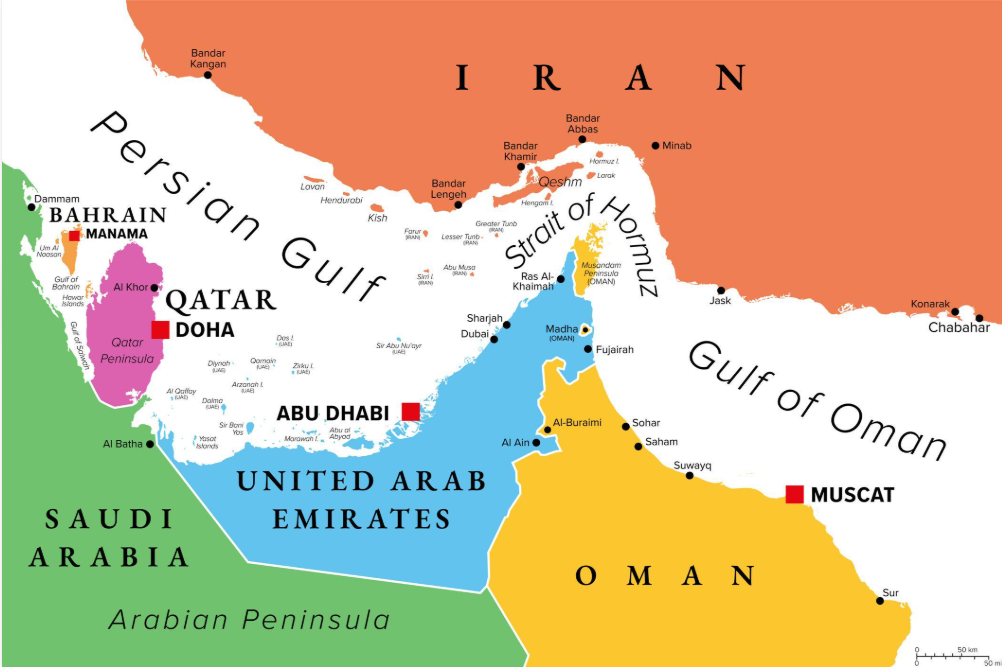
- Bahrain hosts the headquarters of the US Naval Forces Central Command (NAVCENT) and the US Fifth Fleet.
- Its geographical location in the Persian Gulf makes it strategically important for US naval operations and maritime security.
- The presence of US military infrastructure makes Bahrain significant in any escalation involving Iran and the US.
Strategic Importance of the Strait of Hormuz
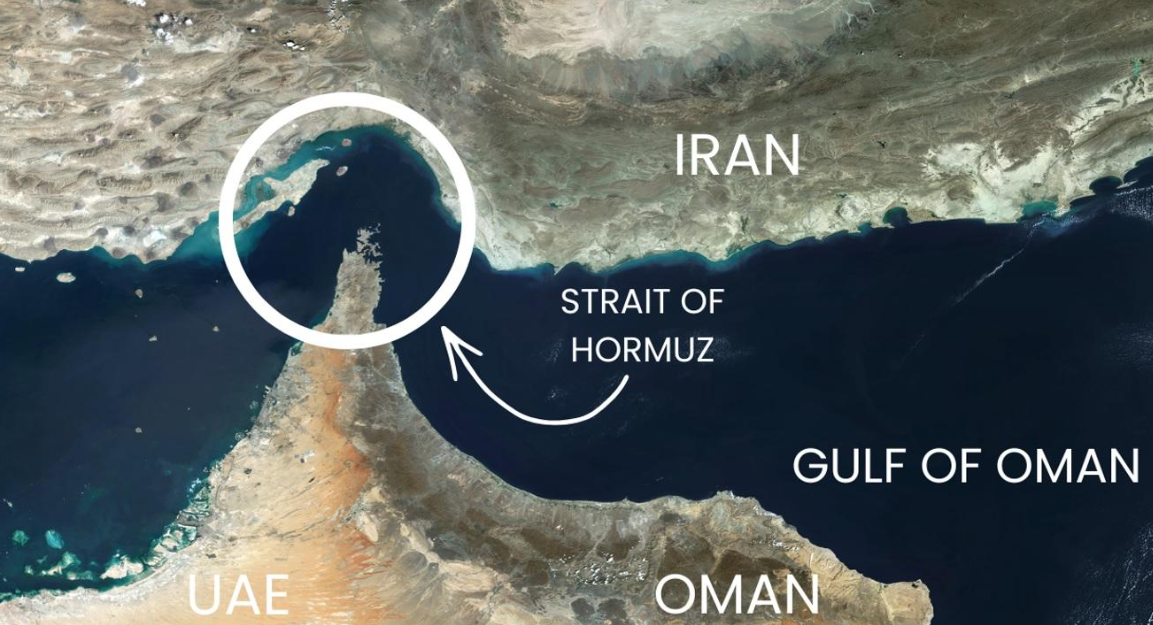
- Location: A narrow maritime passage connecting the Persian Gulf with the Gulf of Oman and the Arabian Sea.
- Geography: Lies between Iran to the north and Oman and the UAE to the south.
- Energy security: Approximately one-fifth of global oil shipments pass through this strategic chokepoint.
- Global trade: It is a critical route for international petroleum and liquefied natural gas (LNG) transportation.
- Strategic vulnerability: Any military confrontation or disruption in the strait can affect global energy supplies, shipping costs and oil prices.
Conclusion
The Iran–US confrontation highlights the strategic importance of the Strait of Hormuz in global energy security and maritime trade. Any disruption in this region can have consequences far beyond West Asia, particularly for energy-importing countries such as India. Ensuring freedom of navigation, maritime security and diplomatic de-escalation remains essential.
Why in News?
Chief Economic Advisor (CEA) V. Anantha Nageswaran highlighted that monetary policy alone may not be sufficient to control inflation caused by global supply-side disruptions. He emphasised the need for fiscal intervention and other public policy measures to address such inflationary pressures.
Key Developments
- The CEA observed that conventional monetary policy tools, particularly interest rate hikes, have limited effectiveness when inflation is driven by supply shortages.
- Excessive monetary tightening in such situations may increase economic difficulties without addressing the actual source of inflation.
- He advocated combining monetary policy with fiscal measures and other government interventions.
- He clarified that his remarks were general observations about the global economy and not a specific assessment of India's monetary policy.
Understanding Monetary Policy and Fiscal Policy
| Basis | Monetary Policy | Fiscal Policy |
| Meaning | Management of money supply, credit and interest rates in the economy. | Government's use of taxation, public expenditure and borrowing to influence the economy. |
| Authority in India | Reserve Bank of India (RBI) | Central Government |
| Main instruments | Repo rate, CRR, SLR, open market operations. | Taxation, subsidies, government spending and public investment. |
| Main objective | Price stability and supporting economic growth. | Growth, employment, redistribution and economic stability. |
Why Are Interest Rate Hikes Less Effective Against Supply-side Inflation?
Interest rate hikes are primarily designed to control demand-driven inflation rather than directly address shortages in the supply of goods and services.
|
1. Demand-side Inflation • Occurs when aggregate demand exceeds the economy's productive capacity. • Excessive consumer spending, investment and credit expansion can push prices upwards. • Increasing interest rates makes borrowing expensive and discourages consumption and investment. • Lower aggregate demand helps moderate inflation. 2. Supply-side Inflation • Arises due to disruptions in the production or availability of goods and services. • Major causes include geopolitical conflicts, supply-chain disruptions, higher crude oil prices, crop failures and rising input costs. • Increasing interest rates cannot directly increase the supply of food, fuel or raw materials. • Higher borrowing costs may further increase production expenses and discourage investment. Example: If food prices rise because of poor rainfall or crop damage, increasing the repo rate cannot increase agricultural production immediately. Measures such as improving supply chains, releasing food stocks and facilitating imports may be more effective. |
Why Is a Combination of Policies Required?
| Monetary Measures | Fiscal and Supply-side Measures |
|---|---|
| Manage inflationary expectations. | Improve the availability of essential commodities. |
| Control excessive credit and demand. | Provide targeted subsidies and tax relief where necessary. |
| Maintain price stability. | Release buffer stocks and facilitate imports. |
| Prevent excessive inflation from becoming persistent. | Address production and distribution bottlenecks. |
India's Inflation and RBI's Monetary Policy
According to the supplied report:
- India's retail inflation reached 6.09% in October, a two-year high, exceeding the RBI's upper tolerance limit of 6%.
- Inflation increased from 5.54% in September, primarily due to higher food prices.
- On October 7, 2026, the RBI increased the benchmark repo rate by 25 basis points to 6.75%, marking its first hike in nearly four years.
- The rate increase raised the possibility of further monetary policy adjustments during the financial year.
Source: IE
Why in News?
- Israeli defence company Rafael Advanced Defense Systems recently unveiled SUPER ICE, a long-range cruise missile carrying a 454 kg warhead, four times heavier than the payload of its predecessor, ICE BREAKER.
About SUPER ICE Missile
- It is a long-range cruise missile developed by Israel's Rafael Advanced Defense Systems.
- It belongs to Rafael's cruise missile family, which includes:
| Missile | Year of Introduction |
| Sea Breaker | 2021 |
| ICE BREAKER | 2023 |
| SUPER ICE | 2026 (recently unveiled) |
- Objective: Designed for long-range stand-off strikes against high-value strategic targets, military facilities and air-defence systems.
- Launch Platforms: Can be launched from aircraft, ground-based systems and naval platforms.
Key Features
| Feature | Description |
| Warhead | 454 kg warhead compatible with the US-made MK83 aerial bomb |
| Navigation | Autonomous navigation system enables low-altitude flight while following terrain |
| Target Acquisition | Electro-optical system with high-precision image-matching technology |
| Guidance | Compares images captured by onboard sensors with reference imagery to determine position and identify targets |
| GPS-denied Capability | Image matching supports navigation and targeting when satellite navigation signals are disrupted or unavailable |
| Range and Speed | Exact specifications are undisclosed; reportedly faster and longer-ranged than ICE BREAKER, which has a range of up to 300 km |
Important Technical Concepts
- Cruise Missile: A guided missile that sustains powered flight through the atmosphere and generally follows a controlled, often low-altitude flight path towards its target.
- Stand-off Strike: An attack launched from a distance that allows the launching platform to remain outside or farther from the target's air-defence threat zone.
- Electro-Optical Guidance: Uses cameras and imaging sensors to detect, recognise and guide the missile towards its intended target.
- Terrain-Following Navigation: Enables a missile to fly at low altitudes by adjusting its flight path according to the surrounding terrain.