
10 नवंबर को लिथियम-आयन बैटरी 'ब्लैक मास' के निर्यात पर प्रतिबंध किस संस्था ने लगाया?
Which body prohibited the export of lithium-ion battery 'black mass' on November 10?
DGFT ने ब्लैक मास को 'Free' श्रेणी से हटाकर 'Prohibited' श्रेणी में डाल दिया, ताकि बैटरी-रीसाइक्लिंग की कीमती सामग्री देश में ही रहे।
The DGFT shifted black mass from the 'Free' to the 'Prohibited' category so that valuable battery-recycling material stays within India. (Source: Indian Express)
'ब्लैक मास' मुख्य रूप से किससे प्राप्त होता है?
'Black mass' is mainly obtained from which of the following?
ब्लैक मास एक मध्यवर्ती पदार्थ है जो पुरानी लिथियम-आयन बैटरियों और बैटरी निर्माण के स्क्रैप को तोड़कर और संसाधित करके मिलता है।
Black mass is an intermediate material obtained by shredding and processing spent lithium-ion batteries and battery-manufacturing scrap. (Source: Indian Express)
निम्नलिखित में से कौन-सा मौद्रिक नीति का उपकरण नहीं है?
Which of the following is NOT an instrument of monetary policy?
सार्वजनिक व्यय राजकोषीय नीति का उपकरण है, जिसे केंद्र सरकार चलाती है। रेपो दर, CRR, SLR और खुले बाजार की क्रियाएँ RBI की मौद्रिक नीति के उपकरण हैं।
Public expenditure is a fiscal policy tool used by the Central Government. Repo rate, CRR, SLR and open market operations are the RBI's monetary policy tools.
ब्याज दरें बढ़ाना किस प्रकार की मुद्रास्फीति को नियंत्रित करने में सबसे अधिक प्रभावी होता है?
Raising interest rates is most effective in controlling which type of inflation?
ऊँची ब्याज दरें उधार महँगा करके उपभोग और निवेश घटाती हैं, इसलिए माँग-जनित मुद्रास्फीति पर असर करती हैं। आपूर्ति की कमी से हुई महँगाई पर इनका सीधा असर नहीं होता; मुख्य आर्थिक सलाहकार ने इसीलिए राजकोषीय उपायों को भी साथ जोड़ने की बात कही।
Higher rates make borrowing costlier and curb consumption and investment, so they act on demand-side inflation. They cannot directly fix supply shortages, which is why the Chief Economic Advisor called for fiscal measures as well.
नोट्स में दी गई रिपोर्ट के अनुसार, अक्टूबर में भारत की खुदरा मुद्रास्फीति कितनी रही?
According to the report in the notes, what was India's retail inflation in October?
अक्टूबर में खुदरा मुद्रास्फीति 6.09% रही, जो दो वर्ष का उच्चतम स्तर और RBI की 6% की ऊपरी सहनशीलता सीमा से अधिक है। सितंबर में यह 5.54% थी; बढ़ोतरी मुख्यतः खाद्य कीमतों से हुई।
Retail inflation was 6.09% in October, a two-year high above the RBI's upper tolerance limit of 6%. It was 5.54% in September; the rise came mainly from food prices.
These notes are not in the language you chose, so they are shown as written.
Source: IE
GS3: Economy | Environment | Science & Technology
Why in News?
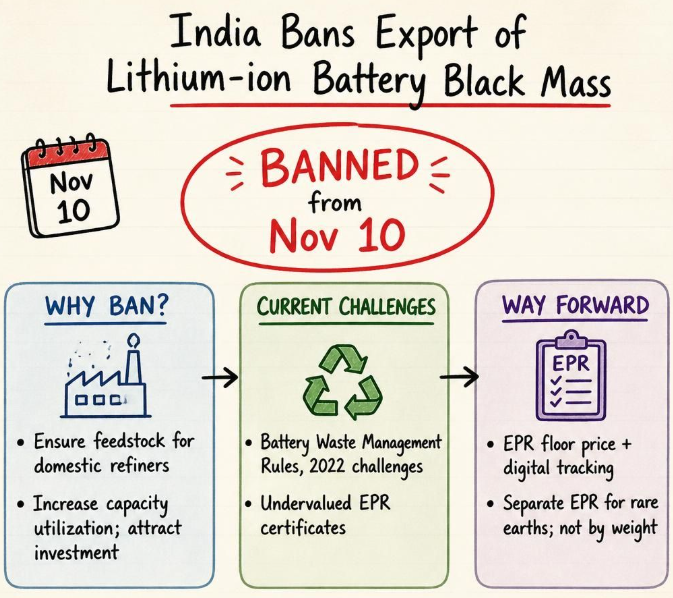
- On November 10, the Directorate General of Foreign Trade (DGFT) prohibited the export of lithium-ion battery black mass by shifting it from the 'Free' to the 'Prohibited' category.
- The move aims to retain valuable battery-recycling materials within India and strengthen domestic recovery of critical minerals.
What is Battery Black Mass?
- Black mass is an intermediate material obtained by shredding and processing spent lithium-ion batteries and battery-manufacturing scrap.
- It contains valuable materials such as lithium, nickel, cobalt, manganese and graphite.
- These materials can be recovered through specialised chemical processing and reused in battery manufacturing.
Objectives of the Export Ban
- Domestic Feedstock: Ensure a steady supply of black mass for Indian recyclers and refiners.
- Capacity Utilisation: Improve the utilisation of domestic recycling facilities.
- Investment: Attract investment in battery recycling and critical-mineral recovery.
- Import Dependence: Reduce India's dependence on imported critical minerals used in battery manufacturing.
Challenges in India's Battery Recycling Ecosystem
- Limited Processing Capacity: Lithium-ion battery recycling is still emerging, with only a few dozen licensed operators, unlike the established lead-acid battery recycling sector.
- Risk of Dumping: Export restrictions alone cannot create a recycling ecosystem. Without adequate downstream processing capacity, accumulated black mass could lead to dumping.
- Undervalued EPR Certificates: Battery Waste Management Rules, 2022, face implementation challenges due to undervaluation of Extended Producer Responsibility (EPR) certificates.
- Insufficient Downstream Investment: Specialised chemical-processing units are needed to recover minerals and supply inputs directly to domestic battery manufacturers.
Way Forward
- Develop specialised chemical-processing facilities to convert black mass into battery-grade materials.
- Introduce a floor price for EPR certificates to reflect the actual cost of mineral recovery and incentivise high-yield recycling.
- Establish digital tracking systems to prevent fake or merely paper-based compliance.
- Strengthen policy support and investment across the battery-recycling value chain.
Why in News?
Chief Economic Advisor (CEA) V. Anantha Nageswaran highlighted that monetary policy alone may not be sufficient to control inflation caused by global supply-side disruptions. He emphasised the need for fiscal intervention and other public policy measures to address such inflationary pressures.
Key Developments
- The CEA observed that conventional monetary policy tools, particularly interest rate hikes, have limited effectiveness when inflation is driven by supply shortages.
- Excessive monetary tightening in such situations may increase economic difficulties without addressing the actual source of inflation.
- He advocated combining monetary policy with fiscal measures and other government interventions.
- He clarified that his remarks were general observations about the global economy and not a specific assessment of India's monetary policy.
Understanding Monetary Policy and Fiscal Policy
| Basis | Monetary Policy | Fiscal Policy |
| Meaning | Management of money supply, credit and interest rates in the economy. | Government's use of taxation, public expenditure and borrowing to influence the economy. |
| Authority in India | Reserve Bank of India (RBI) | Central Government |
| Main instruments | Repo rate, CRR, SLR, open market operations. | Taxation, subsidies, government spending and public investment. |
| Main objective | Price stability and supporting economic growth. | Growth, employment, redistribution and economic stability. |
Why Are Interest Rate Hikes Less Effective Against Supply-side Inflation?
Interest rate hikes are primarily designed to control demand-driven inflation rather than directly address shortages in the supply of goods and services.
|
1. Demand-side Inflation • Occurs when aggregate demand exceeds the economy's productive capacity. • Excessive consumer spending, investment and credit expansion can push prices upwards. • Increasing interest rates makes borrowing expensive and discourages consumption and investment. • Lower aggregate demand helps moderate inflation. 2. Supply-side Inflation • Arises due to disruptions in the production or availability of goods and services. • Major causes include geopolitical conflicts, supply-chain disruptions, higher crude oil prices, crop failures and rising input costs. • Increasing interest rates cannot directly increase the supply of food, fuel or raw materials. • Higher borrowing costs may further increase production expenses and discourage investment. Example: If food prices rise because of poor rainfall or crop damage, increasing the repo rate cannot increase agricultural production immediately. Measures such as improving supply chains, releasing food stocks and facilitating imports may be more effective. |
Why Is a Combination of Policies Required?
| Monetary Measures | Fiscal and Supply-side Measures |
|---|---|
| Manage inflationary expectations. | Improve the availability of essential commodities. |
| Control excessive credit and demand. | Provide targeted subsidies and tax relief where necessary. |
| Maintain price stability. | Release buffer stocks and facilitate imports. |
| Prevent excessive inflation from becoming persistent. | Address production and distribution bottlenecks. |
India's Inflation and RBI's Monetary Policy
According to the supplied report:
- India's retail inflation reached 6.09% in October, a two-year high, exceeding the RBI's upper tolerance limit of 6%.
- Inflation increased from 5.54% in September, primarily due to higher food prices.
- On October 7, 2026, the RBI increased the benchmark repo rate by 25 basis points to 6.75%, marking its first hike in nearly four years.
- The rate increase raised the possibility of further monetary policy adjustments during the financial year.