
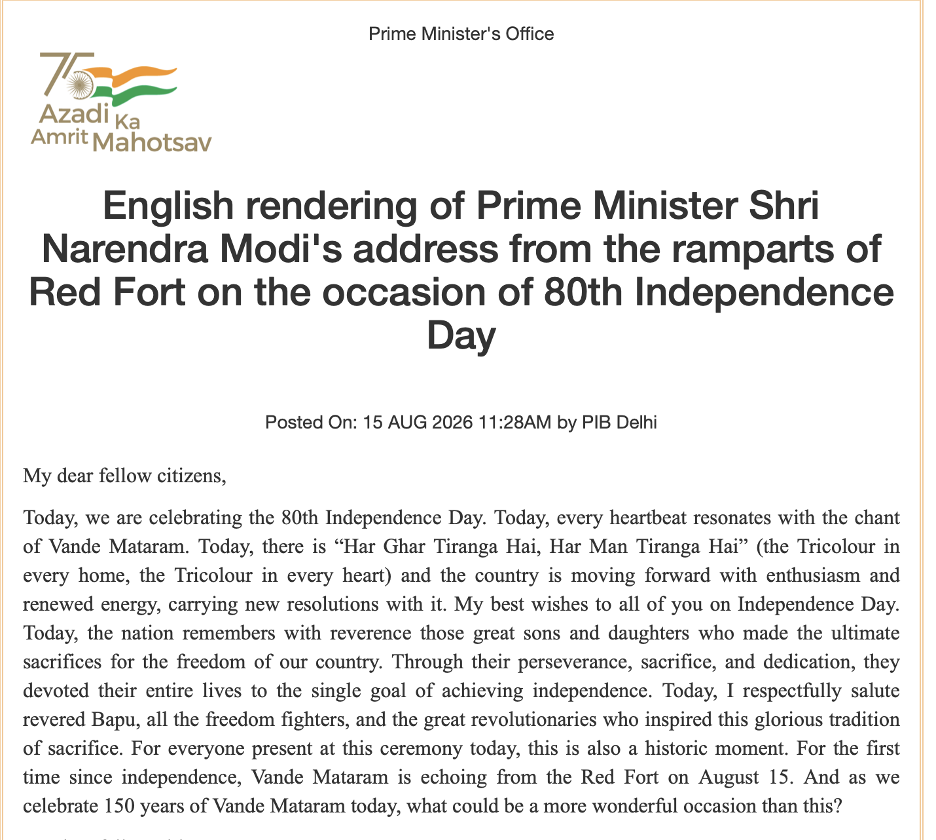
On August 15, 2026, during his 80th Independence Day address, Prime Minister Narendra Modi unveiled a transformative framework for national development titled “Shakti ki Sapt Dhara” (Seven Streams of Strength). This strategic roadmap is designed to propel India toward becoming a developed nation (Viksit Bharat) by 2047.
1. Manufacturing: Global Hub for Cost, Quality, and Scale
The vision for manufacturing focuses on moving India from low-value segments to becoming a dominant force in global production networks.
- The Trinity of Success: PM Modi urged the sector to compete globally on cost, quality, and scale, emphasizing “zero-defect” manufacturing as India’s global brand value.
- Economic Ambition: A bold target has been set to have 50 Indian companies in the Fortune 500 list.
- Intelligent Manufacturing: Future-fit manufacturing will increasingly rely on an “intelligent core”—integrating AI, IoT, and digital engineering to shift from transactional sales to lifecycle partnerships.
2. Agriculture and Food Processing: Global Branding through FTAs
This stream seeks to leverage India’s massive agricultural base and expanding trade partnerships.
- Export as Global Brands: Utilizing recent Free Trade Agreements (FTAs), India aims to create integrated farm-to-export supply chains for spices, millets, and fruits.
- Sustainable Farming: A major transition is underway toward chemical-free and organic farming to meet global quality standards.
- Green Ammonia: The shift toward green ammonia for fertilizers is identified as a key sustainable alternative to traditional, carbon-intensive urea production.
3. Technology and Innovation: The AI and Quantum Frontier
India is positioning itself to be more than just a tech market; it aims to be a global innovation hub.
- Emerging Technologies: Priorities include artificial intelligence (AI), quantum computing, robotics, and space technology.
- Youth Empowerment: A mission-mode initiative will train 1 crore young people in AI over the next year.
- Semiconductor Sovereignty: With three plants already operational and 5–8 more planned, India is aggressively pursuing self-reliance in chip manufacturing.
4. Gati Shakti: Revolutionizing Multimodal Connectivity
Infrastructure is the backbone of this vision, focusing on seamless logistics and high-speed mobility.
- High-Speed Rail (HSR): Beyond the Mumbai–Ahmedabad corridor, the Union Budget 2026–27 announced seven new high-speed rail corridors spanning nearly 4,000 km.
- Aviation and Ports: Operational airports have increased from 74 in 2014 to 165 in 2026 under the UDAN scheme. Port-led development through the Sagarmala project has nearly doubled major port capacity since 2014.
- Integrated Planning: The PM GatiShakti National Master Plan now coordinates planning across 58 ministries using over 3,200 data layers.
5. Defence: Achieving Atmanirbharta and Strategic Exports
India is transitioning from the world’s largest arms importer to a credible global exporter.
- Production and Exports: India achieved record defence production of ₹1.51 lakh crore in FY25, with exports reaching an all-time high of ₹38,424 crore to 80+ countries.
- Indigenisation: Five Positive Indigenisation Lists (PILs) have been issued, placing import embargoes on over 5,500 items to force domestic development.
- Cyber and New-Age Warfare: Focus is shifting toward indigenous capability in drones, electronic warfare, and cybersecurity technologies.
6. Green and Blue Economy: Solutions for Global Warming
Sustainable growth is prioritized through energy independence and ocean resource utilization.
- National Green Hydrogen Mission: Aims for 5 MMTPA production by 2030, positioning India as a global hub for green fuels to combat global warming.
- Nuclear Energy: A target of 100 GW of nuclear power capacity by 2047 has been set, supported by five new reactors.
- The Blue Economy: The “Samudra Manthan” project and NITI Aayog’s deep-sea fisheries framework aim to harness India’s 2 million sq. km Exclusive Economic Zone (EEZ) responsibly.
7. Soft Power: The Global Influence of Indian Culture
India’s influence is being projected through traditional systems and the modern creative economy.
- “Heal in India”: Integrating AYUSH (Ayurveda, Yoga, Naturopathy, Unani, Siddha, and Homeopathy) with modern medicine to attract Medical Value Travel.
- Facilitation: Introduction of the AYUSH Visa and the establishment of five Regional Medical Hubs.
- The Concert Economy: The newly established Live Events Development Cell (LEDC) aims to mobilize the live events market, which was valued at over ₹20,000 crore in 2024.
- Creative Economy: Strategic leadership targets in gaming, VFX, animation, and digital content.