
why in news
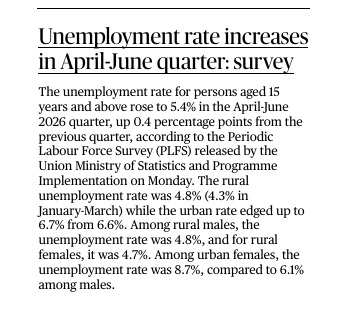
India’s unemployment rate for persons aged 15 years and above rose to 5.4% in the April–June 2026 quarter, up from 5.0% in January–March 2026. The latest data come from the Periodic Labour Force Survey (PLFS) released by the Ministry of Statistics and Programme Implementation (MoSPI).
UPSC Relevance
Economy
About Unemployment
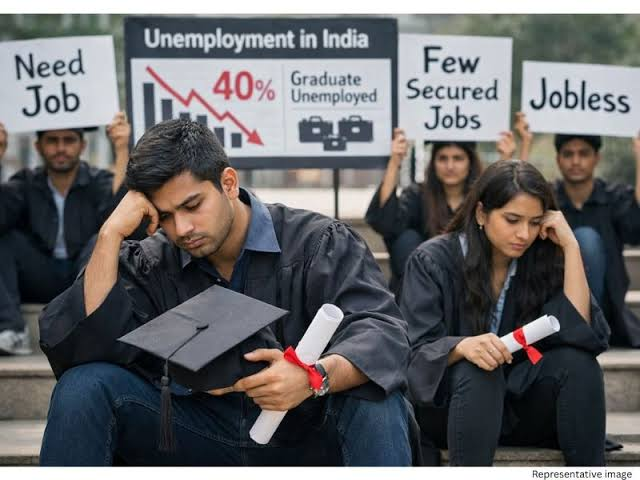
According to OECD-Unemployment happens when a person does not have a job, is available to work, and looks for a job.
Data
| Indicator | Jan–Mar 2026 | Apr–Jun 2026 |
|---|---|---|
| Overall Unemployment Rate | 5.0% | 5.4% ↑ |
| Rural UR | 4.3% | 4.8% ↑ |
| Urban UR | 6.6% | 6.7% ↑ |
| Rural Male UR | 4.8% | 4.8% |
| Rural Female UR | 4.7% | 4.7% |
| Urban Male UR | 6.1% | 6.1% |
| Urban Female UR | 8.7% | 8.7% |
Key Terms Related to Unemployment
- Labour Force: It includes all the people who are presently employed or are searching for jobs.
- Workforce: It includes all the people who are presently employed.
- Unemployment Rate= (Labour Force – Work Force)/Labour Force * 100
- Labour Force Participation Rate (LFPR) = (Labour Force/ Working Age Population) * 100
- Employment-to-Population ratio (EPR): (Workforce/ Working Age Population) * 100
- Worker Population Ratio (WPR): Number of persons employed per thousand persons.
Types of Unemployment
- Frictional unemployment: This type of unemployment occurs when workers are in between jobs or are searching for a job. It is a temporary and natural part of the labor market.
- Structural unemployment: This occurs when there is a mismatch between the skills that workers have and the skills required for available jobs. Structural unemployment can be caused by changes in the economy, such as the decline of certain industries or technological advancements.
- Cyclical unemployment: This type of unemployment is caused by changes in the business cycle, such as recessions or economic downturns. When the economy slows down, companies may cut jobs to reduce costs, leading to increased unemployment.
- Seasonal unemployment: Seasonal unemployment occurs when workers are employed only during certain times of the year, such as during the holiday season or during harvest time in agricultural sectors.
- Technological unemployment: This occurs when technological advancements make certain jobs obsolete, leading to job losses in those sectors.
- Underemployment: This refers to a situation where workers are employed but are not able to work as much as they would like, or are working in jobs that are below their skill levels.
Why is Rising Unemployment a Concern?
Demographic Dividend
- India has a large working-age population and sufficient jobs are not created.
Poverty
- Unemployment → income loss → lower consumption → greater vulnerability to poverty
Agriculture cannot absorb everyone productively
- A large part of India’s workforce is still dependent on agriculture.
Skill–Job Mismatch
- A person may have a degree but lack the skills demanded by employers.
High Informality
- The ILO’s India Employment Report notes that around 82% of workers are in the informal sector and nearly 90% are informally employed.
Regional Imbalance
- Jobs are concentrated in particular states and cities.
- For example:- Bengaluru / Mumbai / Delhi-NCR / Hyderabad / Pune
Seasonal Employment
- Agriculture, construction, tourism and some other sectors do not provide employment uniformly throughout the year.
Consequences
- Financial Stress: One of the most obvious consequences of unemployment is financial hardship. Without a steady income, individuals may struggle to pay bills, cover living expenses, and provide for their families. This may result in more stress and anxiety, which could make it even harder to find employment or make financial decisions. Additionally, it may have an impact on a person’s relationships and general quality of life.
- Mental health issues: Unemployment can also have a negative impact on mental health. It can lead to increased stress, anxiety, and depression, which can, in turn, impact physical health and well-being.
- Reduced productivity and economic growth: High levels of unemployment can lead to reduced productivity and economic growth. When workers are unemployed, there is less demand for goods and services, which can lead to a reduction in economic activity.
- Increase in social problems: Unemployment can also lead to an increase in social problems such as crime, homelessness, and poverty.
- Strained government resources: When unemployment levels are high, governments may need to spend more on social welfare programs to support unemployed individuals and families, which can strain government resources.
Way Forward
- Promoting economic growth: Governments can promote economic growth by investing in infrastructure, providing incentives for businesses to invest and grow, and supporting innovation and entrepreneurship. They should promote labour market strategies that are active, such as training and skill development, to aid employees in gaining new skills and improving their employability, this is what ILO suggests.
- Providing education and training: Education and training programs can help workers develop the skills needed for available jobs, reducing structural unemployment.
- Encouraging foreign investment: World Bank Encourages foreign investment can create new jobs and stimulate economic growth.
- Reducing regulations and taxes: Reducing regulations and taxes can make it easier for businesses to grow and create jobs.
- Providing financial assistance: Governments can provide financial assistance to individuals who are unemployed, helping them to cover living expenses while they search for new jobs.
- Implementing job-sharing programs: Job-sharing programs can reduce unemployment by allowing multiple workers to share one full-time job.
- Investing in renewable energy: Investing in renewable energy can create new jobs in the energy sector and stimulate economic growth.