
UPSC Relevance
GS2 (Polity): Federalism, Centre- State relation
Why In news
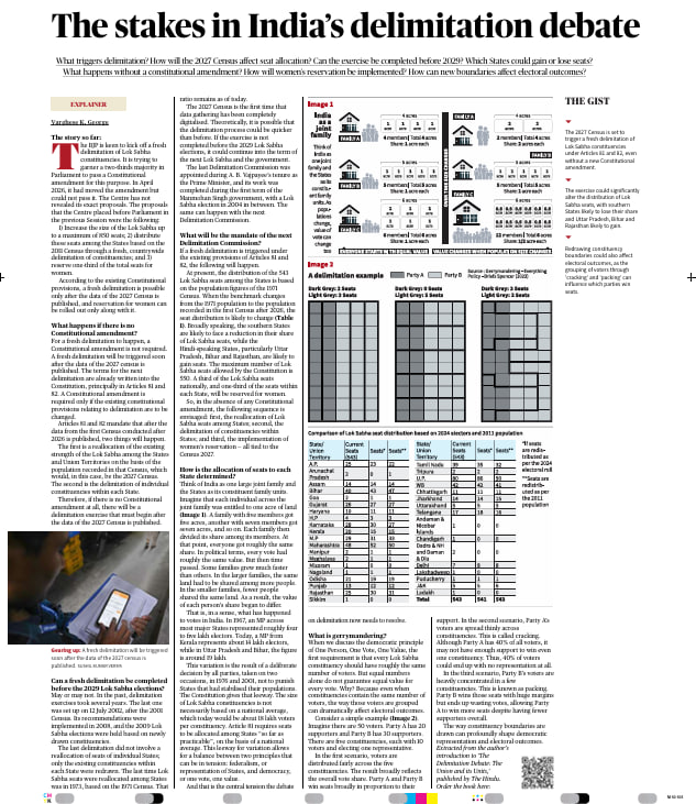
The delimitation debate has gained renewed importance in 2026 because the government has moved towards changes that could enable a fresh delimitation exercise and operationalise one-third reservation for women in legislatures. The proposals have also raised concerns about the future distribution of Lok Sabha seats between states, particularly the North–South representation balance.
What Is Delimitation Commission
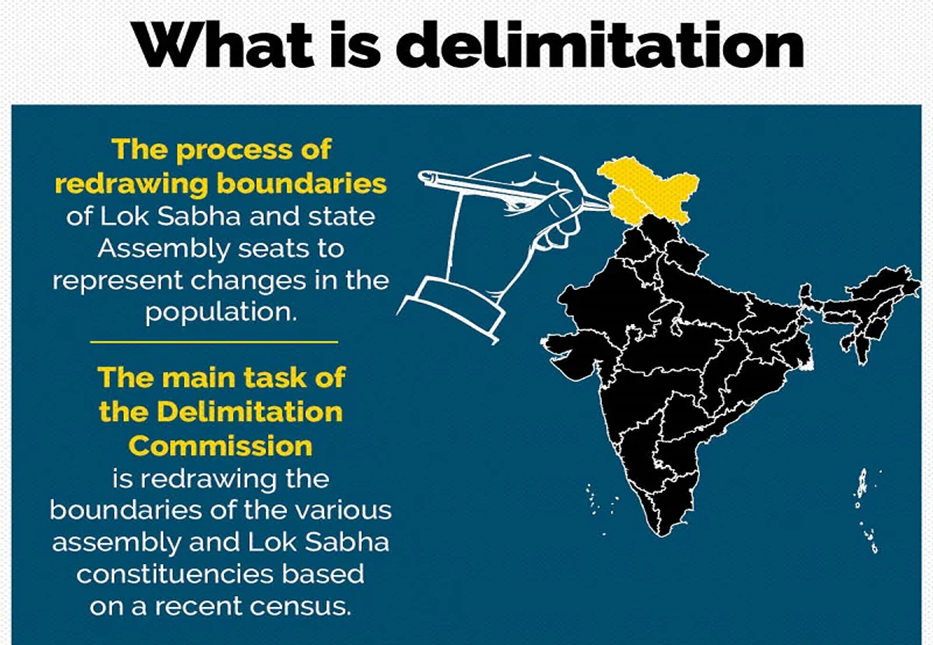
The Delimitation Commission is a high-powered body constituted by the Government of India under an Act of Parliament to redraw the boundaries of parliamentary and assembly constituencies on the basis of the most recent census. Its orders have the force of law and cannot be questioned in any court.
Constitution Provisions
| Article | Provision |
| Article 82 | After every census, readjustment of seats of the Lok Sabha among the States and division of each State into territorial constituencies to be done by Parliamentary law |
| Article 170 | Composition of Legislative Assemblies — each State Assembly divided into territorial constituencies on the basis of population as per the latest census |
| Article 327 | Parliament may make provisions with respect to elections to either House, including the delimitation of constituencies |
| Article 329 | Bars the courts from interfering in electoral matters, including delimitation orders |
Four Delimitation Commissions in India
| Commission | Year | Census Used | Key Point |
|---|---|---|---|
| 1st Delimitation Commission | 1952 | 1951 | First delimitation after Independence; redrew Lok Sabha and State Assembly constituencies. |
| 2nd Delimitation Commission | 1962 | 1961 | Constituencies were redrawn following the 1961 Census and changes in population. |
| 3rd Delimitation Commission | 1972 | 1971 | Based on the 1971 Census; followed by the freeze on inter-state seat allocation. |
| 4th Delimitation Commission | 2002 | 2001 | Chaired by Justice Kuldip Singh; completed its work in 2008. It mainly redrew constituency boundaries because the allocation of seats among States remained frozen. |
Important Point:
42nd Constitutional Amendment Act, 1976
- Froze the allocation of Lok Sabha seats among States based on the 1971 Census.
- The objective was to ensure that States that had successfully implemented family planning/population-control measures were not politically penalised.
84th Constitutional Amendment Act, 2001
- However, delimitation of constituencies within States could still be undertaken.
- Extended this freeze until the first Census after 2026.
Composition of Delimitation Commission
| Member | Role |
|---|---|
| 1. Retired/Serving Supreme Court Judge | Chairperson of the Commission |
| 2. Chief Election Commissioner / Election Commissioner | Member |
| 3. State Election Commissioner | Member, for the concerned State |
Associate Members
The image correctly says that Associate Members do not have voting rights.
They are generally drawn from:
- Members of Lok Sabha
- Members of the State Legislative Assembly
They assist the Commission and give their views, but they are not full voting members.
Remember: Associate Members ≠ Members of the Delimitation Commission.
Projected number of seats based on the 2011 Census:-
| State/UT | 2011Population | Current Seats (as per the 1971 Census) | Projections based on 2011 Census | ||||||
| Total Seats Unchanged | Seats increase by 50% | ||||||||
| Seats | % Share | Projected Seats | Increase (+) /Decrease (-) | % share | Projected Seats | Increase (+) /Decrease (-) | %share | ||
| Andaman & Nicobar Islands | 3,80,581 | 1 | 0.18% | 1 | 0 | 0.18% | 1 | 0 | 0.12% |
| Andhra Pradesh | 8,45,80,777 | 42 | 7.73% | 38 | -4 | 6.93% | 56 | 14 | 6.89% |
| Arunachal Pradesh | 13,83,727 | 2 | 0.37% | 2 | 0 | 0.36% | 2 | 0 | 0.25% |
| Assam | 3,12,05,576 | 14 | 2.58% | 14 | 0 | 2.55% | 21 | 7 | 2.58% |
| Bihar | 10,40,99,452 | 40 | 7.37% | 46 | 6 | 8.39% | 69 | 29 | 8.49% |
| Chandigarh | 10,55,450 | 1 | 0.18% | 1 | 0 | 0.18% | 1 | 0 | 0.12% |
| Chhattisgarh | 2,55,45,198 | 11 | 2.03% | 11 | 0 | 2.01% | 17 | 6 | 2.09% |
| Dadra & Nagar Haveli | 3,43,709 | 1 | 0.18% | 1 | 0 | 0.18% | 1 | 0 | 0.12% |
| Daman & Diu | 2,43,247 | 1 | 0.18% | 1 | 0 | 0.18% | 1 | 0 | 0.12% |
| Goa | 14,58,545 | 2 | 0.37% | 2 | 0 | 0.36% | 2 | 0 | 0.25% |
| Gujarat | 6,04,39,692 | 26 | 4.79% | 27 | 1 | 4.93% | 40 | 14 | 4.92% |
| Haryana | 2,53,51,462 | 10 | 1.84% | 11 | 1 | 2.01% | 17 | 7 | 2.09% |
| Himachal Pradesh | 68,64,602 | 4 | 0.74% | 3 | -1 | 0.55% | 5 | 1 | 0.62% |
| Jammu & Kashmir | 1,25,41,302 | 6 | 1.10% | 6 | 0 | 1.09% | 8 | 2 | 0.98% |
| Jharkhand | 3,29,88,134 | 14 | 2.58% | 15 | 1 | 2.74% | 22 | 8 | 2.71% |
| Karnataka | 6,10,95,297 | 28 | 5.16% | 27 | -1 | 4.93% | 41 | 13 | 5.04% |
| Kerala | 3,34,06,061 | 20 | 3.68% | 15 | -5 | 2.74% | 22 | 2 | 2.71% |
| Lakshadweep | 64,473 | 1 | 0.18% | 1 | 0 | 0.18% | 1 | 0 | 0.12% |
| Madhya Pradesh | 7,26,26,809 | 29 | 5.34% | 32 | 3 | 5.84% | 48 | 19 | 5.90% |
| Maharashtra | 11,23,74,333 | 48 | 8.84% | 50 | 2 | 9.12% | 75 | 27 | 9.23% |
| Manipur | 28,55,794 | 2 | 0.37% | 2 | 0 | 0.36% | 2 | 0 | 0.25% |
| Meghalaya | 29,66,889 | 2 | 0.37% | 2 | 0 | 0.36% | 2 | 0 | 0.25% |
| Mizoram | 10,97,206 | 1 | 0.18% | 1 | 0 | 0.18% | 1 | 0 | 0.12% |
| Nagaland | 19,78,502 | 1 | 0.18% | 1 | 0 | 0.18% | 1 | 0 | 0.12% |
| NCT of Delhi | 1,67,87,941 | 7 | 1.29% | 7 | 0 | 1.28% | 11 | 4 | 1.35% |
| Odisha | 4,19,74,218 | 21 | 3.87% | 19 | -2 | 3.47% | 28 | 7 | 3.44% |
| Puducherry | 12,47,953 | 1 | 0.18% | 1 | 0 | 0.18% | 1 | 0 | 0.12% |
| Punjab | 2,77,43,338 | 13 | 2.39% | 12 | -1 | 2.19% | 19 | 6 | 2.34% |
| Rajasthan | 6,85,48,437 | 25 | 4.60% | 30 | 5 | 5.47% | 46 | 21 | 5.66% |
| Sikkim | 6,10,577 | 1 | 0.18% | 1 | 0 | 0.18% | 1 | 0 | 0.12% |
| Tamil Nadu | 7,21,47,030 | 39 | 7.18% | 32 | -7 | 5.84% | 48 | 9 | 5.90% |
| Tripura | 36,73,917 | 2 | 0.37% | 2 | 0 | 0.36% | 2 | 0 | 0.25% |
| Uttar Pradesh | 19,98,12,341 | 80 | 14.73% | 89 | 9 | 16.24% | 133 | 53 | 16.36% |
| Uttarakhand | 1,00,86,292 | 5 | 0.92% | 4 | -1 | 0.73% | 7 | 2 | 0.86% |
| West Bengal | 9,12,76,115 | 42 | 7.73% | 41 | -1 | 7.48% | 61 | 19 | 7.50% |
| Total | 1,21,08,54,977 | 543 | – | 548 | – | – | 813 | – | – |
Important Judicial Pronouncements related to Delimitation Commission
- Kishorchandra Chhanganlal Rathod vs. UOI, 2024: SC held that constitutional courts have power to review orders of Delimitation Commission if an order is manifestly arbitrary and irreconcilable to constitutional values.
- Meghraj Kothari v. Delimitation Commission & Others, 1966: Judicial interference was restricted only to avoid unnecessary delay in election process. It does not impose an absolute bar on constitutional courts’ power to review orders of Delimitation Commission.
Significance of the Delimitation Commission
Ensures Equal Political Representation
- It redraws constituencies to reduce major differences in population among constituencies.
- Helps uphold the principle of “One Person, One Vote, One Value.”
- Prevents some MPs/MLAs from representing disproportionately large populations.
Rationalises Electoral Boundaries
- Population and administrative boundaries change over time.
- Delimitation helps redraw outdated constituencies according to current demographic and geographical realities.
- It can improve the administrative convenience and accessibility of constituencies.
Ensures Representation of SCs and STs
- Delimitation determines which constituencies should be reserved for Scheduled Castes (SCs) and Scheduled Tribes (STs) based on population distribution.
- This helps provide constitutionally mandated political representation to historically disadvantaged communities.
Strengthens Democratic Legitimacy
- A constituency should ideally represent a reasonably comparable population.
- Periodic delimitation therefore makes electoral representation more equitable and representative.
Promotes Federal Balance
- Delimitation determines the distribution of parliamentary representation among States.
- Therefore, it directly influences the political weight of States in Parliament.
- This makes it particularly important for India’s federal structure.
Addresses Demographic Changes
Population patterns change because of:
- Migration
- Urbanisation
- Different fertility rates
- Population growth
Delimitation allows the electoral system to respond to these demographic changes.
Supports Women’s Political Representation
The implementation of women’s reservation in the Lok Sabha and State Assemblies is linked to the delimitation process under the constitutional framework created by the 106th Constitutional Amendment.
Thus:
Census → Delimitation → Constituency restructuring → Implementation of women’s reservation
Independent and Quasi-Judicial Character
- The Commission is designed to function independently, and its orders have legal force under the applicable Delimitation Act.
- This reduces the possibility of frequent political interference in constituency boundaries.
Helps Prevent Arbitrary Boundary Manipulation
- An independent delimitation process can reduce the possibility of politically motivated constituency boundaries, commonly associated with gerrymandering.
Issues
Issues Associated with Delimitation in India
- Federal Imbalance: Population-based delimitation may favour high-growth states and reduce the relative representation of population-control-successful states.
- North–South Divide: May increase political tensions between northern and southern States.
- SC/ST Representation: Reserved constituencies may not always reflect the latest demographic distribution of SC/ST populations.
- Lack of Public Participation: Limited public involvement can reduce transparency and create dissatisfaction with constituency boundaries.
- Representational Imbalance: Outdated population data can create differences between actual population and political representation.
- Gerrymandering Risk: Boundary changes may raise concerns about politically motivated constituency designs.
Way Forward
- Balanced Seat Allocation: Use TFR + population to balance representation.
- Transparency: Ensure public and stakeholder participation.
- Periodic Delimitation: Review constituencies after every Census.
- Effective Representation: Ensure cohesive, accessible and practical constituencies.
- Federal Consensus: Protect both electoral equality and federal balance.
UPSC PYQ
Q. With reference to the Delimitation Commission consider the following statements: (2012)
- The orders of the Delimitation Commission cannot be challenged in a Court of Law.
- When the orders of the Delimitation Commission are laid before the Lok Sabha or State Legislative Assembly, they cannot effect any modification in the orders.
Which of the statements given above is/are correct?
(a) 1 only
(b) 2 only
(c) Both 1 and 2
(d) Neither 1 nor 2