
Source: IE
Why in News?
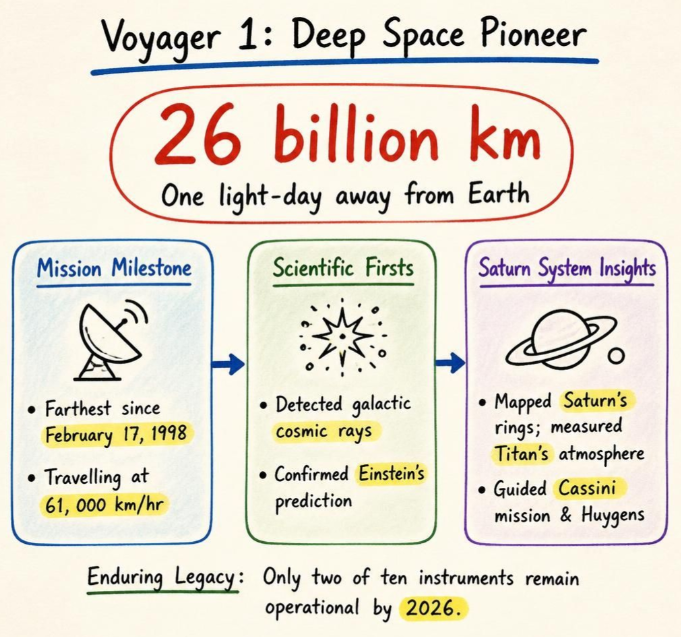
NASA's Voyager 1 has reached a distance of approximately one light-day (26 billion km) from Earth, making it one of the most distant human-made objects in space.
Key Highlights
- Voyager 1 is travelling at approximately 61,000 km/hr.
- It has remained the farthest spacecraft from Earth since 17 February 1998.
- Its observations continue to provide valuable information about interstellar space, cosmic rays and planetary systems.
- Its cameras were switched off in 1990.
- By 2026, only 2 of its original 10 scientific instruments remained operational.
Major Scientific Contributions
1. Galactic Cosmic Rays
- Its ultraviolet spectrometer unexpectedly detected galactic cosmic rays between 1992 and 2013.
- Provided insights into the space environment beyond the Solar System.
- Raised questions about solar wind interactions with interstellar atoms near the heliopause.
2. Einstein's Theory of General Relativity
- Voyager 1's observations independently confirmed Einstein's prediction regarding the frequency shift of electromagnetic radiation in a gravitational field.
3. Study of Saturn and Titan
- Used radio signals to study the distribution of materials and fine structures within Saturn's rings.
- Radio occultation helped measure the temperature and pressure of Titan's atmosphere.
- Its findings contributed to planning NASA's Cassini mission and the Huygens probe.
Quick Learning: Voyager 1
| Particulars | Details |
| Agency | NASA (USA) |
| Launch date | 5 September 1977 |
| Launch vehicle | Titan IIIE-Centaur |
| Mission | Exploration of outer planets and interstellar space |
| Primary targets | Jupiter and Saturn |
| Current status | Interstellar space |
| Twin spacecraft | Voyager 2 |
Important Scientific Terms
- Light-day: Distance travelled by light in one day (approximately 25.9 billion km).
- Heliopause: Boundary where the influence of the solar wind becomes weaker than that of the interstellar medium.
- Galactic Cosmic Rays: High-energy particles originating outside the Solar System.
- Radio Occultation: Technique used to study planetary atmospheres and structures by analysing changes in radio signals passing through them.
More current affairs of 18 November 2026
- Horticultural Production in India
- Voyager 1: One Light-Day Away from Earth
- Climate Change Performance Index (CCPI) 2027
- Belarus – India–Belarus Inter-Governmental Commission
- Quad Announces New Initiatives in AI, Cybersecurity and Maritime Security
- Naturopathy: Natural Healing for a Healthy India