
Source: IE
GS3: Economy | Environment | Science & Technology
Why in News?
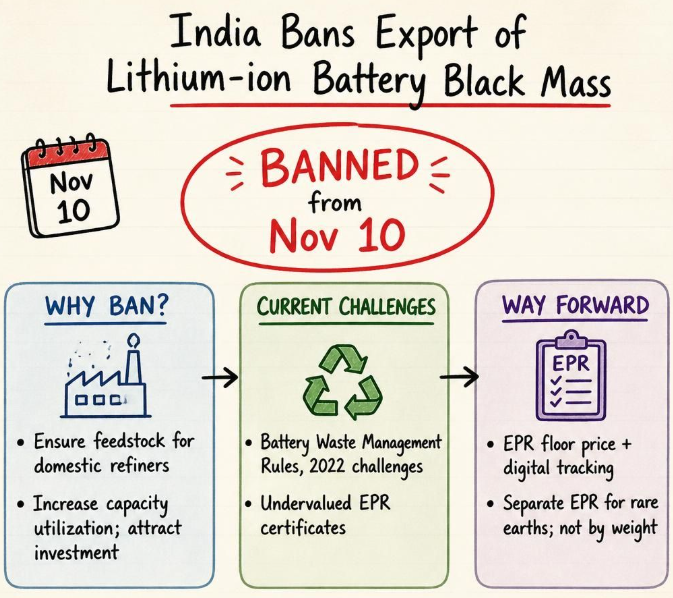
- On November 10, the Directorate General of Foreign Trade (DGFT) prohibited the export of lithium-ion battery black mass by shifting it from the 'Free' to the 'Prohibited' category.
- The move aims to retain valuable battery-recycling materials within India and strengthen domestic recovery of critical minerals.
What is Battery Black Mass?
- Black mass is an intermediate material obtained by shredding and processing spent lithium-ion batteries and battery-manufacturing scrap.
- It contains valuable materials such as lithium, nickel, cobalt, manganese and graphite.
- These materials can be recovered through specialised chemical processing and reused in battery manufacturing.
Objectives of the Export Ban
- Domestic Feedstock: Ensure a steady supply of black mass for Indian recyclers and refiners.
- Capacity Utilisation: Improve the utilisation of domestic recycling facilities.
- Investment: Attract investment in battery recycling and critical-mineral recovery.
- Import Dependence: Reduce India's dependence on imported critical minerals used in battery manufacturing.
Challenges in India's Battery Recycling Ecosystem
- Limited Processing Capacity: Lithium-ion battery recycling is still emerging, with only a few dozen licensed operators, unlike the established lead-acid battery recycling sector.
- Risk of Dumping: Export restrictions alone cannot create a recycling ecosystem. Without adequate downstream processing capacity, accumulated black mass could lead to dumping.
- Undervalued EPR Certificates: Battery Waste Management Rules, 2022, face implementation challenges due to undervaluation of Extended Producer Responsibility (EPR) certificates.
- Insufficient Downstream Investment: Specialised chemical-processing units are needed to recover minerals and supply inputs directly to domestic battery manufacturers.
Way Forward
- Develop specialised chemical-processing facilities to convert black mass into battery-grade materials.
- Introduce a floor price for EPR certificates to reflect the actual cost of mineral recovery and incentivise high-yield recycling.
- Establish digital tracking systems to prevent fake or merely paper-based compliance.
- Strengthen policy support and investment across the battery-recycling value chain.
More current affairs of 14 November 2026
- Critical Minerals: India Bans Export of Lithium-Ion Battery Black Mass
- Samudrayaan Project: Matsya-6000 Deep-Ocean Submersible
- Prime Minister’s Awards for Excellence in Public Administration 2026
- Iran–US Tensions: IRGC Claims Attack on US Radar in Bahrain
- Monetary Policy and Inflation: Limitations of Interest Rate Hikes
- SUPER ICE Missile: Israel’s Long-Range Cruise Missile