
RPSC Rajasthan Administrative Services (RAS) Hub
Your complete preparation gateway for RPSC RAS: Explore the verified examination pattern, download monthly Rajasthan current affairs magazines, and access All-Rajasthan Prelims & Mains mock test series.
Preliminary Exam
(Screening)
- 1 Single Paper (Objective MCQ)
- 200 Marks · 150 Questions
- 3 Hours Duration
Main Examination
(Counted Merit)
- 4 Papers (Descriptive / Written)
- 800 Counted Marks (200 each)
- 3 Hours per paper
Personality Test
(Viva-voce)
- 1 Board Interview
- 100 Marks
- ~25 to 30 minutes
Preliminary Examination — Pattern & Structure
The RPSC RAS Prelims consists of a single objective paper carrying 200 marks. It tests General Knowledge and General Science with significant weightage given to the History, Art, Culture, Literature, Geography, Economy, and Polity of Rajasthan.
General Knowledge and General Science
Core Subject Breakdown: History, Art, Culture, Literature, Tradition & Heritage of Rajasthan; Indian History (Ancient, Medieval, Modern); Geography of World, India, and Rajasthan; Indian Constitution, Political System & Governance; Administrative & Political System of Rajasthan; Economic Concepts and Indian Economy; Economy of Rajasthan; Science & Technology; Reasoning & Mental Ability; Current Affairs (National, International & Rajasthan State events).
Critical RPSC 5th Option Rule: Every question on the OMR sheet contains 5 options (A, B, C, D, E). If you do not wish to attempt a question, you must darken Option 'E'. Failing to darken any circle attracts a penalty of ⅓ mark. Leaving more than 10% (15+ questions) completely blank results in automatic disqualification.
Main Examination — 4 Papers, 800 Counted Marks
The RAS Mains is descriptive and analytical in nature. There are no optional subjects; all four papers are compulsory. Questions range from Short Answer (2 marks / 15 words), Medium Answer (5 marks / 50 words), to Long Analytical Essays (10 marks / 100 words).
| Paper | Subject Composition | Marks | Duration | Nature |
|---|---|---|---|---|
| Paper-I | General Studies - I (History, Economics, Sociology, Management, Accounting & Auditing) | 200 | 3 hrs | Counted in Merit |
| Paper-II | General Studies - II (Administrative Ethics, General Science & Tech, Geography - World/India/Rajasthan) | 200 | 3 hrs | Counted in Merit |
| Paper-III | General Studies - III (Indian Political System, Public Administration, Sports & Yoga, Behavior, Law) | 200 | 3 hrs | Counted in Merit |
| Paper-IV | General Hindi (120 Marks) & General English (80 Marks) | 200 | 3 hrs | Counted in Merit |
| Total Written Merit | 800 | + Interview 100 = 900 Total | ||
Why Paper IV (Hindi & English) is the Rank Decider
Paper IV carries 200 marks (25% of written marks) and directly creates the largest score differences among top rankers:
- General Hindi (120 Marks): Part A (50 Marks) tests grammar, sandhi, samas, upasarg, pratyay, idioms, and corrections. Part B (50 Marks) tests sankshepan, pallavan, formal letter drafting, and translation. Part C (20 Marks) requires writing a structured Hindi essay on contemporary/thematic issues.
- General English (80 Marks): Part A (20 Marks) tests standard English grammar and vocabulary. Part B (30 Marks) covers comprehension, precis writing, and formal business/government correspondence. Part C (30 Marks) covers paragraph and short essay writing.
Personality Test (Interview) — 100 Marks
- Board Panel: Conducted by the RPSC Board at Ghoogra Ghati, Ajmer.
- Marks Allotment: Carries 100 marks (representing 11.11% of the final 900 merit score).
- Focus Areas: Mental alertness, critical powers of assimilation, logical exposition, balance of judgement, leadership qualities, moral integrity, and deep awareness of Rajasthani dialects, customs, socio-economic challenges, and government initiatives.
- No Minimum Qualifying Mark: Marks obtained in the interview are added directly to the Mains score to determine final merit.
Negative Marking & Key Examination Rules
- Prelims Negative Penalty: ⅓ (0.33) marks deducted for every incorrect response.
- 5th Bubble Rule: 10 extra minutes are given after the exam to verify that all questions have at least one darkened circle (A, B, C, D, or E).
- Mains Medium: Candidates can write GS Papers I, II, and III in either Hindi or English. Paper IV requires answers in the respective language script.
- Final Rank Formula: Mains (800) + Interview (100) = 900 Marks determine final ranks for SDM, Dy.SP, Accounts Service, Tehsildar, and Allied services.
How the Final Merit of 900 Marks is Built
| Component | Marks | Counts in Merit? |
|---|---|---|
| Prelims (GS & GK Paper) | 200 | No — Screening Gate Only |
| Mains Paper I (GS-I) | 200 | Yes (22.22%) |
| Mains Paper II (GS-II) | 200 | Yes (22.22%) |
| Mains Paper III (GS-III) | 200 | Yes (22.22%) |
| Mains Paper IV (General Hindi & English) | 200 | Yes (22.22%) |
| Personality Test (Interview) | 100 | Yes (11.11%) |
| Final Merit Total | 900 | Mains (800) + Interview (100) |
Merit Weightage Distribution
RPSC RAS Eligibility: Age Limits & Domicile Rules
Aspirants must hold a Bachelor's Degree in any discipline from a recognized University. Candidates from other states are eligible under the General (Unreserved) category without reservation benefits.
| Category | Age Range (Min–Max) | Attempt Limit |
|---|---|---|
| General / EWS (Male - All India) | 21 to 40 Years | No limit (until upper age) |
| SC / ST / OBC / MBC / EWS (Male - Rajasthan Domicile) | 21 to 45 Years (+5 yrs) | No limit (until upper age) |
| General Category Female (All India) | 21 to 45 Years (+5 yrs) | No limit (until upper age) |
| SC / ST / OBC / MBC / EWS (Female - Rajasthan Domicile) | 21 to 50 Years (+10 yrs) | No limit (until upper age) |
| Widow and Divorced Women | No Upper Age Bar | No limit |
| Persons with Disabilities (PwD - Rajasthan) | +10 Years Relaxation | No limit |
Note: Age is calculated as of January 1st of the year following the notification date. Final year college students can appear for Prelims but must submit proof of graduation before the Mains examination.
RAS Daily Current Affairs Magazine & Questions
Download daily Rajasthan-centric current affairs PDF magazines curated by Shri Raj IAS, featuring daily analytical MCQs, Rajasthan Sujas summaries, and state editorial breakdowns.
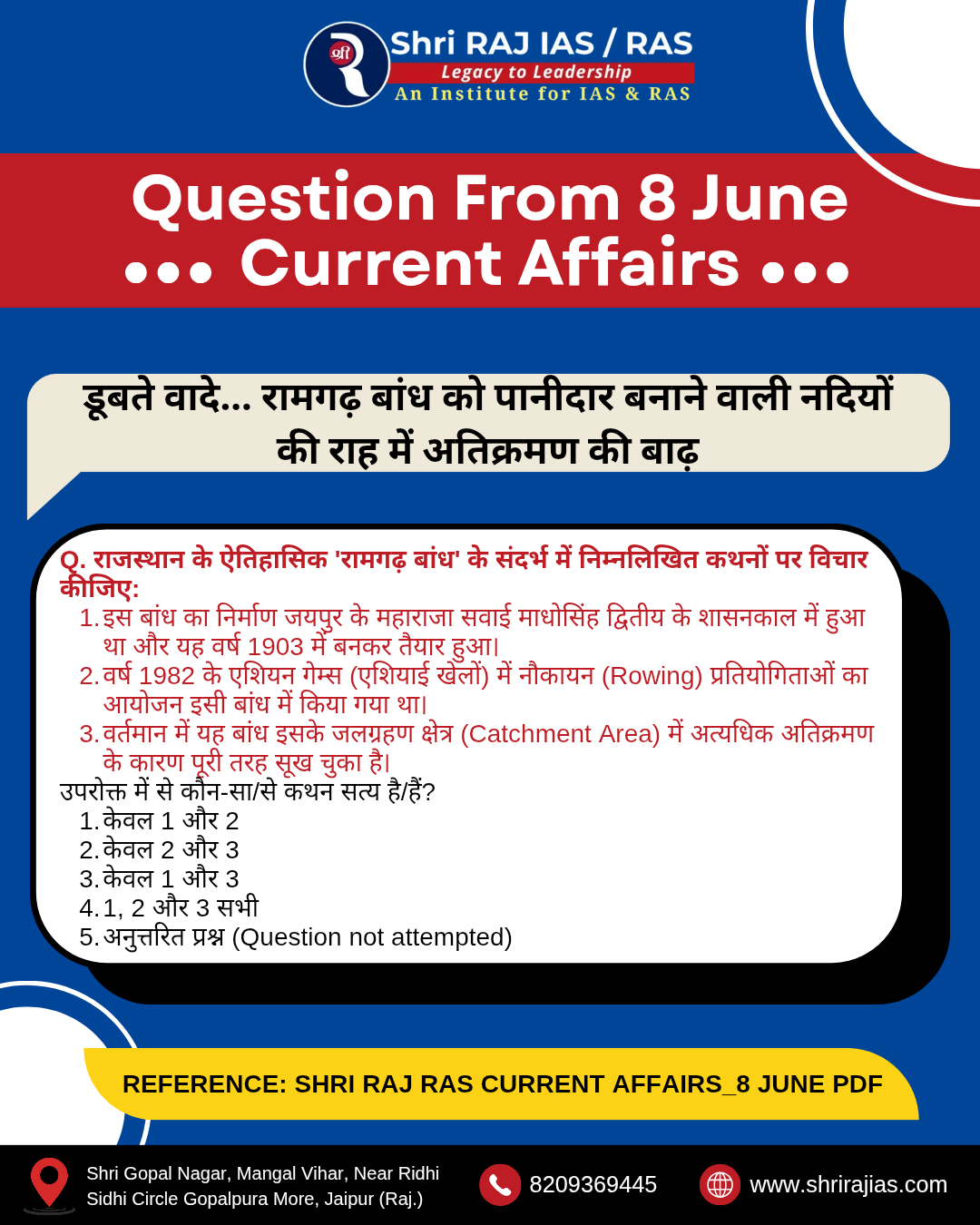
RAS Daily Current Affairs 08-June-2026
Key Highlights: 'डूबते वादे... रामगढ़ बांध को पानीदार बनाने वाली नदियों की राह में अतिक्रमण की बाढ़' — Detailed analysis of Ramgarh Dam history, 1982 Asian Games, catchment area encroachment, and state river restoration plans.
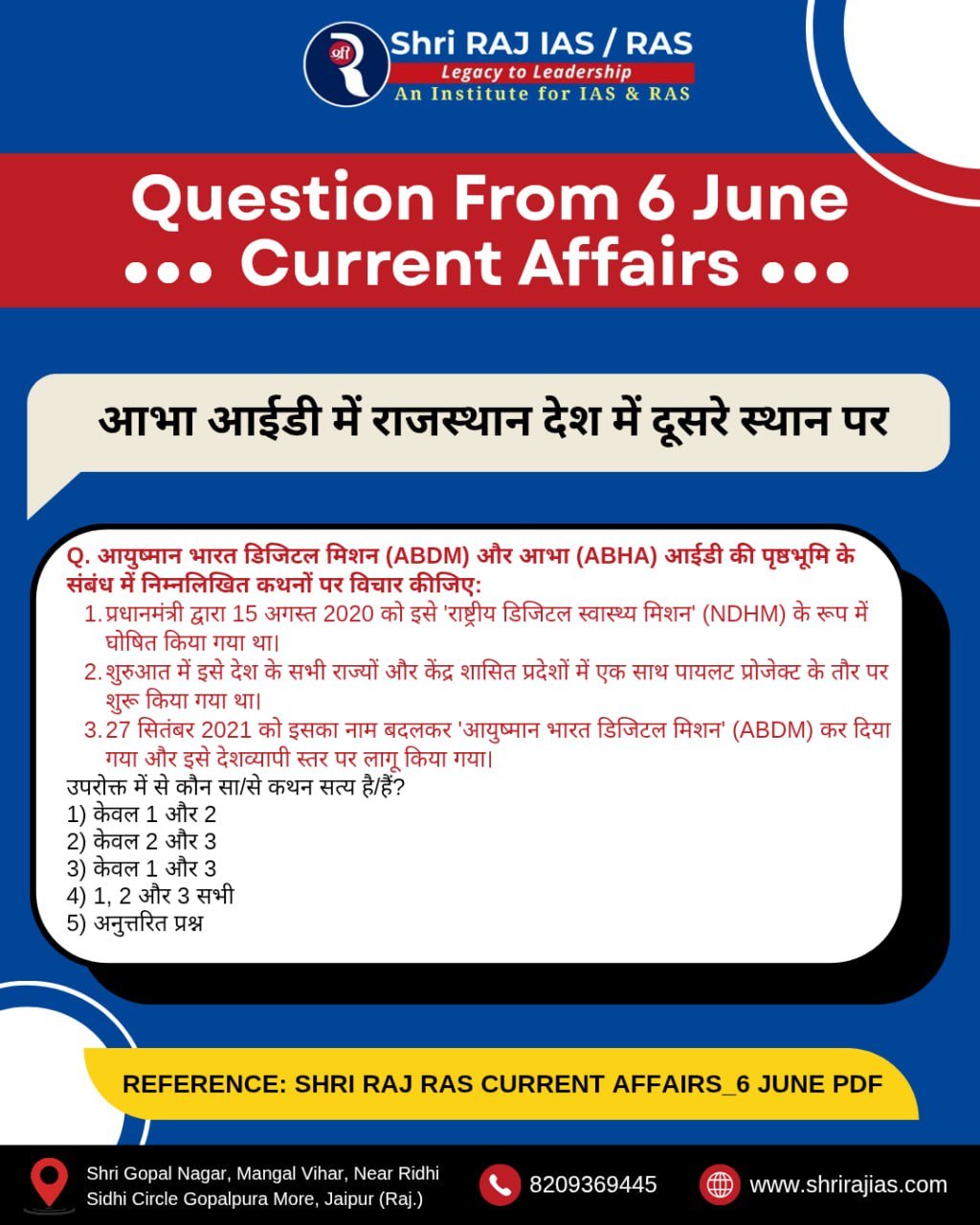
RAS Daily Current Affairs 06-June-2026
Key Highlights: 'आभा आईडी में राजस्थान देश में दूसरे स्थान पर' — Ayushman Bharat Digital Mission (ABDM), ABHA health account generation rankings, digital healthcare delivery, and state implementation analysis.
Current Affairs Magazine Downloads Table
| Date | Magazine / Daily Edition | Key Subject Scope | Download Link |
|---|---|---|---|
| 08-June-2026 | RAS Daily Current Affairs (08-June-2026) | Ramgarh Dam River Encroachments, Rajasthan Water Governance & State Schemes | 📥 Open PDF |
| 06-June-2026 | RAS Daily Current Affairs (06-June-2026) | ABHA ID National Health Rankings, Ayushman Bharat Digital Mission (ABDM) in Rajasthan | 📥 Open PDF |
ALL RAJASTHAN RAS PRE MOCK TEST
Download official All Rajasthan RAS Prelims Mock Tests conducted by Shri Raj IAS, complete with the question booklet and exhaustive bilingual answer keys with step-by-step explanations.
Shri Raj IAS All Raj. RAS PRE MOCK TEST- 01
Full-scale simulation mapped strictly to the RPSC syllabus. Tests Rajasthan History, Art, Culture, Geography, Economy, Polity, Science & Tech, Reasoning, and Current Affairs with exact ⅓ negative marking penalty.
Mock Test Question Booklet & Solutions Directory
| Date | Document / Paper Title | Type | Medium | Download Link |
|---|---|---|---|---|
| 08-June-2026 |
Shri Raj IAS All Raj. RAS PRE MOCK TEST- 01
Complete 150-Question Examination Paper Booklet
|
Question Paper | Bilingual (Hindi + English) | 📥 Download Test 01 PDF |
| 08-June-2026 |
All Raj. RAS PRE MOCK TEST- 01 (Answers and Explanation)
Detailed solution booklet with background context & fact sheets
|
Answer Key & Solution | ENGLISH Medium | 📥 Download English Key |
| 08-June-2026 |
All Raj. RAS PRE MOCK TEST- 01 (Answers and Explanation)
विस्तृत उत्तर कुंजी एवं व्याख्यात्मक हल पुस्तिका
|
Answer Key & Solution | HINDI Medium | 📥 Download Hindi Key |
RPSC RAS Subject-Wise Weightage & PYQ Trends
Strategic breakdown of marks distribution across Rajasthan History, Art, Culture, Geography, Economy, Science & Tech, and Reasoning to optimize your study time.
| Subject / Module | Average Questions in Prelims | Marks Share in Prelims | Mains Paper Alignment |
|---|---|---|---|
| History, Art, Culture & Heritage of Rajasthan | 22 – 25 Questions | ~30 – 34 Marks | Mains GS Paper-I (Unit 1) |
| Geography of Rajasthan, India & World | 18 – 20 Questions | ~24 – 27 Marks | Mains GS Paper-II (Unit 3) |
| Economy of Rajasthan & State Budget | 15 – 18 Questions | ~20 – 24 Marks | Mains GS Paper-I (Unit 2) |
| Indian Polity & Rajasthan Governance | 20 – 24 Questions | ~27 – 32 Marks | Mains GS Paper-III (Unit 1 & 2) |
| General Science & Technology | 18 – 20 Questions | ~24 – 27 Marks | Mains GS Paper-II (Unit 2) |
| Logical Reasoning & Mental Ability | 20 Questions | ~26.6 Marks | Prelims Specific |
| Current Affairs (Rajasthan, National & International) | 20 – 22 Questions | ~27 – 30 Marks | Pre + Mains Integration |
| Total Prelims Paper | 150 Questions | 200 Marks | Screening Cutoff Gate |
Strategic Takeaway: Rajasthan-specific content (History, Culture, Geography, Economy, and Current Affairs) alone accounts for over 65–70 questions (85–95 marks) in Prelims. Mastering Rajasthan GK guarantees clearing the Prelims cutoff comfortably.