
$49 Billion Inflows in Two Months: Why Is the Indian Rupee Still Weak?
In 2 months, $49 billion (around ₹4 lakh crore) in foreign investment came into India — but the rupee didn’t get the same boost it got in 2013.
Why in News
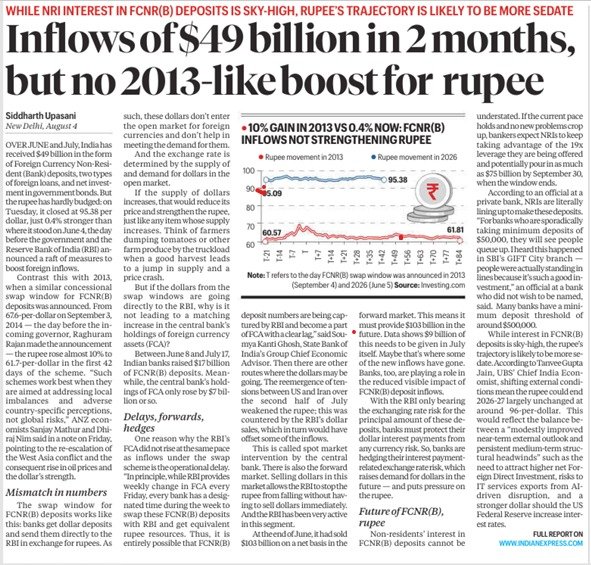
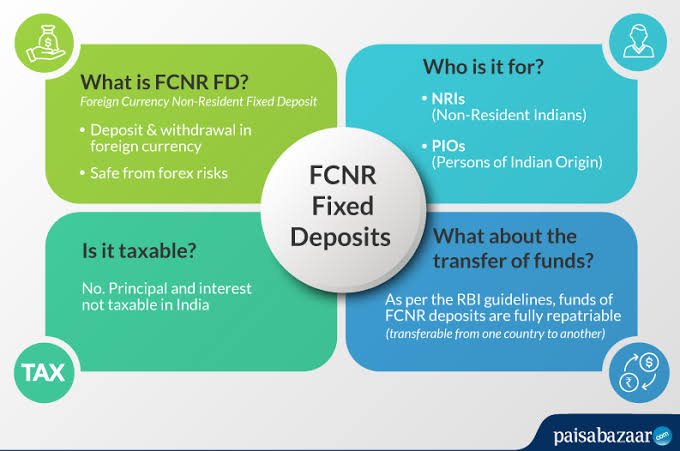
The Reserve Bank of India (RBI) started a special FCNR(B) deposit window in June 2026. The main goal was simple — attract more foreign currency deposits from Non-Resident Indians (NRIs). And it worked really well. In just two months, June and July 2026, this scheme brought in close to $49 billion in inflows.
But here’s the twist. Back in 2013, when RBI ran a similar scheme, the rupee shot up by almost 10%. This time, even with such huge inflows, the rupee has appreciated by only about 0.4%. So we have a strange situation — Inflows of $49 billion in 2 months, but no 2013-like boost for rupee. Let’s understand why this is happening, step by step, in the simplest way possible.
UPSC Relevance
This topic comes under Economy, and is especially important for Prelims. It covers two major areas:
- Banking
- External Sector
Both of these are regular favourites in UPSC Economy questions, so this topic is worth remembering well.
UPSC Prelims 2022 Question
- With reference to the Indian economy, consider the following statements:
- If the inflation is too high, Reserve Bank of India (RBI) is likely to buy government securities.
- If the rupee is rapidly depreciating, RBI is likely to sell dollars in the market.
- If interest rates in the USA or European Union were to fall, that is likely to induce RBI to buy dollars.
Which of the statements given above are correct?
- a) 1 and 2 only b) 2 and 3 only c) 1 and 3 only d) All of the above
Simple explanation:
- Statement 1 is wrong. If inflation is too high, RBI actually sells government securities to pull money out of the system, not buy them.
- Statement 2 is correct. When the rupee falls too fast, RBI sells dollars in the market to slow down the fall and support the rupee.
- Statement 3 is correct. If interest rates abroad fall, investors look for better returns elsewhere, so more dollars flow into India. This gives RBI a good chance to buy those dollars and add them to its reserves.
So, the correct answer is (b) 2 and 3 only.
This question shows why understanding how RBI manages the rupee and dollar supply is so useful for the exam — and it links perfectly with what is happening with the FCNR(B) scheme today.
Why Did RBI Launch This Scheme?
India was facing a mix of problems, and this scheme was RBI’s way of tackling them together:
- ✔ Pressure on the Rupee
- ✔ Global uncertainty
- ✔ Need to improve foreign exchange liquidity
- ✔ Strengthen Forex reserves
In short, RBI wanted a cushion of extra dollars to keep the economy safe from global shocks, and FCNR(B) deposits from NRIs were an easy way to build that cushion.
What is Buy-Sell, Sell-Buy Swap Operation?

This is the real engine behind the whole scheme, so let’s break it down in the easiest way.
Sell-Buy Operation
Think of it as a simple swap between RBI and banks. RBI sells dollars to the banks first, and later buys back the same dollars at the end of the swap period. That is why it is called a sell-buy swap.
This works in two easy steps:
- ✔ Step 1: The bank buys US Dollars from RBI at the exchange rate that is running at that time.
- ✔ Step 2: At the end of the swap period, the bank sells back the same dollars to RBI and gets rupees in return.
So basically, RBI’s dollars get swapped temporarily with the bank’s rupees, for a fixed time period. This is used mainly:
- To check rupee depreciation
- To inject dollars into the system when needed
Note: A buy-sell swap works exactly the opposite way — RBI buys dollars first and sells them back later.
Impacts of This Swap
- ✔ Increases dollar supply, which normally helps the rupee appreciate
- ✔ Helps check exchange rate volatility (keeps the rupee from swinging too much)
- ✔ Leads to a decrease in RBI’s own forex reserves during the swap period
The Big Question — Why Didn't the Rupee Appreciate This Time?
This is the most important part of the whole story. Even with $49 billion coming in, the rupee barely moved. Here’s why:
- Dollars are not entering the open forex market. Banks hand over the dollars directly to RBI. So these dollars never actually reach the open market, and the extra dollar supply that normally pushes the rupee up simply doesn’t happen.
- RBI is keeping these dollars as reserves, instead of letting them circulate in the market. This adds to India’s Foreign Exchange Reserves, but it doesn’t give the rupee the boost that market circulation would.
- Banks get specific days each week to swap their FCNR(B) deposits with RBI. This spreads out the flow and softens any sudden impact on the rupee.
- Many banks are selling dollars in the forward market, instead of selling them immediately in the spot market. Forward market deals don’t move the exchange rate the same way spot deals do, so the visible effect on the rupee stays limited.
- Banks are hedging their risk. Since banks must protect themselves from exchange rate risk and interest rate risk, they hedge their exposure. This hedging activity also takes away some of the pressure that would have otherwise pushed the rupee up.
Put simply — in 2013, the dollars actually reached the market and pushed the rupee up sharply. This time, the dollars are mostly sitting with RBI as reserves, so the rupee’s movement has stayed calm and steady.
Benefits of the FCNR(B) Scheme
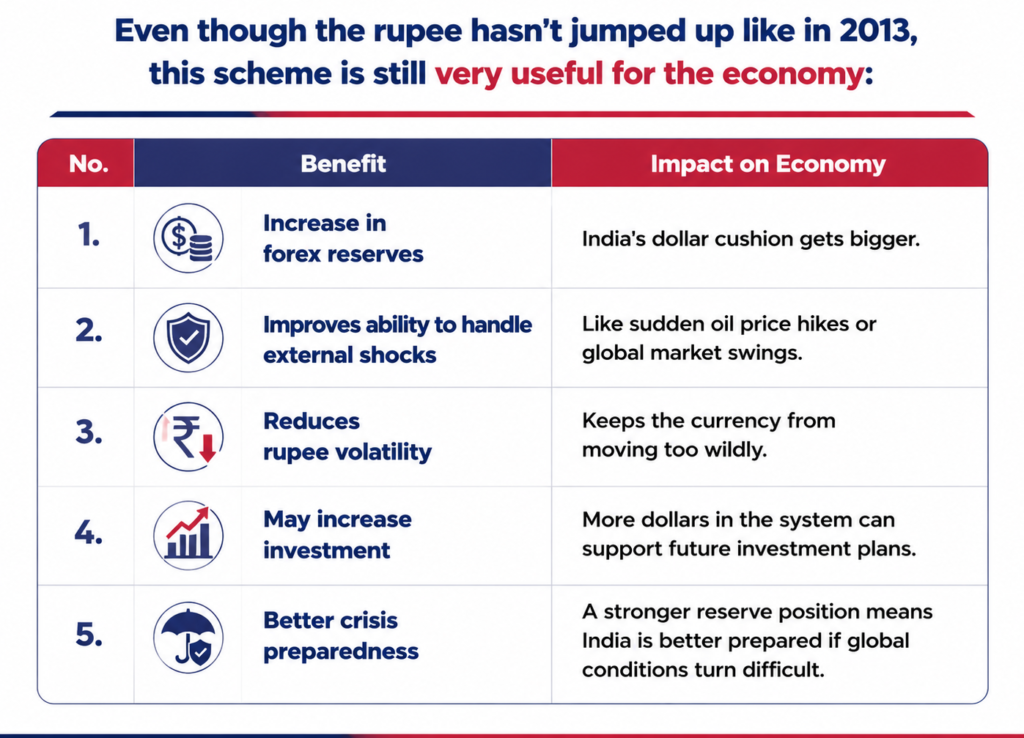
Even though the rupee hasn’t jumped up like in 2013, this scheme is still very useful for the economy:
- Increase in forex reserves — India’s dollar cushion gets bigger.
- Improves ability to handle external shocks — like sudden oil price hikes or global market swings.
- Reduces rupee volatility — keeps the currency from moving too wildly.
- May increase investment — more dollars in the system can support future investment plans.
- Better crisis preparedness — a stronger reserve position means India is better prepared if global conditions turn difficult.
Final Thoughts
The story of Inflows of $49 billion in 2 months, but no 2013-like boost for rupee teaches us an important lesson — a big inflow of dollars doesn’t always mean a big jump in the currency’s value. What really matters is where those dollars go. If they stay with RBI as reserves instead of flowing into the open market, the rupee stays calm even when the inflows are huge.
For UPSC aspirants, this is a perfect real-world case to understand FCNR(B) deposits, the sell-buy swap mechanism, and how RBI manages the rupee and India’s external sector — topics that keep coming back in the Prelims exam, just like the 2022 question we discussed above.
For More Information
📞 Call: +91-9355532555
🌐 Website: www.shrirajias.com