
Why in news
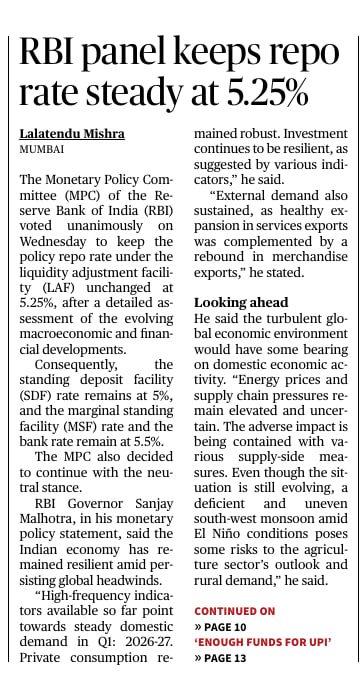
The Reserve Bank of India’s Monetary Policy Committee (MPC) has unanimously decided to keep the Repo Rate unchanged at 5.25% under the Liquidity Adjustment Facility (LAF). The decision reflects the RBI’s cautious approach as domestic growth remains resilient but global uncertainties continue.
UPSC Relevance
Banking Sector
Why did RBI keep the Repo Rate unchanged?
Domestic Economy Remains Strong
According to RBI Governor Sanjay Malhotra:
- High-frequency indicators suggest steady economic activity.
- Private consumption remains robust.
- Investment demand is resilient.
- Manufacturing and services sectors continue to perform well.
Monetary Policy Committee
Monetary Policy Committee was constituted in 2016 as a statutory body under the RBI Act(1934) in order to formulate monetary ppolicy in India.
Composition
Total Members 6 including RBI chairperson
- RBI Governor – ex-officio chairperson (permanent Chairman during committee meeting)
- RBI Deputy Governor
- One more member from RBI to be nominated by the Central Board of Directors.
- 3 other members are be appointed by the Central Government.
Term: Members of MPC hold office for a period of four years and are not eligible for re-appointment.
Meetings: The MPC is required to meet at least four times in a year.
Quorum: 4 members.
Decision: The MPC takes decision based on majority vote (by those who are present and voting. In case of a tie, the RBI governor will have the second or casting vote. The decision of the committee would be binding on the RBI.
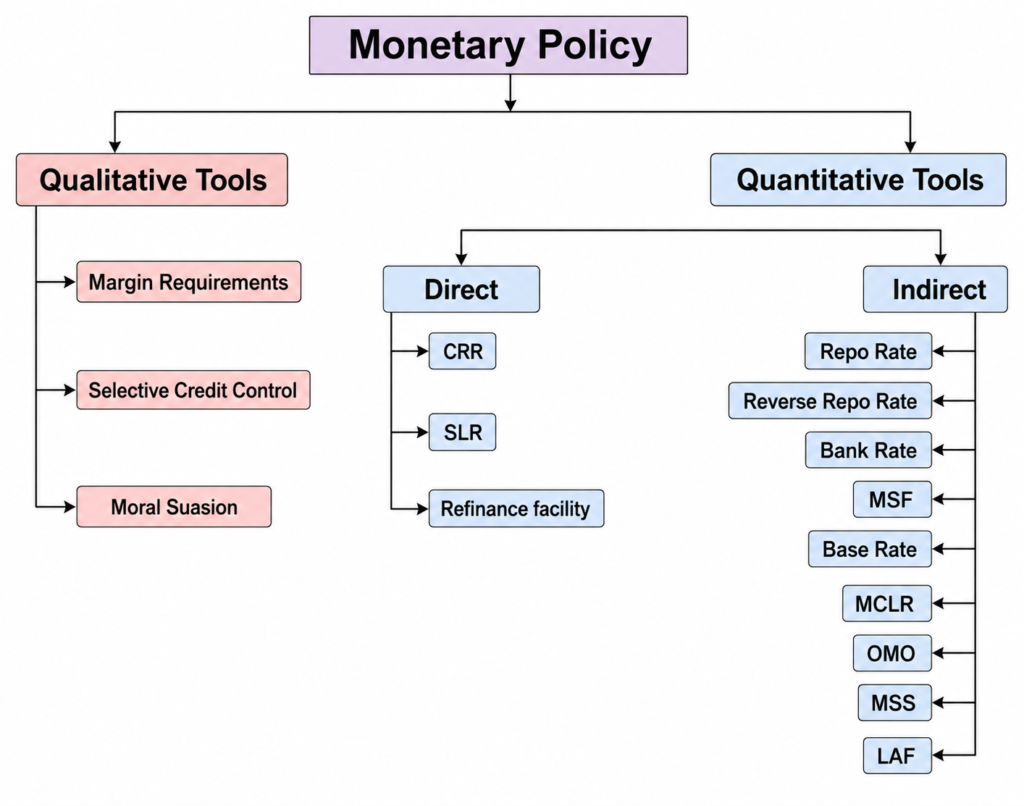
MPC Tools
Quantitative tools
Repo Rate

Repo rate refers to the interest rate at which the RBI provides short-term liquidity to banks against the collateral of government securities.
Note:- Vice-versa in case of reverse repo rate
Bank Rate
Rate at which RBI provides long-term borrowings to its clients. Its clients include GoI, state governments, banks, financial institutions, cooperative banks etc. An increase in bank rate will make borrowing from RBI expensive and hence money supply will tend to decrease.
CRR(Cash Reserve Ratio)
CRR refers to the percentage of total deposits of a bank to be kept with RBI in the form of cash only.
SLR(Statutory Liquidity Ratio)
SLR refers to the percentage of total deposits of a bank to be kept with itself in the form of liquid assets such as cash, gold, government securities such as T-Bills, Dated Securities, State Development loans (SDLs) and other eligible securities such as Oil Bonds.
Note- Increase in Rates will tends to decrease money supply or Liquidity in the market and Vice-Versa
Open Market Operation
OMO refers to sale and purchase of government securities by RBI in the open market with the aim of
influencing liquidity in the economy in the medium term.
MSF(Marginal Standing Facility)
- Liquidity management window under which banks can borrow additional overnight liquidity over and above LAF window.
- Under Repo, banks can borrow overnight liquidity only by pledging securities over and above the securities held under SLR requirement.
Qualitative tools
Margin requirements:
Margin refers to the difference between the Loan and Collateral value. The RBI may lay down different margin requirements for different categories of loans (Vehicle, Home, Business etc) to control credit to different sectors.
Consumer Credit Regulation:
RBI can issue rules to set the minimum/maximum level of down-payments
and periods of payments for purchase of certain goods.
Rationing of credit:
Rationing of credit is a method by which the RBI seeks to limit the maximum amount of loans and advances and, also in certain cases, fix ceiling for specific categories of loans and advances.
Moral Suasion:
Is a milder form of credit control in which the RBI can persuade the commercial banks to co-operate with the general monetary policy. Since it involves no administrative compulsion or threats of punitive action it is a psychological and informal means of selective credit control.
Direct Action:
This step is taken by the RBI against banks that don’t fulfil conditions and requirements.
Note:- https://www.rbi.org.in
For Reference you can Visit
Practice Question
Q. Which of the following statements is/are correct regarding the Monetary Policy Committee (MPC)?
- It decides the RBI’s benchmark interest rates,
- It is a 12-member body including the Governor of RBI and is reconstituted every year.
- It functions under the chairmanship of the Union Finance Minister.
Select the correct answer using the code given below:
a) 1 only
b) 1 and 2 only
c) 3 only
d) 2 and 3 only
Q. If the RBI decides to adopt an expansionist monetary policy, which of the following would it not do?
- Cut and optimize the Statutory Liquidity Ratio
- Increase the Marginal Standing Facility Rate
- Cut the Bank Rate and Repo Rate
Select the correct answer using the code given below:
a) 1 and 2 only
b) 2 only
c) 1 and 3 only
d) 1, 2 and 3