
IAS Training at LBSNAA: What Happens After UPSC Selection?
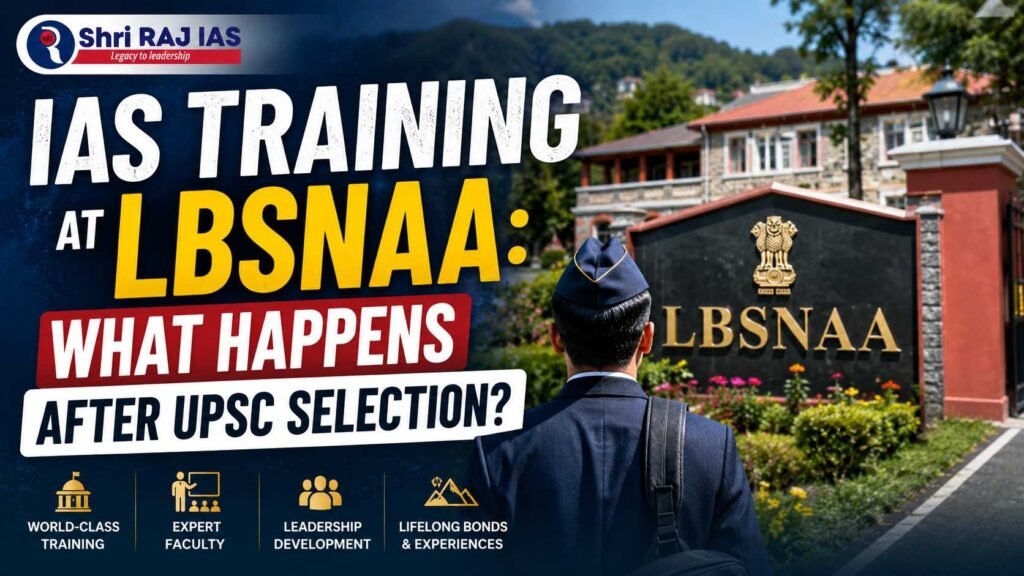
Congratulations! You’ve cracked one of India’s toughest examinations – the UPSC Civil Services Examination. But your journey to becoming an IAS officer doesn’t end here. In fact, it’s just the beginning. At Shri RAJ IAS, we often receive questions from our successful candidates about what happens next. The answer lies in the prestigious IAS training at LBSNAA – the Lal Bahadur Shastri National Academy of Administration in Mussoorie.
As Delhi’s leading UPSC coaching institute, we believe in preparing our students not just for the examination, but for the entire journey ahead. Let me walk you through everything you need to know about the training that transforms a UPSC qualifier into a fully-fledged civil servant.
Most aspirants spend years preparing for the exam and very little time understanding what happens after selection. At Shri Raj IAS, we believe that knowing the full journey — not just the exam — makes you a better, more motivated candidate.
So today, let us walk you through everything that happens after UPSC selection, right up to your first posting as an IAS officer. This is the most detailed guide on IAS training at LBSNAA you will find anywhere.
What is LBSNAA?
LBSNAA full form is the Lal Bahadur Shastri National Academy of Administration. It is India’s premier civil services training institution, named after the nation’s second Prime Minister, Lal Bahadur Shastri. The academy was established in 1959 and has been shaping India’s administrative backbone ever since.
The LBSNAA motto — “Sheelam Param Bhushanam” — translates to “Character is the highest ornament.” Every element of the training programme at the academy is designed around this philosophy.
Who goes to LBSNAA after UPSC? Officers selected for the Indian Administrative Service (IAS), Indian Police Service (IPS), Indian Foreign Service (IFS), Indian Revenue Service (IRS), and several other Group A Central Services all begin their careers here. It is the one place where India’s future district collectors, senior police officers, and foreign diplomats share the same classroom and the same riding track.
| Service | Trains at LBSNAA |
| Indian Administrative Service (IAS) | Foundation Course + Phase I & II |
| Indian Police Service (IPS) | Foundation Course only, then SVPNPA |
| Indian Foreign Service (IFS) | Foundation Course only, then SSIFS |
| Indian Revenue Service (IRS) | Foundation Course |
| Other Group A Central Services | Foundation Course |
After the common Foundation Course, IPS officers move to Sardar Vallabhbhai Patel National Police Academy (SVPNPA) in Hyderabad for specialised police training — which is the key difference between IAS and IPS training paths.
What Happens After UPSC Final Result?
The period between your UPSC final result and your first day at LBSNAA involves several important administrative steps. Here is the IAS joining process step by step:
Step 1 — Cadre Allotment
After the final merit list, the government publishes cadre allotment for all IAS-selected candidates. The allotment of IAS cadre depends on your rank, preference, category, and the cadre vacancy available in a given year. This is done by the Ministry of Personnel, Public Grievances and Pensions.
Step 2 — Medical Examination
A mandatory medical exam after UPSC selection is conducted at designated government hospitals. The medical standards for IAS are defined under the Civil Services (Medical Examination) Rules. Candidates must meet the required physical and medical fitness criteria.
Step 3 — Document Verification
Document verification for LBSNAA follows the medical exam. You will be asked to submit originals and attested copies of your mark sheets, degree certificates, identity proof, caste certificate (if applicable), and the UPSC admit card and scorecard.
Step 4 — Joining Instructions
Once documents are verified and cadre is allotted, you receive official joining instructions from the Department of Personnel & Training (DoPT). These specify your reporting date, dress requirements, and items to bring.
Time Gap Between Result and Training
Typically, the time gap between the UPSC final result and LBSNAA reporting is around 3 to 6 months, accounting for cadre allotment, medical examination, document verification, and administrative processing.
| Stage | Approximate Timeline |
| UPSC Final Result Declared | Month 0 |
| Cadre Allotment Published | Month 1–2 |
| Medical Examination | Month 2–3 |
| Document Verification | Month 3–4 |
| Joining LBSNAA | Month 4–6 |
LBSNAA Location, Campus & How to Reach
Location and Weather
LBSNAA is located in Mussoorie, Uttarakhand, a Himalayan hill station at approximately 2,000 metres above sea level. The academy is perched amidst forests and mountains with panoramic views of the Doon Valley.
The weather at LBSNAA Mussoorie is a far cry from the heat of most Indian cities. Summers are pleasantly cool (15–25°C), while winters can be biting cold, often dropping below freezing with snowfall. Probationers are advised to carry warm clothing even when joining in summer months.
How to Reach LBSNAA Mussoorie
The nearest major city is Dehradun, approximately 35 kilometres from Mussoorie.
| Mode | Route |
| By Train | Nearest railway station: Dehradun Railway Station |
| By Air | Nearest airport: Jolly Grant Airport, Dehradun (~60 km) |
| By Road | From Dehradun, Mussoorie is well connected by road (NH707A) |
| From Delhi | ~300 km via NH58 or by taking a train to Dehradun |
LBSNAA Campus and Hostel Facilities
The campus is spread across a large, well-maintained estate with colonial-era architecture blending into the mountain landscape. The hostel rooms are comfortable single-occupancy rooms with attached bathrooms — modest but adequate for the life of focused training.
Campus facilities include a well-stocked library, seminar and lecture halls, a gymnasium, swimming pool, outdoor sports grounds, equestrian facilities (for the famous horse riding sessions), a medical centre, and a dining mess. The mess food follows a nutritious institutional format, with deductions made from the probationer’s monthly salary to cover mess charges.
There is a specific dress code and etiquette that probationers are expected to follow — formal attire for academic sessions, sports gear for PT, and traditional Indian wear during cultural events. Discipline and punctuality are considered non-negotiable aspects of life on campus.
IAS Training Duration & Phases
LBSNAA training duration spans approximately two years in total, broken into distinct phases. Here is a comprehensive breakdown:
| Training Phase | Duration | Location |
| Foundation Course | 15 weeks | LBSNAA, Mussoorie |
| Phase I Training (IAS-specific) | ~26 weeks | LBSNAA, Mussoorie |
| Bharat Darshan (National Study Tour) | ~4 weeks | Multiple states across India |
| District Training (Probationer Posting) | ~52 weeks | Allotted cadre state |
| Assistant Secretary Training | ~8 weeks | Central Ministries, New Delhi |
| Phase II Training | ~8 weeks | LBSNAA, Mussoorie |
The Foundation Course (15 Weeks)
The LBSNAA Foundation Course duration of 15 weeks is the most iconic phase. All civil service probationers — IAS, IPS, IFS, IRS, and others — train together here, forging lifelong professional bonds across services. The Foundation Course emphasises constitutional values, governance basics, national integration, ethics, physical fitness, and leadership.
Phase I Training
IAS Phase I training at LBSNAA is where the IAS-specific curriculum deepens. Law, administration, public policy, financial management, and state-specific governance structures are covered in detail. This phase also includes the famous Bharat Darshan, a national study tour that takes probationers across different regions of India to experience governance challenges firsthand.
District Training Period
The IAS district training period is arguably the most transformative. Probationers are posted to districts in their allotted cadre state for approximately one year. During this time, they work under senior IAS officers, observe revenue administration, engage with block-level governance, and begin understanding the real ground reality of public service. This is where theory meets practice.
Phase II Training and Assistant Secretary Posting
After district training, probationers return to LBSNAA for Phase II training, which focuses on advanced policy modules and assessment. This is followed by an assistant secretary training posting at a Central Ministry in New Delhi, where probationers work directly within the machinery of the Union Government.
LBSNAA Training Curriculum & Subjects
The LBSNAA training curriculum is far more comprehensive than most people imagine. It is not a university — it is a finishing school for future administrators, combining academic rigour with physical training, cultural exposure, and real-world field experience.
Foundation Course Syllabus
| Subject Area | Key Topics Covered |
| Constitution & Law | Indian Constitution, IPC, CrPC, Evidence Act, Land Laws |
| Public Administration | Governance structures, policy implementation, e-governance |
| Economics & Development | Macro-economics, rural economy, public finance |
| Ethics & Integrity | Case studies, moral reasoning, anti-corruption framework |
| History & Culture | Indian civilisation, national integration, regional diversity |
| Language Training | Hindi proficiency + regional language of allotted cadre |
| Physical Training | Fitness, horse riding, outdoor activities, trekking |
| Leadership & Management | Team dynamics, crisis response, communication skills |
Language Training for IAS Officers
One area that surprises many new probationers is the language training for IAS officers. Beyond Hindi, probationers are required to learn the primary language of their allotted cadre state. An officer allotted to Tamil Nadu will train in Tamil; one going to Rajasthan will focus on Rajasthani cultural and linguistic orientation. This is essential for ground-level administration.
Law and Administration Courses for IAS
Law and administration courses for IAS form the backbone of Phase I training. Revenue law, land acquisition laws, public order maintenance, and judicial procedures are covered so that an IAS officer is legally equipped from day one of field posting.
Exam and Grading
LBSNAA exam and grading happens at multiple points during training. Probationers are assessed through written exams, presentations, field assignments, and physical tests. These grades form part of the overall probation assessment and can influence future career trajectory. Poor performance may result in the extension of the probationary period.
Mission Karmayogi and iGOT Platform
The government’s Mission Karmayogi initiative has now integrated digital learning into civil service training. The iGOT Karmayogi platform supplements in-person training with online competency-based modules that IAS officers continue using even after confirmation.
Daily Routine & Life at LBSNAA
Life at LBSNAA Mussoorie is demanding, structured, and unlike anything a civilian lifestyle offers. Ask any IAS officer about their time here and they will almost certainly call it one of the most memorable periods of their life.
A Typical Day at LBSNAA
| Time | Activity |
| 5:30 AM – 7:00 AM | Physical Training / Horse Riding |
| 7:00 AM – 9:00 AM | Personal Time, Breakfast at Mess |
| 9:30 AM – 1:30 PM | Academic Sessions / Lectures |
| 2:30 PM – 5:30 PM | Group Projects, Workshops, Field Visits |
| Evening | Sports, Cultural Events, Self-Study |
| Post-Dinner | Informal peer discussions, reading |
Horse Riding and Physical Fitness Training
Horse riding training at LBSNAA is one of the most talked-about aspects of the programme — and for good reason. It is compulsory, conducted on the academy’s own equestrian grounds, and serves a purpose beyond the literal. It builds posture, discipline, and a composure that reflects in an officer’s bearing for the rest of their career.
Physical fitness training is non-negotiable throughout the training period. Early morning PT sessions, outdoor treks through the Mussoorie hills, and sports activities are integral to the daily schedule. The academy does not allow sedentary habits.
LBSNAA Sangam Programme
The LBSNAA Sangam programme is a structured initiative that brings IAS, IPS, and IFS probationers together for joint sessions, discussions, and activities. The idea is to build mutual understanding and respect across services — officers who will spend their careers interacting with each other begin building those professional relationships from day one.
Zonal Day Celebrations
Zonal Day celebration at LBSNAA is one of the most vibrant cultural events on campus. Probationers are grouped by their cadre zones and each group celebrates the culture, cuisine, folk music, dance, and traditions of their allotted states. It is joyful, deeply educational, and builds a sense of pride in one’s cadre.
Is LBSNAA Training Hard?
Honestly — yes. The schedule is packed, the physical demands are real, and there is constant assessment. But it is hard in a purposeful way. Every element of the training is designed to push you beyond comfort zones, build resilience, and prepare you for the extraordinary responsibility of administering a district of a million people. Most officers look back at their LBSNAA days with deep affection.
IAS Salary & Stipend During Training
| Salary Component | Details |
| Basic Pay (Level 10, 7th Pay Commission) | ₹56,100 per month |
| Dearness Allowance (DA) | As applicable |
| House Rent Allowance | Not applicable (campus accommodation provided) |
| Mess Deductions | Deducted from salary for food |
| Other Deductions | NPS contribution, other statutory deductions |
| Approximate In-Hand | ₹45,000–₹50,000 (after deductions) |
After LBSNAA: First Posting & Career Path
IAS First Posting After Training
After completing all training phases, the IAS probationer receives their first independent posting. Typically, the first posting of an IAS officer after training is as a Sub Divisional Magistrate (SDM) — a critical field role that involves revenue administration, law and order, land records, and local governance.
IAS Officer Roles After Training
| Stage | Role / Posting |
| After District Training | Sub Divisional Magistrate (SDM) in allotted state |
| Mid-career | District Collector / District Magistrate |
| Senior level | Secretary to State Government / Joint Secretary at Centre |
| Senior IAS | Additional Secretary / Secretary to Government of India |
The role of District Collector is often considered the most iconic in the IAS career. It is the posting where an officer is truly the face of the government for millions of citizens — overseeing disaster management, land administration, law enforcement coordination, and development schemes.
IAS Probation Period and Presidential Confirmation
The IAS probation period typically lasts two years. At the end of this period, after satisfactory completion of all training phases and assessments, the officer is formally confirmed as an IAS officer by the President of India. This presidential confirmation is a constitutional formality that marks the permanent induction of the officer into the All India Services.
IAS Promotion Path After Confirmation
Once confirmed, the IAS promotion path follows a structured seniority-based system with performance overlays:
| Years of Service | Designation |
| 0–4 years | SDM / Deputy Secretary level |
| 5–9 years | District Collector / Joint Secretary |
| 10–16 years | Commissioner / Secretary State Government |
| 17–25 years | Principal Secretary / Joint Secretary GoI |
| 25+ years | Chief Secretary / Secretary to GoI |
Final Thoughts — From Shri Raj IAS
At Shri Raj IAS, we say this to every batch we teach: clearing UPSC is a milestone — but the mission begins at LBSNAA.
The two years of IAS training at LBSNAA are where raw intelligence and hard work transform into governance competence and administrative character. Understanding this journey beforehand gives you the right mindset — not just to crack the exam, but to serve the nation well once you do.
If you are at the beginning of this journey and looking for the right guidance, our faculty at Shri Raj IAS is here to support you every step of the way.
👉 Connect with our team today — let’s plan your UPSC journey together.
Because the right mentor, at the right time, changes everything.
🚀 Contact Us
Secure your seat today (Limited to first 100 candidates):
👉 Visit us : Shri Raj IAS
📞 Call: +91-9355532555
🌐 Website: www.shrirajias.com
Frequently Asked Questions (FAQs)
Q1. How many IAS officers are selected every year?
Approximately 80 to 180 IAS officers are selected annually, depending on the vacancies notified by UPSC. You can check the latest notifications on the UPSC official website.
Q2. What happens after LBSNAA training?
After completing the two-year training period at LBSNAA, IAS officers are posted to their respective state cadres, typically as Sub-Divisional Magistrates (SDMs) or Assistant Collectors. Following Phase II training, officers are assigned to work as Assistant Secretaries in New Delhi under different ministries for about 3 months, gaining experience in central government operations and center-state coordination. After this, the President of India formally confirms their appointment to the service.
Q3. Can married candidates join LBSNAA?
Yes. Marital status is no barrier. Married probationers can join LBSNAA, though campus accommodation arrangements for families may differ from those for single probationers.
Q4. Do IAS trainees get paid while training at LBSNAA?
Yes, IAS trainees receive a monthly salary of Rs 56,100 during their training period. However, after deductions for mess charges, hostel fees, and accommodation, the actual take-home stipend is around Rs 35,000-40,000 per month.
Q5. Do IAS officers get a house after training?
IAS officers typically receive government accommodation after completing their probation and getting posted, usually when they begin serving as Sub Divisional Magistrates. Officers are provided government housing at nominal rent that is significantly lower than market rates, with the type and size of accommodation depending on their rank and posting location. IAS officers generally receive large houses or bungalows with additional facilities like security guards, housekeeping staff, and gardeners.