
UPSC vs State PSC: Which Should You Prepare for First?
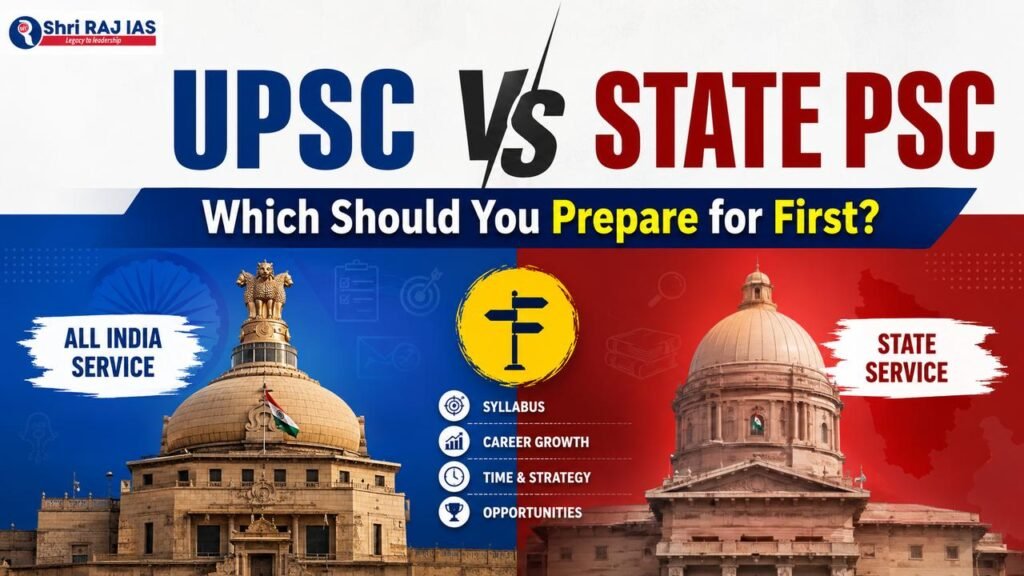
Every year, lakhs of aspirants sit down with the same question in their mind — should I go for UPSC, or should I start with a State PSC exam? This confusion is completely normal. Both paths lead to respected government careers, but they differ in scope, difficulty, eligibility, and career growth. If you are also stuck between UPSC and State PSC, this guide will help you make a clear, informed decision.
Understanding UPSC and State PSC: The Basic Difference
The Union Public Service Commission (UPSC) is a central-level body that conducts the Civil Services Examination (CSE) to recruit officers for services like IAS, IPS, and IFS. These officers can be posted anywhere in the country and even at the central government level.
State Public Service Commissions, on the other hand, are state-level bodies — like UPPSC (Uttar Pradesh), RPSC (Rajasthan), BPSC (Bihar), or MPSC (Maharashtra) — that recruit officers for provincial administrative posts. A State PSC officer usually serves within their home state, handling district-level and state-level administration.
UPSC vs State PSC: Quick Comparison Table
| Feature | UPSC Civil Services | State PSC |
| Conducting Body | Union Public Service Commission (Central) | State-level commission (e.g., UPPSC, RPSC, BPSC) |
| Scope of Posting | Pan-India postings, central deputation | Within the home state only |
| Syllabus Focus | National and international issues, analytical | 20–30% state-specific history, culture, geography |
| Age Limit (General) | 21 to 32 years | Typically 21 to 40 years (varies by state) |
| Attempt Limit | 6 (General), 9 (OBC), unlimited (SC/ST) — within age limit | Usually no fixed attempt limit |
| Competition | Over 10 lakh applicants, ~0.1% selection rate | Comparatively lower, state-restricted pool |
| Career Ceiling | Cabinet Secretary (central level) | Chief Secretary (state level) |
UPSC vs State PSC: Key Differences You Should Know
1. Exam Pattern and Syllabus
UPSC’s syllabus is broad and analytical. It covers national and international issues, and expects candidates to connect topics across subjects like polity, economy, geography, and current affairs. The exam tests depth of understanding, not just memory.
State PSC exams, such as UPPSC or RPSC, follow a similar three-stage pattern (Prelims, Mains, Interview) but with a twist — around 20 to 30 percent of the syllabus focuses on the specific state’s history, culture, geography, and governance. This makes State PSC exams slightly more factual and regional in nature compared to UPSC.
2. UPSC Eligibility Compared with State PSC Eligibility
This is where most students get confused, so let’s break it down clearly.
Educational Qualification: Both UPSC and State PSC exams require a bachelor’s degree from a recognised university. There is no minimum percentage requirement in either case. Final year students awaiting their results are allowed to apply for both UPSC and State PSC exams, though they must submit proof of graduation before the Mains stage.
Age Limit: Here lies one of the biggest differences.
For UPSC Civil Services Examination 2026, the age limit for General and EWS candidates is 21 to 32 years, calculated as of 1 August 2026. OBC candidates can apply up to 35 years, SC/ST candidates up to 37 years, and PwBD candidates get relaxation up to 42 years or more, depending on the category.
For UPPSC (a major State PSC example), the age limit is noticeably wider — 21 to 40 years for General category candidates as of the notified cut-off date, with further relaxation for reserved categories. Most other State PSCs also allow a higher upper age limit than UPSC, generally between 35 and 40 years.
UPSC Age Relaxation vs State PSC Age Relaxation: UPSC provides age relaxation of 3 years for OBC, 5 years for SC/ST, and up to 10 years for PwBD candidates. State PSCs like UPPSC typically offer 5 years of relaxation for OBC and SC/ST candidates within the state’s domicile, though exact numbers vary by state, so always check the official notification.
3. UPSC Attempts vs State PSC Attempts
This is a major deciding factor for many aspirants.
UPSC restricts attempts strictly. General category candidates get 6 attempts, OBC candidates get 9 attempts, and SC/ST candidates get unlimited attempts, but only within their respective age limits.
Most State PSC exams, including UPPSC, do not impose any fixed attempt limit. As long as you fall within the prescribed age bracket, you can appear as many times as you want. This flexibility is one reason many aspirants choose to prepare for a State PSC exam alongside UPSC, since a missed UPSC attempt does not necessarily mean a wasted year.
4. Competition and Selection Rate
UPSC Civil Services Examination attracts over 10 lakh applicants every year for around 900 to 1000 vacancies, making the selection rate roughly 0.1 percent — one of the toughest in the world. State PSC exams, while still competitive, generally see a smaller applicant pool restricted to that state’s residents (for reserved categories), so the competition, though tough, is comparatively more manageable.
5. Career Growth and Postings
UPSC-recruited officers, especially IAS and IPS, get pan-India postings and have a faster path to top administrative roles like Cabinet Secretary at the central level. State PSC officers usually stay within their home state throughout their career, and the highest post they can generally reach is Chief Secretary of that state. This does not mean State PSC careers are lesser — many State PSC officers build extremely fulfilling careers with strong regional influence and quicker on-ground impact.
UPSC vs State PSC: Which Is Better for You?
There is no one-size-fits-all answer here — it truly depends on your personal goals.
Choose UPSC first if:
- You are within the UPSC age bracket and have enough attempts left
- You want a pan-India career and central-level exposure
- You are drawn to policy-making at a national scale
Choose State PSC first if:
- You are closer to the UPSC upper age limit and want to safeguard your career timeline
- You want to serve and grow within your home state
- You prefer a syllabus that overlaps significantly with UPSC but has a regional focus
A smart middle path: Many successful officers actually prepare for both simultaneously, since nearly 70 to 80 percent of the UPSC and State PSC syllabus overlaps at the Prelims level. Preparing for UPSC largely covers your State PSC preparation too, so attempting both in the same year is a common and practical strategy — not an either-or decision for most aspirants.
Can Final Year Students Apply for UPSC and State PSC?
Yes. Both UPSC and most State PSC commissions, including UPPSC, allow final year graduation students to apply. However, you must be able to submit proof of your degree by the time the Mains examination stage begins. If you’re currently in your final year, this is actually a good time to start your preparation for either exam.
Final Thoughts
Both UPSC and State PSC exams open the door to a respected, impactful government career — the real difference lies in scale, timeline, and how much flexibility you need. If you’re young in age with several attempts ahead of you, starting with UPSC makes sense. If you’re watching the age clock or want a stronger regional career, a State PSC exam like UPPSC or RPSC could be your first step. And if you’re unsure, remember that preparing for one usually prepares you for the other too.
At Shri Raj IAS, we guide aspirants through both UPSC and State PSC preparation with structured mentorship, updated study material, and realistic strategy planning based on your age, background, and goals. If you’re still weighing your options, our Rajasthan PSC RAS Exam 2026 guide and Best PCS Coaching in Delhi guide can help you explore the State PSC route in more depth, while our Best IAS Coaching in Delhi page explains how we support UPSC aspirants from day one.
For official and updated details, always refer to the UPSC official website and the UPPSC official website (or your respective State PSC’s website) before applying.
Contact us
For More Information Call: +91-9355532555
 Website: www.shrirajias.com
Frequently Asked Questions
1. UPSC vs State PSC — which is better?
Neither is universally “better” — it depends on your goals. UPSC offers a pan-India career and faster growth to top central posts, while State PSC offers a state-focused career with a wider age limit and no fixed attempt cap in most states. Many aspirants prepare for both together since the syllabus overlaps heavily.
2. Should I choose UPSC or State PSC first?
If you are young with several attempts remaining, starting with UPSC makes sense since it opens both national and state opportunities. If you are closer to the UPSC age limit, starting with a State PSC exam like UPPSC or RPSC is a safer first move.
3. What is the difference between UPSC and State PSC?
UPSC recruits for central and all-India services like IAS and IPS with nationwide postings, while State PSCs recruit for state-level administrative posts limited to that state. Their syllabus, age limit, and attempt rules also differ, as explained in the comparison table above.
4. What is the UPSC age limit compared to State PSC age limit?
UPSC recruits for central and all-India services like IAS and IPS with nationwide postings, while State PSCs recruit for state-level administrative posts limited to that state. Their syllabus, age limit, and attempt rules also differ, as explained in the comparison table above.
5. Can final year students apply for UPSC and State PSC?
Yes, final year graduation students can apply for both UPSC and most State PSC exams, including UPPSC. You will need to submit proof of your degree before the Mains stage.
6. Is there a difference in UPSC attempts vs State PSC attempts?
Yes. UPSC allows 6 attempts for General category, 9 for OBC, and unlimited for SC/ST within the age limit. Most State PSC exams, including UPPSC, do not have a fixed attempt limit — you can appear as many times as you like within the age criteria.