
How Do You Choose the Right UPSC Optional Subject in 2026?
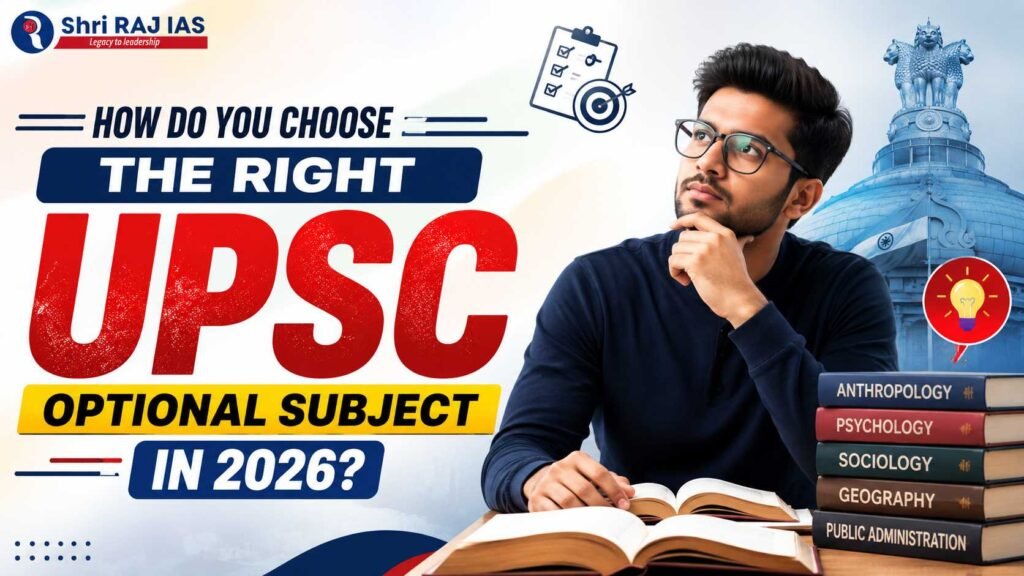
Picking your UPSC Optional Subject is one of the most consequential decisions in your entire UPSC journey — and unlike General Studies, it isn’t fixed by a common syllabus every aspirant shares. It carries 500 marks (250 marks each across two papers) out of the 1,750-mark Mains merit total, which means a single subject choice can genuinely make or break your final rank.
Yet every year, thousands of aspirants pick their UPSC Optional Subject based on a friend’s suggestion, a topper’s interview, or plain guesswork — and regret it months later, when revision starts feeling like a grind instead of a habit. This guide answers the real questions aspirants ask about their UPSC Mains optional subject, in roughly the order you’d naturally ask them, so you can make this decision once and get back to actual preparation.
What Exactly Is a UPSC Optional Subject, and Why Does It Carry So Much Weight?
Your UPSC Optional Subject consists of two papers of 250 marks each — 500 marks total — out of the 1,750 marks that decide your Mains merit list. That’s more than a quarter of your entire written score, decided almost entirely by a subject you choose yourself, from among the 48 optional subjects UPSC currently offers (25 core disciplines plus 23 literature options). You can verify the current list and detailed unit-wise syllabus for every subject on the official UPSC syllabus page.
Unlike General Studies, where every aspirant answers an identical paper and scores tend to cluster in a narrow band, marks in the optional subject can vary widely from one candidate to another. A well-matched optional, prepared with genuine interest, can pull your total score up in a way GS rarely allows. A poorly matched one can quietly drag your rank down even when your GS preparation is otherwise solid.
Why Does the Right UPSC Optional Subject Matter So Much for Your Final Rank?
Because GS scores cluster together, your UPSC Optional Subject is often the actual difference between a good rank and a great one. Two candidates with near-identical GS totals can finish hundreds of ranks apart purely because one chose an optional that matched their strengths and answer-writing style, while the other didn’t.
This is exactly why the decision deserves real time upfront, not a rushed guess in the first week of preparation. Aspirants who treat their optional subject choice as an afterthought often spend a full year quietly fighting their own syllabus, while those who choose deliberately end up looking forward to revising it instead.
Should You Choose Your UPSC Optional Subject Based on Your Academic Background?
Your academic background is a reasonable starting point — not a rulebook. If you already hold a strong undergraduate foundation in History, Sociology, Political Science, Geography, Public Administration, or a language literature, you’ll genuinely save time on groundwork, since you already know the core concepts and terminology.
That said, plenty of toppers each year choose a UPSC Optional Subject with no connection to their degree at all. Engineers regularly pick Sociology. Doctors pick Anthropology. What matters more than your degree on paper is whether the subject genuinely interests you and whether it works well alongside your General Studies preparation. Background can help you start faster — it shouldn’t be the only factor that decides your final choice.
Which UPSC Optional Subjects Overlap Best With General Studies?
This is where an informed choice earns you real, measurable time. Some optionals overlap so heavily with GS papers that preparing for one effectively prepares you for the other too — a GS overlap aspirants often call double preparation mileage:
- Sociology optional — overlaps with GS-I (Indian Society) and GS-II (Social Justice)
- Public Administration optional — overlaps with GS-II (Governance) and GS-IV (Ethics)
- PSIR (Political Science & International Relations) — overlaps almost entirely with GS-II
- Geography optional — overlaps with GS-I (Geography) and also helps directly in Prelims
- History optional — overlaps with GS-I (Art & Culture, Modern India)
- Anthropology optional — overlaps with GS-I (Society) and is known for a compact, static syllabus
Choosing a UPSC Optional Subject with strong GS overlap means less brand-new content to learn from scratch — and more hours available for revision, answer writing, and test series instead of endless first reads. This is one of the single biggest efficiency gains available anywhere in your preparation timeline, and it’s worth weighing seriously even if the subject isn’t your first instinctive choice.
Should You Choose a UPSC Optional Subject Just Because It's Trending Among Toppers?
Topper interviews and success-rate data get shared constantly, and they’re genuinely tempting to lean on when you’re unsure. But treat this kind of data with real caution. A subject “trending” among toppers in a given year often simply means more well-prepared aspirants happened to choose it that year — not that the subject itself guarantees marks for anyone who picks it.
Use topper trends as one input among many when picking your UPSC Optional Subject, never as the deciding factor on their own — the aspirant behind that result also brought their own background and 12–18 months of consistent effort, which won’t automatically transfer to you.
How Can You Test Your Interest in an Optional Subject Before Finalizing It?
Before you lock anything in, give yourself a genuine trial period: spend 10–14 days actually working through the basic syllabus and a couple of standard books for your top two shortlisted options, not just skimming a summary.
Pay close attention to how you actually feel during those two weeks. Are you retaining the concepts without forcing it? Do you find yourself wanting to read more, or does every session feel like a chore you’re pushing through? Sustained interest over 12–18 months of daily preparation matters far more than any list ranking “scoring” subjects online — and a two-week trial is the fastest, most honest way to find out which UPSC Optional Subject genuinely holds your attention.
Should You Review Previous Year Papers Before Finalizing Your Subject?
Yes, and it’s a step most aspirants skip entirely. Pull the last four or five years of previous year question papers for your shortlisted options and read the actual questions, not just the syllabus topics they’re drawn from — the official syllabus and exam pattern are laid out in full on the UPSC website. Notice how each question is framed — are you being asked to simply define and describe, or to analyze, compare, and take a stance? That framing tells you far more about a paper’s real demand than the syllabus topic list ever will.
Then take it one step further: pick two or three of those real previous year questions and write full answers under timed conditions, exactly as you would in the actual exam. This single exercise often reveals more in one afternoon than weeks of casual reading, because it forces you to test the gap between understanding a topic and actually building a scoring answer on it in twenty-five minutes.
Does Your Answer-Writing Style Matter
It matters more than most aspirants expect going in. Optionals like History, Sociology, and Anthropology reward well-structured, example-rich descriptive answers that narrate and illustrate ideas clearly. Optionals like PSIR and Public Administration instead reward analytical, framework-based answers that lean on theories, thinkers, and structured argumentation.
Be honest with yourself about which answer-writing style comes naturally to you. If you enjoy building arguments around frameworks and citing theory, PSIR or Public Administration will likely feel intuitive fairly quickly. If you enjoy narrating and illustrating ideas through real, concrete examples, History, Sociology, or Anthropology may suit you better. This single factor directly affects how fast you improve through test series — which, more than any single reading session, is where most of your real score gains actually happen.
By When Should You Finalize Your UPSC Optional Subject?
Ideally, finalize your UPSC Optional Subject within the first one to two months of serious preparation — right after completing the two-week trial described above, once you’ve had time to compare your shortlisted options honestly. With UPSC Mains 2026 scheduled to begin in August, aspirants still preparing have a natural incentive to lock this decision in early rather than let it drift.
Waiting too long has a real, quiet cost: every extra month spent undecided is a month not spent on focused revision of anything. But rushing the decision in a single day is worse — a hurried choice often leads to a mid-year switch, which costs far more time overall than a careful two-week trial ever would. Treat the first month of your preparation as the decision window for your UPSC Optional Subject, then commit and stop revisiting it.
What Is the Best UPSC Optional Subject for Beginners in 2026?
There’s no single universal answer here, but some patterns hold consistently for aspirants who are just starting out. Subjects like Public Administration, Sociology, and Anthropology are commonly recommended as a starting point for beginners, because their language is accessible even without a humanities background, their syllabi carry strong GS overlap, and quality study material is widely available.
That said, “best for beginners” still depends on you specifically — an aspirant drawn to governance may find Public Administration easier to sustain than Sociology, and vice versa for someone drawn to social structures. Treat this list as a shortlist worth trial-testing, not a final answer to copy blindly.
Final Word
There’s no single “best” UPSC Optional Subject for everyone — only the best one for you, based on your background, genuine interest, GS overlap, and how realistically you can manage the syllabus within your available timeline. Once you’ve made your choice using the questions above, the real key is to commit fully rather than second-guessing the decision every few months.
At Shri Raj IAS, we offer dedicated Optional Foundation Courses across Public Administration, Sociology, History, Geography, PSIR, Anthropology, and Hindi Literature, with subject-expert faculty and structured answer-writing practice to help you get the most out of whichever UPSC Subject you finally choose.
[Explore our Foundation Courses →]
Visit us at :Shri RAJ IAS
Website: www.shrirajias.com
Frequently Asked Questions (FAQs)
1. Can I change my UPSC Optional Subject mid-preparation?
Yes, but it comes at a real cost — every month spent restarting a new syllabus is a month not spent on revision. Changing your optional is sometimes the right call if your trial period reveals a genuine mismatch, but it should be a rare, early decision rather than a repeated pattern.
2. Does my optional subject choice affect UPSC Prelims?
Not directly — Prelims has no optional subject component of its own. But subjects like Geography and History indirectly strengthen your Prelims preparation too, since their content overlaps meaningfully with the GS Prelims paper.
3. Which UPSC Optional Subjects suit working professionals with limited study hours?
Anthropology and PSIR are frequently recommended for working professionals because of their comparatively compact, well-defined syllabi, which are easier to revise multiple times around a full-time job.
4. Is coaching necessary for a UPSC Optional Subject?
Not strictly, but structured guidance and regular answer-writing feedback genuinely speed up improvement — especially for analytical optionals like PSIR and Public Administration, where framework and structure matter as much as content.
5. How many optional subjects does UPSC currently offer?
UPSC currently offers 48 optional subjects — 25 core disciplines and 23 language literature options, including History, Geography, Sociology, Public Administration, and PSIR. Always cross-check the current list on the official UPSC syllabus page before finalizing, since it is reviewed periodically by the Commission.