
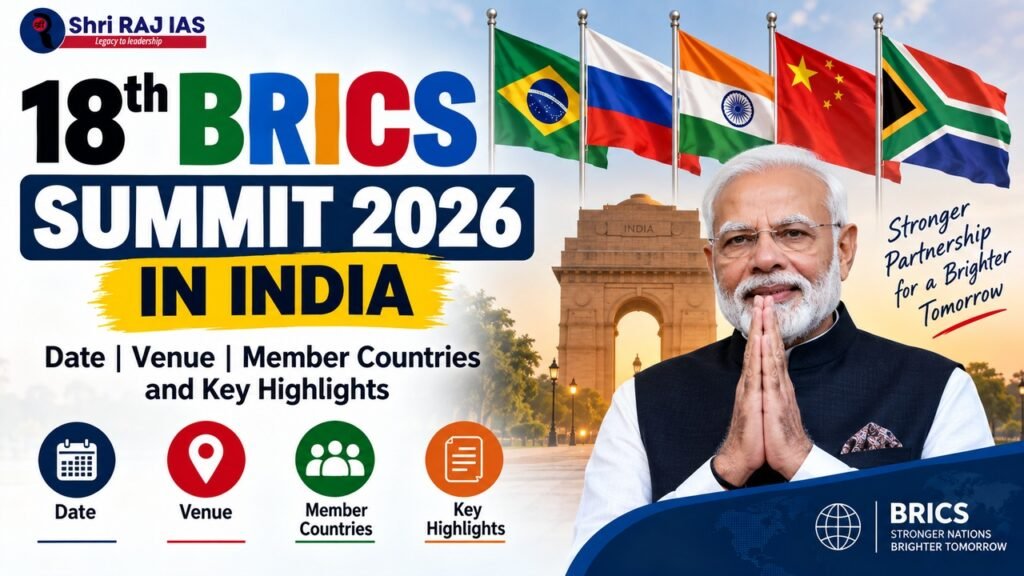
18th BRICS Summit 2026 in India: Date, Venue, Member Countries and Key Highlights
What is BRICS? Understanding the Bloc
BRICS started as an economist’s concept and has evolved into the world’s most significant challenge to Western-dominated global governance structures. The acronym originally represented five emerging economies with tremendous growth potential: Brazil, Russia, India, China, and South Africa.
From Acronym to Global Alliance
Goldman Sachs economist Jim O’Neill first coined the term “BRIC” in 2001 to identify emerging economies with exceptional development prospects. The group formally materialized at its inaugural summit in Yekaterinburg, Russia in 2009.
South Africa’s inclusion in 2010 completed the original five-member formation, which remained unchanged for over a decade. The real transformation occurred in 2023 when the bloc initiated its most aggressive expansion, fundamentally reshaping its composition and reach.
Why BRICS Matters for Your UPSC Preparation
Understanding BRICS is crucial for UPSC because:
- It reflects shifts in global power dynamics
- India’s role as a balancing force in international relations
- Alternative institutional frameworks challenging Western hegemony
- Economic cooperation models for emerging economies
- India’s presidency in 2026 demonstrates leadership capabilities
18th BRICS Summit 2026: New Delhi
The 18th BRICS Summit, marking the bloc’s 20th anniversary, was hosted by India in New Delhi on September 12-13, 2026. This represented India’s fourth presidency since joining BRICS in 2006.
Venue: Bharat Mandapam Convention Centre, New Delhi
Host: Prime Minister Narendra Modi
Theme: “Building for Resilience, Innovation, Cooperation and Sustainability”
Tagline: “Humanity First”
Summit Significance for UPSC
The New Delhi summit tested the bloc’s cohesion following major expansion:
- Integration of 10 partner countries alongside 11 full members
- Consensus-building amid geopolitical tensions
- Operationalizing payment infrastructure
- Establishing frameworks for future member additions
- Demonstrating India’s diplomatic capacity
Key Summit Outcomes
Payment Systems Launch
- Full operational deployment of BRICS Pay targeted
- Cross-border payment framework linking national systems
- Local currency settlement mechanisms activated
CBDC Coordination
- Interoperability between e-Rupee, digital yuan, Brazil’s DREX, and UAE CBDC
- India’s RBI leading technical coordination
- Historic bilateral CBDC linkage agreements
Expansion Framework
- Clear protocols for partner country progression
- Criteria for full membership evaluation
- 45+ applications from countries seeking entry
BRICS Member Countries 2026: Complete Breakdown
The 11 Full Member Nations
As of September 2026, BRICS comprises 11 full member countries, each contributing unique strengths to the alliance:| Country | Joined | Population | Key Contribution | Notes |
| Brazil | 2006 (Founding) | 217 Million | Agricultural superpower, commodity exporter | 2025 presidency host; world’s largest agricultural exporter |
| Russia | 2006 (Founding) | 144 Million | Energy giant, de-dollarization driver | Under Western sanctions; de-dollarization advocate |
| India | 2006 (Founding) | 1.44 Billion | Fastest-growing major economy | 2026 presidency host; rapidly expanding GDP |
| China | 2006 (Founding) | 1.43 Billion | Dominant economic force | Largest NDB stakeholder; yuan internationalization |
| South Africa | 2010 | 62 Million | African gateway | Hosted 2023 expansion summit |
| Egypt | Jan 1, 2024 | 106 Million | Suez Canal control, Middle East bridge | Critical geopolitical importance |
| Ethiopia | Jan 1, 2024 | 130 Million | Africa’s fastest-growing economy | Significant development potential |
| Iran | Jan 1, 2024 | 89 Million | Energy reserves, sanctions solidarity | Strategic Asian positioning |
| UAE | Jan 1, 2024 | 10 Million | Financial hub, digital currency innovation | CBDC pilot partner with India |
| Saudi Arabia | Invited Aug 2023 | 36 Million | World’s largest oil exporter | Participates as full member (formal status debated) |
| Indonesia | Jan 6, 2025 | 280 Million | ASEAN’s largest economy, critical minerals | First Southeast Asian member; G20 participant |
What This Expansion Means
The 11 full members collectively represent:
- Approximately 45% of world population (nearly 3.9 billion people)
- Over 41% of global GDP in purchasing power parity terms
- Dominant positions in agriculture, energy, and manufacturing
- Critical control over strategic resources (oil, rare earths, food production)
Economic Comparison: BRICS vs G7
Key Economic Metrics (2026)
| Metric | BRICS (11 Members) | G7 | Significance |
| Population | ~3.9 billion (45% of world) | ~770 million (10%) | BRICS represents majority of humanity |
| GDP (PPP) | ~41% of global GDP | ~28% of global GDP | BRICS exceeds G7 in purchasing power |
| GDP (Nominal) | ~$33 trillion | ~$47 trillion | Nominal gap narrowing annually |
| Avg Growth Rate | 3.4% (2025) | 1.2% (2025) | Nearly 3x faster BRICS expansion |
| Oil Production | ~44% of global | ~26% of global | BRICS controls key resource |
| Agricultural Output | 44% global wheat; dominant in rice, beef, soy | Smaller share | Food security control |
| Foreign Reserves | China: $3.2T; Russia: $600B+ | Japan: $1.3T | Significant financial capacity |
Implications for Global Order
This economic data indicates:
- Shifting power dynamics favoring the Global South
- Multipolar world emerging from unipolar structure
- Alternative institutions becoming credible alternatives
- Decentralization of global decision-making accelerating
- Impact on commodity prices and trade patterns
India’s Contribution to BRICS Growth
India stands as BRICS’ fastest-growing economy:
- GDP Growth 2025: 6.2%
- GDP Growth Projection 2026: 6.2%
- Total GDP: $4.51 trillion (nominal)
- Role: Largest recipient of NDB financing ($6.9 billion across 18 projects)
De-Dollarization: Myth vs Reality
Common Misconception
Media headlines frequently proclaim BRICS is creating a common currency to “replace the dollar.” This oversimplifies the actual situation.
The Reality
BRICS has explicitly rejected a common currency approach. Instead, the bloc is developing alternative payment infrastructure:
BRICS Payment Systems Explained
- BRICS Pay A decentralized cross-border payment system designed to:
- Link Russia’s SPFS, China’s CIPS, India’s UPI, and Brazil’s Pix
- Enable direct transactions in local currencies
- Bypass SWIFT and dollar intermediaries
- Targeted for full deployment: September 2026 summit
- mBridge (Multi-CBDC Bridge) Developed with the Bank for International Settlements:
- Processes cross-border transactions in national currencies
- Central bank digital currency platform
- By November 2025: processed 4,000+ transactions worth $55.49 billion
- Operational success demonstrating feasibility
- CBDC Interoperability Central bank digital currency linking:
- India’s e-Rupee with China’s digital yuan
- Brazil’s DREX and UAE CBDC integration
- Bilateral agreements already signed (India-UAE)
- January 2026: India’s RBI formally proposed CBDC linkage
- “The Unit” Token (Pilot)
- 40% gold-backed, 60% BRICS currency basket
- Piloted October 31, 2025
- Settlement instrument testing
- No confirmed deployment timeline
Impact on Trade Settlement
India-Russia Trade Example:
- Nearly 95% now settled in national currencies (April 2026)
- Demonstrates practical de-dollarization at bilateral level
- Model for broader BRICS cooperation
Official Position on Dollar Replacement
India’s External Affairs Minister (March 2025):
“There is no policy on our part to replace the dollar”
This statement reflects BRICS’ nuanced approach: reducing dollar dependency rather than complete replacement.
BRICS Pay and Alternative Payment Systems
BRICS Pay: Technical Architecture
BRICS Pay functions as an alternative to SWIFT (Society for Worldwide Interbank Financial Telecommunication), the Western-dominated international payment system.
How BRICS Pay Works
Traditional Model:
Exporter → SWIFT → Intermediary Banks → Dollar Conversion → Importer
BRICS Pay Model:
Exporter → BRICS Pay → Direct National Currency Transfer → Importer
Connected Payment Networks
Russia’s SPFS
- Alternative to SWIFT
- Domestic interbank payment system
- Used since Western sanctions (2014)
China’s CIPS
- Cross-border interbank payment system
- Yuan settlement focus
- Operational since 2015
India’s UPI
- Universal Payments Interface
- World’s fastest-growing digital payment system
- Handles 150+ billion transactions annually
- Model for cross-border adaptation
Brazil’s Pix
- Instantaneous payment system
- Rapid adoption across population
- Real-time settlement capability
Implementation Timeline
- Announced: 2026 (Brazil’s presidency)
- Technical Coordination: India’s RBI leading
- Full Deployment Target: September 2026 New Delhi summit
- Significance: Most concrete de-dollarization step to date
Benefits for BRICS Members
- Reduced transaction costs
- Faster settlement times
- Currency risk mitigation
- Insulation from unilateral sanctions
- Financial sovereignty enhancement
Key Issues and Internal Tensions
Why Consensus Remains Difficult
Despite shared interests, BRICS faces significant internal disagreements that constrain unified action.
Fault Line 1: China vs India
Border Disputes:
- 2020 Galwan Valley clash
- Ongoing territorial disagreements
- Creates fundamental trust deficit
Strategic Divergence:
- China favors accelerated yuan internationalization
- India prefers multiple currency standards
- India resists binding BRICS agreements limiting sovereignty
Quad Participation:
- India simultaneously participates in Quad (US, Japan, Australia)
- Signals determination not to be captured by China-Russia axis
- Creates perception of divided loyalties
Fault Line 2: Russia’s Sanctions Complication
Operational Constraints:
- Over $300 billion in Russian reserves frozen by Western governments
- NDB cannot fund Russian projects without jeopardizing capital market access
- Creates functional limitations on Russia’s integration
De-dollarization Paradox:
- Russia advocates most aggressively for de-dollarization
- Yet remains most sanctioned member
- Limits practical implementation of alternative systems
Fault Line 3: Middle East Tensions
Egypt vs Ethiopia Disagreement:
- Disputed UN Security Council reform positions
- Nile water-sharing conflicts
- Both refused to sign joint communiqué (September 2024 foreign ministers’ meeting)
Iran Inclusion Strains:
- UAE and Saudi Arabia maintain close US ties
- Iran’s presence creates strategic complications
- Different regional alignments and interests
2024-2025 Communication Breakdown
Notable Event (2024):
- BRICS foreign ministers failed to adopt joint statement
- India issued unilateral chair’s statement instead
- Reflected divisions over Middle East conflicts
Implication:
- Consensus remains fragile
- Expansion testing bloc’s unity
- Internal management of diversity remains challenging
BRICS Grain Exchange: Agricultural Cooperation
An Underreported Initiative
Among BRICS’ most ambitious yet least-publicized initiatives is the proposed BRICS Grain Exchange—a digital marketplace for direct agricultural trade.
What is the BRICS Grain Exchange?
A proposed platform enabling:
- Direct grain transactions between producers and importers
- Alternative currency settlement (bypassing US dollar)
- Circumventing US-denominated commodity pricing
- Enhanced food security through intra-BRICS trade
Development Timeline
December 2023: Russia’s Union of Grain Exporters proposes concept
March 2024: President Putin endorses initiative
September 2025: Formally acknowledged in BRICS Joint Media Statement
Early 2026: Technical working groups established; no launch date confirmed
BRICS’ Agricultural Dominance
The bloc’s grain production capacity is staggering:
- 44% of global wheat production
- Dominant positions in rice, beef, soy production
- Combined agricultural exports exceed $165 billion annually
Brazil’s role: Record agricultural exports in 2025 ($165+ billion) position it as key driver.
Strategic Implications
- Food Security: Self-sufficiency among member nations
- Market Power: Collective control over commodity pricing
- Trade Independence: Reduced reliance on Western commodity exchanges
- South-South Cooperation: Enhanced agricultural technology transfer
For UPSC: This represents sectoral cooperation moving beyond finance into critical commodities.
Key Takeaways for UPSC Preparation
Conceptual Understanding
- Institutional Alternatives: BRICS represents deliberate institutional-building by emerging economies
- Multipolar World: BRICS is symptom of shift from unipolar to multipolar global order
- South-South Cooperation: Model for Global South cooperation beyond North-dominated institutions
- Strategic Autonomy: India’s participation reflects commitment to strategic independence
Current Affairs Relevance
- Geopolitics: BRICS decisions affect international relations, UN reform, regional stability
- Economics: De-dollarization, alternative payment systems, commodity pricing
- Trade: Impact on India’s exports, agricultural trade, technology cooperation
- Development: NDB financing for infrastructure, sustainable development goals
Exam Preparation Focus Areas
- BRICS summit outcomes and declarations
- Member countries’ roles and contributions
- India’s leadership and diplomatic achievements
- NDB’s significance and operational structure
- De-dollarization mechanisms (not replacement, but alternatives)
- Internal tensions and consensus-building challenges
- Economic comparisons: BRICS vs G7/Western institutions
Final Thoughts
The 18th BRICS Summit 2026 in New Delhi represents far more than diplomatic gatherings. It signals the consolidation of an alternative institutional framework through which the Global South is reasserting agency in global affairs.
For UPSC aspirants, understanding BRICS is essential for comprehending:
- Contemporary international relations dynamics
- India’s foreign policy orientation and diplomatic capacity
- Alternative development models and institutional frameworks
- Emerging challenges to Western-dominated global governance
- Trade and economic cooperation patterns reshaping global commerce
The bloc’s evolution—from economist’s acronym to consequential global alliance—exemplifies how emerging economies are collectively building parallel institutions to advance shared interests. India’s presidency demonstrates commitment to multilateral cooperation, development-centric global order, and equitable representation for the Global South.
As global power continues redistributing away from Western centers, BRICS will remain central to understanding 21st-century international relations.
Final Thoughts
The UPSC CAPF interview is your final step toward becoming an Assistant Commandant. With the right guidance, preparation, and mock interview practice, you can significantly improve your performance.
The Shri Raj IAS Interview Guidance Program (IGP) provides everything you need — from mock interviews to personality development — under one roof.
For More Information
📞 Call: +91-9355532555
🌐 Website: www.shrirajias.com
Frequently Asked Questions (FAQs)
Q1: How many countries are in BRICS in 2026?
A: BRICS comprises 11 full member countries and 10 partner countries as of September 2026.
Full members: Brazil, Russia, India, China, South Africa, Egypt, Ethiopia, Iran, Saudi Arabia, UAE, and Indonesia.
Partner countries: Belarus, Bolivia, Cuba, Kazakhstan, Malaysia, Nigeria, Thailand, Uganda, Uzbekistan, and Vietnam.
Q2: Why did Argentina withdraw from BRICS?
A: Argentina withdrew in January 2024 under newly elected President Javier Milei. He cited ideological preference for Western free-market principles and opposition to BRICS’ political orientation. Milei’s government prioritizes alignment with the United States over emerging market cooperation.
Q3: What is the actual status of Saudi Arabia in BRICS?
A: Saudi Arabia was invited in August 2023 and participates in summit activities as a full member. However, Reuters reporting indicated Riyadh deliberately delayed formal accession to avoid antagonizing the United States. By 2026, it is counted among the 11 full members in official-leaning sources, though its formal accession status technically remains ambiguous.
Q4: Has BRICS created a common currency?
A: No. BRICS explicitly rejected a common currency approach. Brazil’s 2025 presidency formally shelved this idea. Instead, the bloc focuses on interoperable payment systems (BRICS Pay, mBridge) and CBDC linkage allowing local-currency settlements.
Q5: What is the significance of India's BRICS presidency in 2026?
A: India’s presidency demonstrates:
- Leadership capacity in managing diverse interests
- Diplomatic skills in building consensus amid tensions
- Technical leadership in payment system coordination (RBI leading BRICS Pay development)
- Commitment to development-centric global cooperation
- Platform to advance Global South interests in international forums