
Why in news
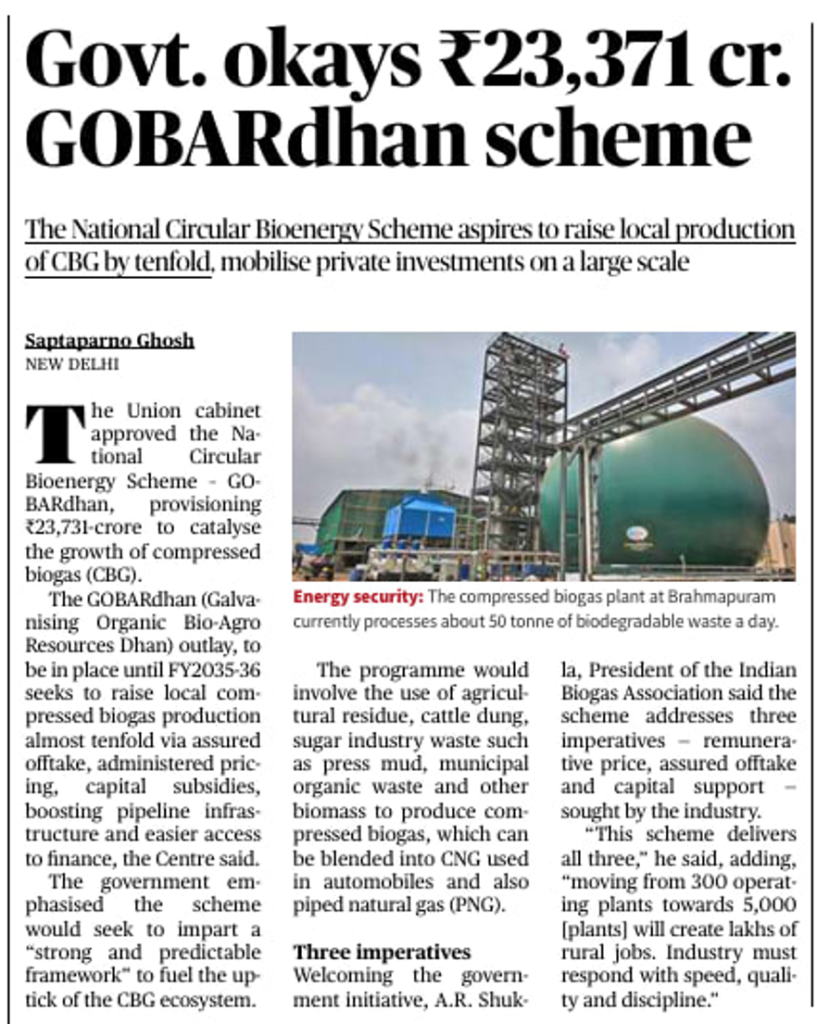
The Union Cabinet has approved the National Circular Bioenergy Scheme (GOBARdhan) with a total outlay of ₹23,371 crore. The scheme aims to significantly boost Compressed Biogas (CBG) production, encourage private investment, improve waste management, enhance farmers’ income, and strengthen India’s clean energy transition.
UPSC Relevance
Govt. Schemes
About Gobardhan Scheme
- Galvanizing Organic Bio-Agro Resources Dhan’ (GOBARdhan) was announced in the Budget Speech of the Hon’ble Finance Minister in Feb 2018 for management and conversion of cattle dung and solid waste in farms to compost, fertilizer, biogas and bio-CNG.
- GOBARdhan was launched on 30th April, 2018 by D/o Drinking Water & Sanitation.
- It is a crucial umbrella initiative of the Ministry of Jal Shakti, Government of India.
Reference- https://gobardhan.sbm.gov.in/about-us
Primary Objective: To safely manage cattle waste, kitchen leftovers, and agricultural residue, converting them into biogas, bio-CNG, and organic manure to generate rural wealth and clean energy.
Benefits
- Effective management of solid waste in villages promote environmental sanitation.
- Provides public health (reducing vector-borne diseases)
- Increases household income
- Organic manure increases agricultural productivity.
- Expansion from roughly 300 operating plants to a target of around 5,000 plants is expected to generate large-scale rural employment across collection, transportation, processing, and plant operations.
- It reduces carbon footprint (Help in Net Zero by 2070)
- Organic Waste → Energy → Fertilizer → Agriculture → Organic Waste (Waste to Wealth)
Challanges
- Collecting biomass from scattered farms is expensive and logistically difficult.
- CBG plants require substantial capital.
- Many plants struggle with operational efficiency and maintenance.
- Reliable long-term procurement arrangements are essential.
- Farmers and local bodies need greater awareness of waste segregation and biomass supply opportunities.
- Only 115 CBG plants are functional as of December 2024, against the target of 5,000 by 2030.
Solutions:
- Develop biomass aggregation centres.
- Strengthen gas pipeline connectivity.
- Promote decentralized village-level bioenergy plants.
- Encourage municipal participation in waste segregation.
- Provide stable pricing and long-term purchase agreements.
- Promote research for efficient biogas technologies.
UPSC PYQ Mains
Q. What are the impediments in disposing the huge quantities of discarded solid waste which are continuously being generated? How do we remove safely the toxic wastes that have been accumulating in our habitable environment? (2018)