
IAS vs IPS vs IFS vs IRS: Roles, Perks & How Ranks Decide Your Service
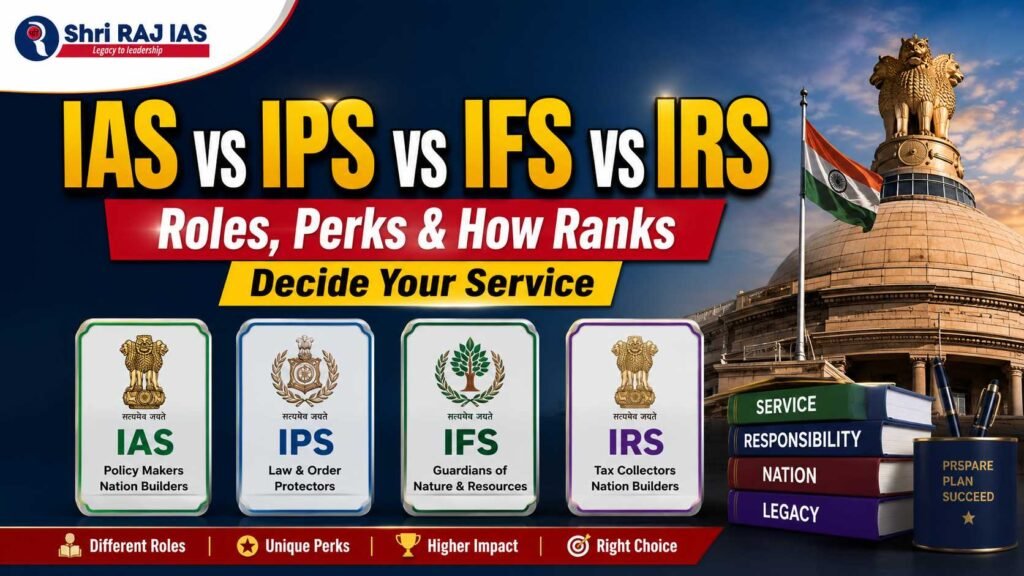
Every UPSC aspirant reaches a point where one question keeps coming back: IAS vs IPS vs IFS vs IRS — which service should I actually aim for? It’s a fair question. All four belong to India’s top civil services, but their work, lifestyle, and career path are quite different. In this blog, we break down the difference between IAS and IPS, the IFS role in diplomacy, IRS tax administration duties, and how your UPSC rank actually decides which service you get.
What is the Difference Between IAS, IPS, IFS and IRS?
Before comparing IAS vs IPS vs IFS vs IRS in detail, it helps to know what each service does at a glance:
- IAS (Indian Administrative Service) – Handles general administration, policy implementation, and district governance.
- IPS (Indian Police Service) – Responsible for law and order, crime investigation, and internal security.
- IFS (Indian Foreign Service) – Represents India abroad and manages diplomatic relations.
- IRS (Indian Revenue Service) – Manages direct and indirect tax administration for the government.
The IAS and IPS are part of the All India Services, meaning officers can be posted to any state, while the IFS operates under the Ministry of External Affairs and the IRS falls under Central Services (Group A). This structural difference is the starting point of any real comparison of All India Services.
How is a Civil Servant's Daily Life Different Across Services?
Civil servant daily tasks vary a lot by service. An IAS officer’s day may include reviewing government schemes, public grievance hearings, and disaster coordination. An IPS officer’s day revolves around law enforcement duties and crime prevention. An IFS officer handles trade negotiations and embassy administration, while an IRS officer focuses on tax assessment and enforcement of tax laws.
What is the IAS Job Profile and How Does a District Magistrate Work?
The IAS job profile is considered the broadest among all civil services. A young IAS officer usually starts as a Sub-Divisional Magistrate and later becomes a District Magistrate (DM) — the top administrative authority of a district. The DM vs Superintendent of Police comparison is common among aspirants: the DM leads district administration and revenue matters, while the SP (an IPS officer) handles police functioning and public order in the same district. Both work closely together, though their command structures remain separate.
What Are IPS Duties and Powers?
IPS duties and powers include maintaining law and order, preventing and investigating crime, traffic management, VIP security, and counter-terrorism operations. IPS officers typically begin as Assistant Superintendent of Police (ASP) and rise through the ranks to Superintendent of Police, Deputy Inspector General, and eventually Director General of Police (DGP) at the state level, or leadership roles in central agencies like the CBI and IB.
What is the IFS Role in Diplomacy?
The IFS role in diplomacy makes it one of the most sought-after services for aspirants interested in international affairs. IFS officers serve as diplomats, negotiators, and representatives of India in embassies and consulates worldwide. Their responsibilities include managing bilateral relations, protecting the interests of Indian citizens abroad, and shaping India’s foreign policy. Officers often begin as Third Secretary at an Indian mission and can rise to the rank of Ambassador or High Commissioner.
What Are IRS Tax Administration Duties?
IRS tax administration duties involve two broad branches — Income Tax and Customs & Indirect Taxes (GST). Officers assess tax returns, investigate tax evasion, conduct raids in fraud cases, and ensure smooth revenue collection for the government. While the IRS doesn’t carry the same field-level public visibility as the IAS or IPS, it offers strong analytical work and, in many cases, better pay progression at senior levels.
IAS vs IPS: Which is Better?
This is one of the most searched questions among aspirants, but there’s no single right answer. If you enjoy administration, policy-making, and broad decision-making authority, the IAS may suit you better. If you’re drawn to law enforcement, discipline, and on-ground crime control, the IPS could be a better fit. Both carry high respect, but their day-to-day work culture is very different.
IRS vs IFS Roles: How Do They Differ?
IRS vs IFS roles differ significantly in nature. The IRS is finance and enforcement-focused, working within India, while the IFS is diplomacy-focused, working largely outside India. If financial analysis and enforcement excite you, IRS suits you. If you’re passionate about global affairs, language skills, and cross-cultural work, IFS is the better path.
Salary, Perks & Benefits: How Do IAS, IPS, IFS and IRS Compare?
While comparing IPS perks and privileges against IFS foreign posting allowances, note that IFS officers often receive higher overall compensation during foreign postings due to cost-of-living adjustments, whereas IAS and IPS officers enjoy stronger administrative influence within India.
Civil Service Rank Structure: How Do Ranks Decide Your Service?
Understanding the civil service rank structure is key to understanding how ranThe IAS salary scale generally starts similarly across all these services under the 7th Pay Commission structure, but perks vary:
Service | Starting Perks & Benefits |
IAS | Government housing for civil servants, official vehicle, domestic staff, high administrative authority |
IPS | Police perks including official residence, security staff, uniform allowance, service weapon |
IFS | Foreign posting allowances, diplomatic immunity, international housing benefits |
IRS | Government accommodation, travel allowance, and access to enforcement-related perks |
ks decide service allocation. After the UPSC Civil Services Examination, a merit list is prepared, and candidates fill service preferences during the DAF (detailed application form) stage. Broadly:
- Top rankers usually get the IAS, followed by IFS and IPS, based on both UPSC rank for IFS/IAS/IPS and the number of seats available (vacancy).
- The IAS promotion timeline generally moves from Sub-Divisional Magistrate to District Magistrate, and eventually to Secretary-level posts at the state or central government.
- IPS rank hierarchy moves from ASP to SP, IG, and DGP.
- IFS grade levels move from Third Secretary to Ambassador rank over a career span.
- Seniority in All India Services is determined by the year of appointment and cadre allocation rules within each state cadre.
What is the UPSC Service Allocation Process?
The UPSC service allocation process works on merit list and service preference: your rank, the number of vacancies, category, and your filled preference order together decide your final service. This is why many aspirants ask how to choose between IAS and IPS early — because a well-thought-out preference order matters as much as your rank itself. For the latest rules, always refer to the official notifications on the UPSC website and cadre allocation policy on the Department of Personnel and Training (DoPT) portal. Aspirants interested in the IFS role in diplomacy can also check postings and mission details on the Ministry of External Affairs website, and those exploring IRS tax administration duties can refer to the Income Tax Department portal.
Final Words
There’s no universally “best” service in the IAS vs IPS vs IFS vs IRS debate — the right choice depends on your interests, strengths, and career vision. Whether you’re drawn to administration, law enforcement, diplomacy, or finance, all four services offer respect, responsibility, and the opportunity to serve the nation.
If you’re still unsure which service to target, our expert mentors at Shri Raj IAS can guide you through the entire decision-making process — from understanding the UPSC syllabus and UPSC exam pattern to building the right Mains preparation strategy. Join our Foundation Course or enroll in our Mentorship Program to get personalized guidance on choosing and preparing for the service that fits you best.
Register now to begin your UPSC journey with Shri Raj IAS.
📞 Call: +91-9355532555
🌐 Website: www.shrirajias.com